Mar 03 2012

Poems of the Day: More From Free Write Jail Arts

A few weeks ago, I posted some youth created poetry from participants in the Free Write Jail Arts & Literacy Program here in Chicago. Below are a couple of other poems from the incarcerated youth at the Cook County Juvenile Temporary Detention Center who participate in Free Write programming:

Hope
by Kendall H

It’s dark where I am
and I cannot find the light
There are shadows all around me
and my heart is full of fright
everyone is cheerful
they never even see
that storm clouds are forming
upon the peaceful sea

I cannot see the future
and I cannot change the past
but the present is so heavy
I don’t think I’m going to last

Doing Hard Time
by Demetria R

Being in here
is what you call hell
locked in these cold dark cells
A moment of freedom
we do not see
five minutes of air
is what we breathe
Didn’t blame it on the victim
or the suspect
is what he supposed to be
just blamed it on me
Ok I did it
I confess
but it wasn’t that bad
to go through this stress
Doing hard time is what it be
Cold food and raw meat is what we eat
Getting told when to sleep
and how long to shower
The minutes go past like hours
Living with all these girls
taking they s***
This is not me
I can’t do this
Doing hard time
all alone
Not knowing when I’ll go home
It’s hard in here
locked in a room
between a thousand bricks
I need my freedom
I am ready to go
I can’t take it no mo’
Living by they laws
obeying by they rules
Can’t take a piss when I choose
I will never be in CCJTDC again
We are their property
They get all revenge
Jail is hard
Jail is rough
You’ll be in here after one big f*** up
A old body is what they call me
but I consider myself different
You should never wanna
be in my position
These girls is not yo friends
nor is these n*****
They sit back and clow you
to they friends.
doing hard time like in the pen
Yeah, that’s it
I never wanna do hard time again.

Mar 02 2012

Guest Post: Another Shame of the Nation – Juvenile Life Without Parole

Another Shame of the Nation ~ Juvenile Life Without Parole
by nancy a heitzeg

On March 20, 2012, The Supreme Court of the United States will hear Oral Arguments in the cases of Miller v. Alabama and Jackson v. Hobbs. Both cases, argued on Eighth Amendment grounds by Equal Justice Initiative, involve 14 year old boys – sentenced to die in prison for their involvement in homicides. Miller had a documented history of abuse, and Jackson, an accessory but not the gunman, was charged in a felony murder case, an Arkansas store robbery gone wrong.

But, as always, much more than the fate of these two rests on this case. At stake is the fate of more than 2500 persons serving Life without Parole for crimes committed while under the age of 18, some, all future redemption denied, when they were as young as 11 years old. 73 of these 2500 were under the age of 14 at the time of the commitment offense.

One might also argue that our status as a “civilized” nation rests, at least in part, on the Court’s judgment here. The U.S. is the only country in the world that practices JLWOP, and remains, with Somalia, one of two nations in the world which has refused to ratify the UN Convention on the Rights of the Child, a document which expressly forbids this very practice.

And, as in the 5-4 Roper v. Simmons (2005) and Sullivan v. Florida/Graham v. Florida (2010) which finally finally finally abolished the death penalty and Juvenile Life Without Parole (JLWOP) for non-homicide offenses respectively, the fate of these youth and the moral compass of the nation will rest on the whims of one Justice Anthony Kennedy.
Too much responsibility for Just One Man….

Read more »

Mar 01 2012

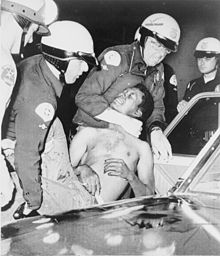
Watts 1965 and Some Thoughts About Police Violence…

Earlier this week, the 1965 Watts Rebellion came up in the context of a sociology class that I teach at a local university. Unsurprisingly many of my students knew little to nothing about the history of this police riot. For those who had heard of Watts, they only had very basic information about the incident. Almost no one knew of the central role that a militarized police force played in both inciting and then ultimately brutally repressing the rebellion.

Because of racist covenants, Blacks in Los Angeles were restricted to two main community areas: Watts was one of these. Poverty and unemployment were endemic in the community. Most of the businesses were run by outsiders and the majority did not employ community residents. These businesses were very much resented by locals. This fact would become important to understanding why so many local businesses were targeted during the uprising.

On the evening of August 11, 1965, 21 year old Marquette Frye was stopped by a white highway patrolman, named Lee Minikus, near Watts for driving erratically. The officer smelled liquor on his breath and told him to walk a straight line. According to the officer, Frye failed the test and was charged with driving under the influence. Officer Minikus began to write a ticket and Marquette started to argue that he should be let off without one. During this time, his stepbrother Ronald was a passenger in the car but when he saw that a tow truck was approaching to impound it, he stepped out and asked if he could drive the car to his mother’s house just a couple of blocks away. In the meantime, their mother, Mrs. Frye had heard about the incident from neighbors and arrived on the scene with her license and registration (the car was hers) asking the police not to impound the car. Officer Minikus agreed to let her take the car and then she began to admonish her son Marquette for being intoxicated. According to an account by historian Robert Conot, this is when things took a turn for the worse:

“Momma, I’m not going to jail. I’m not drunk and I’m not going to jail.”…As he spoke to his mother, his voice broke. He was almost crying. Spotting the officers [who were approaching], he started backing away, his feet shuffling, his arms waving…All his old anger, the old frustration, welled up within Marquette… What right did they have to treat him like this? [He screamed at the cops,] whipping his body about as if he were half boxer, half dancer…”

According to official accounts, the police made calls for reinforcements. One police officer used his nightstick and according to him accidentally hit Marquette Frye in the forehead causing his head to bleed. Ronald tried to protect his brother and was hit in the stomach. Minikus grabbed Marquette and threw him into a squad car. Mrs. Frye rushed to the aid of her sons and jumped onto Minikus’s back. She was restrained by other officers and also put into a police car. In the end, all three Fryes were under arrest.

It was a hot summer evening so many residents were outside their homes and witnessed the traffic stop and subsequent arrests. Within 10 minutes a crowd of 25 had grown to nearly 300. Within 20 minutes the crowd swelled to over 1000 people. One of the onlookers was a young student at Compton Junior College named Joyce Ann Gaines. She had run out of a nearby beauty salon so she still had on her smock. A police officer felt something on the back of his neck and decided that it was spit. He identified Gaines (who was innocent) as the culprit. She struggled against being removed from the crowd and arrested. One of her friends tried to intervene to help her and he was promptly put in a squad car too.

Tensions in the community were high to say the least. As the police finally retreated, they left behind an angry crowd. Rumors flew that the young woman, Joyce Gaines, who had been arrested was pregnant. People also said that the Fryes had been mistreated and abused during the incident This incident took place within the context of a community that was sick of constant police harassment. This was also a community fed up with living in dilapidated housing and angry about the ongoing racism that they were experiencing. The Frye incident was the spark but the anger and tension had been simmering for decades. The Watts Rebellion of 1965 lasted for seven days and it took a contingent of nearly 14,000 national guardsmen along with thousands of police officers to eventually quell the uprising. The rebellion resulted in 34 deaths, over a thousand injured and property damage in excess of $40 million dollars.

For an excellent account of the Watts uprising, I highly recommend Robert Conant’s book “Rivers of Blood, Years of Darkness.” To view a collection of photographs about Watts, click here.

Why does Watts matter in 2012? Well because as Malcolm X said: “Armed with the knowledge of our past, we can charter a course for our future.” Last year, I wrote that discussions about law enforcement’s brutality toward Occupy Movement participants were divorced from historical context. This is of great concern because I believe that it limits the effectiveness of social justice movements when we act as though everything old is new again. We should be learning from past experience to improve for the future. The lessons of the past should be informing our current strategies for social transformation. As thousands of people prepare to descend upon my city for Chicago Spring (G8/NATO Summits), I think that we have an opportunity to avoid the past mistakes in terms of our interactions with the police.

I have been and am currently working on a few projects that I hope will help to inform and educate the broader public about the longstanding tradition of oppressive policing toward marginalized populations (including some activists and organizers). One of the projects that I am most excited about is a series of pamphlets about historical moments of police violence. I reached out to some friends inviting them to contribute to the project. I am thrilled to say that several people have taken on the challenge of researching and writing one or two pamphlets (which will be no more than 30 pages each). Topics include: Oscar Grant, the 1937 Memorial Day Riots, Timothy Thomas, The Dixmoor Five, Mississippi Summer, The Danzinger Bridge Incident, the Young Lords, 1968 Democratic Convention, Black Protests on College Campuses, among others…

This idea is inspired by the many pamphlets (precursors to today’s zines) that circulated in the U.S. & in the developing world during the 1950s and 60s in particular. W.E.B. DuBois, CLR James and many other luminaries published short 10 to 30 page pamphlets about different political ideas and historical figures that would sell for as little as 15 or 25 cents. Many were also distributed free of charge. These were produced by companies like International Publishers out of New York or associations like the Afro-American Heritage Association here in Chicago. The goal is to revive this idea for the 21st century recognizing that it is important not to confine learning to classrooms and facilitated spaces. The pamphlets will be made available free of charge online and we hope to print a limited number of copies that can be mailed to currently incarcerated youth and adults.

The first couple of pamphlets will hopefully be published in May. We will continue to publish other pamphlets throughout the course of the year.

Feb 29 2012

Shame and Prison…

“Shame is like everything else; live with it for long enough and it becomes part of the furniture. — Salman Rushdie

I received a letter from a reader of this blog about three weeks ago. I am still processing it and so I am moved to write today about shame. Specifically, I want to write about shame and silence as it relates to prison. I have a good friend whose father has been incarcerated for most of her life. She hardly speaks of him. She says that she doesn’t miss him. I believe her.

When I look in the mirror, I see his face and I feel debilitating disgust,” she once told me.

She was 10 when he went to prison. She is now 37. He will likely never be released.

It is rare when she will bring her father up with me. Though one day, about five years ago, she mused:

What does it say about me that this man is my father?”

Lewis Smedes has written that:

“the difference between guilt and shame is very clear—in theory. We feel guilty for what we do. We feel shame for what we are.”

My friend is and will always be the daughter of a man sentenced to spend his natural life in prison. This is a fact. This is not the end all and be all of her identity though. Yet I fear that she is ‘doing time’ with her father even though she has no contact with him. She is trapped in her identity as the daughter of a ‘lifer’. Worse she is trapped in her “secret” identity as the daughter of a prisoner. This is something to be whispered and to be shared only with those who are blessed to become part of the inner circle of her life.

My friend has struggled with substance abuse. About five years ago, I asked her mother if I could write a letter to my friend’s father. She was taken aback at first but gave me her blessing. I sent him a letter introducing myself as a friend of his daughter and asked if he would answer the following question in writing: “What was the best day that you ever had?” I asked him to be as descriptive as possible in the letter. About two weeks later, I received a response from him and it was 10 pages long. That letter almost ended my friendship with his daughter. But that is a story for another day.

I had hoped that my friend would read that letter and that perhaps she might begin to see her father beyond his fixed identity as a “prisoner.” If she could move away from seeing him as a one dimensional figure, then perhaps (I thought) she could also begin to embrace other parts of her own self beyond the “daughter of a prisoner” identity. While I thought I was being helpful and loving, my actions were not received as such and I almost lost a very good friend.

But five years later, if you wonder if I would still reach out to her father in the way that I did, the answer is yes. For while there is no happily ever after to this story yet, I have seen small changes in my friend. It took her over 18 months but she eventually did read her father’s letter. Last year, she was in Chicago and over dinner she said: “You know he isn’t a monster. It makes a difference to know that somehow.” What difference does it make? I can’t tell yet. But I know that as she begins to humanize her father, my friend will begin to embrace her own humanity as well.

As I said, there is no happily ever after to this story. And that’s OK.

Feb 28 2012

The Jailers Need New Jobs…

by Rachel Marie-Crane Williams

Well it’s been a very eventful past few hours. Yesterday’s post about closing Illinois prisons generated pitched comments and “discussion” on my organizational facebook page. Several former and current staff members from one of the youth prisons recommended for closure decided that they wanted to make their voices heard. Here are some of their responses:

I work at iyc Joliet & I strongly disagree with the closing of these institutions, work there b4 u speak against a system that keeps violent people off our streets

You want to know a little about what we do at IYC Joliet (Illinois Youth Center). We help by providing Care and Custody. Many of our youth receive needed counseling, therapy, and appropriate academic services while with us because we provide a level of security custody and control that our school systems can’t. We house and care for violent individuals who have failed to comply with the rules while housed at lesser secure facilities. We are closer to the city of Chicago (where most of our youth come from) enabling parents, advocates, and legal teams, who aid in youth therapy to visit without extensive travel. WE house young men ranging from 16-21 who are locked up for crimes ranging from rape to capital murder. This is no day camp. Some of these guys are HABITUAL CRIMINALS and will be IN and OUT of the system for the REST OF THEIR LIVES! WE work with a population that America wish’s didn’t exist. WE work side by side with the rapist, the murderer, the molester….do you want these guys to roam YOUR neighborhood freely because some politician failed to comply with an established budget? We should keep IYC Joliet open because we’re effective at what we do

Before you think about closing these facilities see how these youth personally assault you just for doing your job. What makes you think they wont hurt you or your loved ones out on the streets when they are already murderers, rapist, etc. They dont care what you or anyone else has to say. They listen to the gangs they are in. The youth at IYC-Joliet are facing adult charges and the majority are young adults aging 18-20. Know the facts before you jump to a conclusion about putting them back on the streets.

Obviously this so called group does not care about the safety of the community!!! She like the havoc that these criminals reak on society! This group feels like the criminal should not pay for the crimes that they have committed. Please tell me how do you sleep when someone’s loved one is 6 ft under but you push for the MURDERER to go free!!!

Iyc-Joliet doesn’t house children!!!! These are mostly 18-21 year old men!!!!! Do you watch the news? All of the teens killing people and raping kids are at IYC-Joliet. This prison houses the worst 250 juvenile males in the state!! Go ahead and try and mentor the 18 year old who has killed three people or the 17 year old who beat his mom to death with a hammer or the 18 year old who raped a young girl in a basement at her friends birthday party (oh yeah and he was on parole… Where was NIA then…????) Maybe they can come and live at your house so you can mentor and love them.

1st of all, I absolutely agree. There are better ways to prevent young people from doing fucked up things. You can start with letting parents discipline their kids with out the fear of DCFS knocking in your door saying your abusing them. 2nd thing, their are places kids can go to get treated and the help they need. They all don’t just get thrown in jail. Understand this. The juveniles we have at IYC JOLIET need a lot more than you think. Over half these kids are looking at doing some serious time for some serious crime. Juveniles that do petty crimes don’t just come to IYC JOLIET. This is the LAST stop befor they go to an adult facility. If you close IYC JOLIET these “violant offenders” that you said project nia doesn’t want to go free will in fact, be set free into your community.

If you all do in house assessments be prepared to be there by yourself these youth are not going to be in their houses waiting for you. These youth will be out in the streets doing some of the same things that got them incarcerated. I laugh at the bleeding hearts it takes a special person to work with these youths and you all are not one of them. These youth will do unspeakable things to each other and staff. Go and visit just one facility and I pray that you go to IYC Joliet and I hope they take you on a tour of Dorm 4 or even Dorm 3 or maybe even better Dorm 7. Get a clue we protect you so you can sleep at night and know that your family is safe and sound, no one is going to come and rape, murder, or kill you and your family because we keep the worst of the worst at bay and under control behind these walls we call IYC Joliet.

we are Hard working people trying to make a living just like the rest of you. We do a job that many of you could not and would not do!!! Q: what do u do when someone comes in your house in the middle of the night? what do you do when you come home and someone has killed a family member? What do you do when you come home and your Child is being Raped? What do you do when you get robed on the street? do you call the police or do you talk and try to council them????

What comes across in these responses? What do you notice?

Fact: Less than 35% of youth in Illinois youth prisons are incarcerated for violent crimes. Less than 1% are incarcerated for murder.

Fact: The Governor has recommended closing IYC-Joliet and TRANSFERRING the youth currently incarcerated there to other youth prisons in the state.

Fact: It costs an average of $90,000 a year to incarcerate a young person in Illinois.

Then in the midst of all of those comments, I saw this one from an incredible young woman I know and I smiled because it reaffirmed why I do the work that I do:

“Wow, there’s a whole lot of ignorance going on around here…Project NIA is a fantastic organization that cares about the wellbeing and rehabilitation of young people, as opposed to their imprisonment. No adults take advantage of children and force them to make cards for terrible youth in jail…have you ever stopped to think that maybe if somebody actually showed these imprisoned youth that they CARE that maybe they wouldn’t act out in the ways that they do? I’m not saying that youth in prison haven’t done some horrendous things…I’m saying that they are still young people and we should be supporting them and helping them learn from their mistakes, not imprisoning them so that they never have a chance to change or find a better life. I happen to volunteer at a juvenile detention center and I make it my business to work with at-risk youth, as a former foster kid. I really don’t appreciate YOU adults who act like you know everything about what these children have been through. They are not lost causes. They are not inherently terrible. A lot of young people reoffend within hours of release because they don’t have homes to go to…did you ever think of that? Seriously, Project NIA provides articles and reports with statistics of imprisonment and strives to fight the racism, classism, and adultism that results in the imprisonment of our youth. Anyone that can read could see that, and anyone with even the smallest amount of compassion would believe in HELPING troubled youth rather than keeping them behind bars. People like you make me sick to my stomach, but you’re all the inspiration I need to continue to fight a corrupt system.”

Feb 27 2012

On Closing Prisons in Illinois… A Time For Action

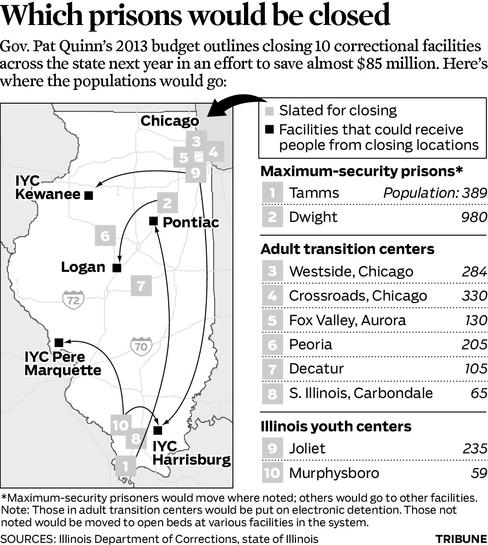
It’s been a long time coming but last Wednesday, Governor Quinn announced that he was recommending the closure of two adults prisons (TAMMS and Dwight) and two youth prisons (IYC-Murphysboro and Joliet). Closing the two youth prisons alone is expected to save the state over $17 million dollars in a year.

Last year, Gov. Quinn had already recommended that IYC-Murphysboro be closed. I wrote about the resistance that emerged to his recommendation here. Elected officials and unions successfully postponed the closure of Murphysboro. The unions in this state are well-organized and committed to keeping their members’ jobs. Anti-prison advocates are less organized and we were unsuccessful in countering the arguments advanced in favor of keeping the prison open. We have another chance now. Before I get further into my discussion about the youth prisons, I want to take a moment to say a few words about TAMMS-Supermax prison which is also on the closure list.

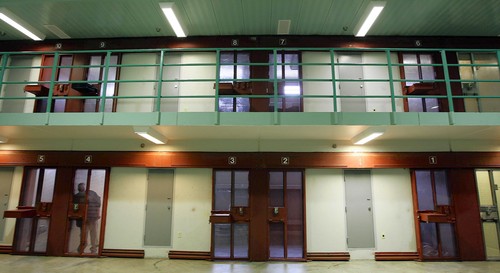
Tamms Cells (2009)

TAMMS is and has always been a bad idea. It is a torture chamber that keeps prisoners locked in cells 23 hours a day. My friend Laurie Jo Reynolds, the lead organizer of TAMMS YEAR TEN , put it best in a recent interview when she said that “Illinois fell for a “foolish national trend” in the 1980s and built a “vengeful and wasteful prison” the state didn’t need.” The seeds of TAMMS’s destruction were sown from its inception.

For just a glimpse of the horror that is TAMMS prison, I recommend that you read the Dart Society’s recent investigative report about solitary confinement. I defy you to read these words by Anthony Gay who is locked up at TAMMS and not be moved to action:

“I’ve been trapped for approximately nine years. The trap, like a fly on sticky paper, aggravates and agitates me,” he writes. “America, can you hear me? I love you America, but if you love me, please speak out and stand up against solitary confinement.”

In introducing their photo documentary of TAMMS, the Chicago Tribune described the prison as follows:

Conditions are harsh, and meant to be. For at least 23 hours a day, prisoners sit in solitary confinement in 7-by-12-foot cells. There is no mess hall. Meals are shoved through a chuckhole in cell doors. Contact with the outside world is sharply restricted. For a rare visit from relatives or friends, inmates are strip-searched, chained to a concrete stool and separated from visitors by a thick glass wall. There are no jobs and limited educational opportunities.

These words are tame. They do not capture the true horror of life at TAMMS. This article in the Tribune begins to get at some of it. So I am asking you to in the words of Anthony Gay, “please speak out and stand up against solitary confinement.” You can do that very easily by signing this petition thanking Governor Quinn for his recommendation to close TAMMS. For more background on TAMMS, read this essay by the terrific folks at Solitary Watch.

Finally, I want to say a few words about the experience of being locked in a cell when you are 15 years old. I am currently working with a young man who is now 19. He spent two years between the ages of 15 to 17 locked up at IYC-St. Charles (a youth prison in Illinois). He was traumatized by the experience. It will take years for him to heal. He cannot sleep because he is plagued by nightmares. He is not alone in this. I have worked with many many young people who are broken by the experience of being incarcerated. It is time for us to utilize community-based alternatives to incarceration as the FIRST resort. Prison is “no place for kids.” If you live in Illinois, please take a moment to sign this petition thanking Governor Quinn for his leadership and encouraging him to hold firm on his recommendation to close these facilities. It will only take a moment but you will be making a real difference.

Feb 26 2012

Prisoners & Medical Experimentation: Willing Bodies?

I came across this photograph last week and I decided to buy it.

This is an original press photo dated 12/1/1961 that appeared in the Chicago Sun Times with the following caption:

One of the convicts who exposed himself to malaria sits in a hospital bed at Stateville and takes a pill that may cure him of malaria.

I was intrigued by this history since I know nothing about it. Some quick internet research led me to an article by Bernard Harcourt titled “Making Willing Bodies” which documents a history of the University of Chicago’s medical experimentation on prisoners at Stateville.

In 1944, 432 Stateville prisoners were infected mosquitoes carrying the most virulent strain of malaria under the supervision of medical researchers from the University of Chicago. Harcourt (2011) describes the process:

The first “bite day” was March 8, 1944. The procedure took longer than expected. The plan was to bite sixteen prisoners on that first day, and “each man had to have the same number of first bites, second bites, and third bites” (Leopold 1974:310). Each mosquito was in a little cylindrical cage that was placed up to the skin of the inmate: “You took a mosquito, placed its cage on A’s forearm and watched carefully until the mosquito bit him. Then, when you were sure that the mosquito had inserted its proboscis well under the skin, but before it had had a chance to fill up with blood, you lifted the cage gently from A’s arm and placed it on B’s. Here, too, the mosquito must have a chance to bite, but not to fill up with blood. Then you placed the cage on C’s arm, and here you let the mosquito ‘bite out’— drink its fill” (Leopold 1974:310).

Easier said than done. Many of the mosquitoes did not cooperate, others were not sufficiently infected after dissection, and so it took until 3 a.m. that first day to get the job done—with all the doctors and researchers gradually leaving, eventually letting a single doctor finish with the assistance of Nathan Leopold, the notorious Stateville inmate of Leopold and Loeb infamy, who would participate actively in the human experiments as lab technician, as researcher, and as volunteer. In all, each of the inmates “received the bites of ten infected mosquitoes” (Alving et al. 1948:3; Leopold 1974:310-11).

Each of the prisoners who participated in the study signed a “consent” form. The initial cohort of prisoners who participated in the study were white and had to submit to a battery of medical tests. The impact of the medical experimentation on prisoners is contested history:

According to the official story and the news media, none of the Stateville prisoners suffered fatal harm as a result of the malaria experiments. The Chicago Daily Tribune reported that “None of the volunteering convicts died but many were made violently ill as a result of their infection with vivax malaria and subsequent treatment with drugs then in the experimental stage” (Howard 1947:10). Leopold’s memoir, though, tells a slightly different story and does include at least one inmate death directly associated with the testing of antimalarial drugs (1974:320). For the rest of the inmates, the experiments tended to be extremely painful. The malaria was a virulent strand, one of the most potent. When Leopold had it, he claimed, it caused headaches “unlike any other headache in the world. You think from moment to moment that your head is going to split, and you wish to gosh it would!” (1974:321).

As the historian Nathaniel Comfort notes, “No longitudinal study was performed on the Stateville prisoners to assess the long-term effects of these regimens. Heart failure is now a known side effect of some synthetic antimalarials. Leopold suffered two heart attacks while on the malaria project and eventually died of heart failure in 1974” (Comfort 2009:195).

Harcourt (2011) makes that case that some of the prisoners who participated in this study saw themselves as contributing the war effort. They saw themselves as “good soldiers.” The University of Chicago Malaria study ended in the mid-1970s when the country decided to stop using prisoners for medical experimentation. Harcourt writes: “Since then, we no longer inflict disease intentionally on sacrificial bodies—even with their formal consent. Human subjects committees and institutional review boards now police that domain of research and ensure that human subjects are not treated like laboratory animals (p.7).”

Harcourt compares the prisoners who “consented” to participate in these medical experiments at Stateville under coercive conditions with the young soldiers who were conscripted to serve during World War II under threat of incarceration. He offers interesting ideas about the true nature of “consent” specifically with respect to the use of our bodies by the State.

Many reading this might want to ask why prisoners would “willingly” subject themselves to painful medical experimentation. Harcourt invites the reader to reframe that question:

Rather, the question to ask is how the prisoners’ apparent willingness to catch malaria was achieved. How was their consent fabricated? And here, the answer turns out to be somewhat less remarkable than expected: by the ordinary means of governance, by associating the sacrifice of the body to citizenship and country, by raising the national flag, by framing everything through the lens of the war effort; by investing these prisoners and soldiers in their own destiny, nurturing them, and turning them into entrepreneurs of their own will (Foucault 2004:232-36); by joining “the care and governing of the polity to the care and governing of the affective self” (Stoler 2009:71).17 It is a device that is, as we have seen, extremely productive.

What this episode illustrates is the State’s immense power to get us to ” manufacture consent.” Harcourt expands on this idea:

“The implications, though, are stunning—in two significant ways. Stunning, first, because, if consent can be achieved within Stateville prison, surely it can be achieved anywhere. If we can convince ourselves that these inmates volunteered and that their consent was legitimate—despite the fact that they were in formally coercive conditions— then it must not be hard to manufacture consent elsewhere. And not surprisingly, we do. We produce willingness in our everyday lives—willingness to accept the daily and banal routines of service, work, family life, and citizenship. Like the prisoners at Stateville, we make ourselves feel the need to sacrifice ourselves—to serve, to abide, to agree—by associating self-sacrifice with fidelity, devotion, citizenship, and patriotism. These associations—of sacrifice and family, work, country, or beyond that, humanity—are the techniques of governance that produce willing subjects. They help produce experimental subjects in prisons, at the extremity of consent-making; but they also produce daily acts of submission. The new mother who stops working in order to follow her husband or care for her children; the act of childbearing itself, as a sacrifice of one’s body for one’s family; the wage-earner who accepts a night shift or takes a second job to provide more for his or her children; the taxpayer who pays for things she really does not believe in, like war, sex education or abstinence programs—all of the sacrifices that we make in our daily lives, how often they are placed within the rubric of fidelity to family, to political community, to country (p. 17).”

Read the whole article, it is extremely interesting and thought-provoking.

Feb 25 2012

Poem of the Day: And in the U.S.A.

And in the U.S.A.
(State of emergency in New Brunswick, N.J.)
by Miguel Algarin

If something is not done
Criminal Justice will collapse,
or worse, there will be riots in jails
just like those in Essex, Union, and Bergen Counties.
Prisons overflow, they can’t hold,
there’s no space, the courts dismiss everything,
only extreme cases are retained,
though it’s still difficult to hold on to
people who react with brutal crimes.
The hitch is in the rapid dismissals,
can’t keep up with those handcuffed,
the courts are jammed,
the list of fugitives grows.
If beds aren’t found,
the jails’ll explode,
set on fire by inmates
who yield to violent passions.

Feb 24 2012

“We Don’t Defend Murderers”: The Case of Jerry Newson

I have complex feelings about the NAACP. On the one hand, it is impossible to imagine where I would be as a black woman in the 21st century without its contributions to the movement for racial justice. In the early 20th century, the organization led a long-term campaign against lynching and during the civil rights era it fought successfully to desegregate schools and public accommodations. On the other hand, time and again I have come across stories about the NAACP turning down the cases of people of color who were not perceived to be “model” clients.

I recently came across the story of a young black man named “Jerry Newson” as I was doing some research about false police confessions. Newson was an 18 year old young man living in Oakland who was accused and convicted of murdering two people in 1948. The case apparently became a sensation at the time.

On October 22 1948, two people were found in a drug store shot through the head “execution-style.” The victims were a pharmacist named Robert Savage (who was white) and his clerk Marjorie Ruth Wilson (who was a light-skinned black woman). The police were quoted at the time as suggesting that the motive for the murders was robbery and that about $600 was missing from the store. This crime shocked the West Oakland community and a number of local resources were deployed to apprehend the culprit(s). The police were under pressure to solve the case and after a few days, they settled on Jerry Newson as the prime suspect for the crime.

Newson was born in 1931 in Louisiana. He came to live with his aunt and uncle in Oakland in 1944. He quit school in the 11th grade and leased a shoe shine stand at the corner of 11th and Broadway.

On October 25, 1949, two police officers J.J. Murphy and John H. Strum found Jerry Newson in a local poolhall and told him that they had some questions for him. They were investigating a robbery that had occurred on October 13th at the Harbor Home projects. The robber had gotten away with $1275 dollars. Jerry admitted immediately that he had in fact robbed the rent office of the Harbor Home projects. The robbery was described as follows:

“Jerry had entered the rent office on October 13 in broad daylight wearing a loud colored shirt. Once in the office, he brandished an empty .45 automatic, belonging to his Uncle James, and ordered the money turned over to him.”

He later told the policemen about the gun, “I forgot to put the cartridges in.” Jerry Newson was no master criminal: he left fingerprints at the scene of the robbery and could be easily identified by the victims of the robbery.

During his questioning about the Harbor Home robbery, the police discovered that Jerry Newson had been acquainted with both Robert Savage and Marjorie Wilson. In fact, he had shined Mr. Savage’s shoes and had “bought barbecue for Marjorie.” The police saw an opening and secured a “confession” about the murders from Jerry.

His lawyer, Robert Treuhaft, offers this account of Newson’s alleged “confession”:

They started interrogating him about the murder, and he said, oh yes, he knew Doc Savage the pharmacist, and he’d been in the drugstore lots of times. They were old friends of his. So they said, “Well, did you do it?” He said, “No, no. I was a friend of Doc’s.” They said, “Well, where were you?” Well, he had an alibi. But he’d been with a friend named Harris. So they went out and arrested Harris. They both denied everything, but they kept them for another week under interrogation with no lawyer; and then took Newson to Berkeley for a lie detector test. Berkeley had the equipment; and they had a man there, Inspector Riedel, who supposedly knew how to use it.

So, what actually happened was that he was in this contraption for some time, totally new to him, and the questions kept coming in a dozen different forms, did you do it, did you do it. And finally he said, “You want me to say I did it. I did it. Let me go home now.” So the press, a dozen reporters, were outside the room waiting for the word, and Inspector Riedel said, “He confessed.” So they all rush in and Riedel says, “Would you write this down?” And he says, “What do you mean? I was kidding. I didn’t do it.” Well, that was the sum total confession.

The first time that Jerry Newson saw an attorney was on October 30th, five days after his arrest. Robert Treuhaft was a Civil Rights Congress attorney whose wife had approached Newson’s family with an offer to help. The first words that Newson said to him were: “I don’t know whether I need a lawyer, I told them all about the Harbor Homes robbery the day they arrested me, and I didn’t do the murders. So what do I need a lawyer for?” Little did Jerry know what he was in store for him. He also told Treuhaft that he had been placed in solitary confinement, interrogated for 18 straight hours, and only been given one bowl of mush during the entire time of his incarceration.

Newson was tried and ultimately convicted of first degree murder on May 18,1950. He was sentenced to die in the gas chamber at San Quentin.

After the trial, Truehaft was contacted by a couple of technicians in the Oakland Police Department who wanted to speak off the record about the firearm evidence. Truehaft explained:

“They called me up and said, “Don’t, whatever you do, let that firearms evidence get out of the courtroom. Make sure that it is preserved.” So then they met with Bert and me privately, in our office. “We know our business,” they said. “We could not find a match. There are always accidental matches. They sent this evidence over to this big-shot in San Francisco, a hot-shot expert. When he couldn’t find a match, they took it away from him and they sent it to this guy in Berkeley. When we heard that he claimed that he had a match, we said we’d like to see it. And we went out to his laboratory, and we rotated the bullets and we couldn’t see it. He had an assistant show us. We only saw what one called `accidentals,’ which you see anytime but which disappear when you rotate the bullets.

“Those photographs though are absolutely phony. That white line doesn’t exist. There’s supposed to be a hairline within the microscope that separates the two fields. We asked him [Kirk] why there was no hairline, why they had to draw the line in by pencil — he said, well, something was wrong with the equipment, and we got this white space in between. Then he drew his pencil lines in such a way that instead of separating the two fields as a properly adjusted hairline should, it goes through the edge of the field of one bullet. When you do that, it’s obvious that everything on either side of the line will match.”

“I’ll never forget those men, Fuller and Davis, good Catholics, who put their jobs on the line by giving us affidavits for use on our motion for a new trial. We lost on the motion for a new trial. Death penalty cases go directly to the State Supreme Court. The Supreme Court reversed the conviction, not on the firearms evidence, but on other grounds, and ordered a new trial. Well, having won on the Supreme Court was a tremendous victory. The guy had been in death row for about a year.”

Jerry Newson was not set free after the Supreme Court reversed his conviction. There were two more trials (with the third trial ending in a hung jury). Truehaft recounts what happened next:

And so, after three trials, the murder charges were dismissed. But Newson didn’t go free. He had pleaded guilty to the earlier offense — robbery of the housing project. For a first offense, an eighteen-year-old would usually get a maximum of five years and he would be out in a year and a half. Well, he was kept in jail for eleven years on that robbery conviction. Every time he came up for parole, Coakley would warn the Parole Board, “This man’s a killer, we know he’s a killer. Something went wrong in his trial, but it’s your responsibility. If you let him out, you’re letting a killer out, a murderer.” And the parole authority never did grant parole. Finally, we went to Court, and finally prevailed on a writ of habeas corpus. But anyway, it’s a long, long history, and it was fascinating.

I had certainly never heard of Jerry Newson and the story is indeed a fascinating one. But it was this sentence that really stayed with me from Truehaft’s account: “The NAACP had refused to take the case. I’d gone to them. I went to a meeting of the executive board, and I said, “Look, we need you in this case.” They said, “We don’t represent murderers.”

Feb 22 2012

‘Jail, No Bail’: A Strategy of Civil Disobedience

Last week, I watched an interesting documentary that aired on my local PBS station. It focused on the origins of the “Jail, No Bail” strategy implemented by the Student Non-Violent Coordinating Committee (SNCC) during the Civil Rights Movement.

Below is a trailer for the documentary:

I was unfamiliar with the story of the Friendship Nine before watching the film:

“On the morning of January 31, 1961, a group of eighteen African-American civil rights demonstrators (thirteen men and five women), most of whom were students at Friendship College, converged on the McCrory’s 5-10-25¢ Variety Store in downtown Rock Hill. Authorities had been notified ahead of time that there would be protests and they were on duty by 8:30 AM in case of trouble. Initially the protesters marched up and down the street carrying protest signs. Then, male demonstrators went inside the store and ten of the thirteen young men sat down at the counter and refused to leave.”

When the young people were arrested, they were ordered to pay a $100 fine or be sentenced to 30 days of hard labor. The young Freedom Fighters decided to serve the 30 days of hard labor. This was the beginning of the codification of a “jail-in” strategy in the black freedom movement. Even while they were locked up, the SNCC students protested and brought attention to the brutal conditions of their incarceration. Claybourne Carson, author of In Struggle: SNCC and the Black Awakening of the 1960s, suggests that:

“For students, the Rock Hill “jail-in” was an attempt to revive the student movement by returning to the moral principle of non-cooperation with evil that was the basis of passive resistance (p.32).”

I find the history of the black freedom movement rich and endlessly fascinating. I am very interested in how black people have interacted with the carceral state throughout history. The black freedom movement provides a good opportunity to explore the themes of captivity and freedom.

Below is a report from the News Hour on PBS about the documentary. If you have a chance to see it, you should.