To the police officer who refused to
sit in the same room as my son because
he’s a “gang banger”:
by Luis Rodriguez
How dare you!
How dare you pull this mantle from your sloven
sleeve and think it worthy enough to cover my boy.
How dare you judge when you also wallow in this mud.
Society has turned over its power to you,
relinquishing its rule, turned it over
to the man in the mask, whose face never changes,
always distorts, who does not live where I live,
but commands the corners, who does not have to await
the nightmares, the street chants, the bullets,
the early-morning calls, but looks over at us
and demeans, calls us animals, not worthy
of his presence, and I have to say: How dare you!
My son deserves to live as all young people.
He deserves a future and a job. He deserves
contemplation. I can’t turn away as you.
Yet you govern us? Hear my son’s talk.
Hear his plea within his pronouncement,
his cry between the breach of his hard words.
My son speaks in two voices, one of a boy,
the other of a man. One is breaking through,
the other just hangs. Listen, you who can turn away,
who can make such a choice; you who have sons
of your own, but do not hear them!
My son has a face too dark, features too foreign,
a tongue too tangled, yet he reveals, he truths,
he sings your demented rage, but he sings.
You have nothing to rage because it is outside of you.
He is inside of me. His horror is mine. I see what
he sees. And if my son dreams, if he plays, if he smirks
in the mist of moon glow, there I will be, smiling
through the blackened, cluttered and snarling pathway
toward our wilted heart.
Uncategorized | prison culture | Comments Off on Poem of the Day: To the police officer who refused to sit in the same room as my son because he’s a “gang banger”
Over the past few months, I have been getting regular e-mails from young people with incarcerated parents. They have been heartfelt, poignant, and often overwhelming. The writers have shared some deeply personal stories with me. I am grateful that they want to share them with a stranger. Perhaps it is actually easier to do so than it is to talk with one’s intimates. I have been reading some poetry and prose by San Quentin prisoners in a special edition of the Criminal Class Review. The title of the issue is “Yard Time, Hard time, Our time: The Writings of San Quentin State Prison H-Unit” and the entire volume is wonderful. I want to share a few pieces that address the role of family in the lives of prisoners.
In writing about “what truly scares him,” Jeff McCafferty offers these words:
Well, for me, the scariest thing is losing my kids or not being able to see them for years or having them grow up without me, no forgiveness in the long run. My kids are so much a part of me and my happiness. I live through them, just as they depend on me as a father, my guiding light in life choices and style and actions. We are currently separated and because of my prison sentence in SQ, they live in Oregon, far away from me in SoCal. I have not seen them since ’06 and it is starting to freak me out. I am scared they are never going to get to see me ’til they are all over 18. My son is 14, and my daughter is less than a month away from 13. I think of them every day. Now I am not scared in terms of my personal future. I will be fine. Things in my personal life get right back on track most of the time after prison. I just want my kids in my future. They are the best. Can’t wait to spend quality time with them. I am going to make sure I structure my life so when I am reunited with them, we can catch up on the past few years. This is the hardest and scariest thing for them, and we all miss one another. But life has a way of full-circle returns, and I am going to take advantage of it and hold on with both hands. I will not be scared this time. No fear, just a death grip with the past in my mind, and the future in my heart. Life returns.
Here is William Sare responding to the same question:
What truly scares me to death is getting out of prison and not having any family left. Everybody’s gone but me. I think about that every day and night. It is something I just can’t seem to kick. I can’t think of anything worse than losing your family while you are locked up. I am really not scared of very much, but that is one thing I can’t seem to handle, losing everyone I love. I am not really a people person, but when it comes to my family, I would give up my own life for them, because once they’re gone, what’s left for me? That’s right, sorrow and pain, and I mean the kind of pain you just can’t get rid of. I’ll be honest. They are the only people I really care about, so that is my biggest fear in life.
James Blankenship writes about the cycle of intergenerational drug abuse and in just a few sentences is able to convey loss, love, frustration, grief and perhaps finally some fledgeling hope:
1986: (Four years old) Momma! Why you burnin’ that spoon with a lighter? You sick, momma? Why you giving yourself a shot?
1990: Mom, there’s a whole bunch of police outside. Mom, why are they taking me? I didn’t do anything wrong. I don’t want to go.
1992: Mom, when can I come home? What do you mean I have to wait ’til you pass a drug class? How long does that take? Six months, that’s all, and then I can come home? You promise?
2000: Mom, I have you! You promised that you would come get me. All this over a drug? I can’t believe you would abandon your own flesh and blood just because you can’t stop getting high. I’ll never be like you. I’ll never leave my kid!
2008: Hey Honey! Daddy misses you. I only have two more years to go. Then I’ll be home. I know I promised I would never leave you. I just made a mistake. I promise it will never happen again.
When I came to the crossroads, I had a choice to follow the map my mom drew for me or make that turns and take the right path. I chose the wrong way. Now I’m going the same thing to my daughter that my mother did to me. Is it too late to make a u-turn? Maybe I cam find a short cut. I just pray I don’t get lost on the way back.
I look forward to sharing more pieces from this terrific publication in the coming weeks on this blog.
Uncategorized | prison culture | Comments Off on Longing for Family While Inside…
I am proud to be associated with this important project. If you are in Chicago this weekend, please consider stopping by for this event.
Chicago Torture Justice Memorials OPEN HOUSE Saturday, March 17, 4-6pm
Jane Addams Hull-House Museum
800 S. Halsted St, Chicago
Facebook RSVP
Help us tell the story of torture in Chicago……
Come to our OPEN HOUSE and find out everything you need to know to submit a proposal for a speculative monument that memorializes police torture in Chicago and the struggle against it.
JOIN US as we launch our fabulous new website including:
— an archive of media history on the Burge torture cases
— video testimonials by torture survivors
— sample memorials
— and more
PLUS…
— a special performance by FM Supreme will illustrate the power of poetry as a memorial to the torture survivors
— a short presentation by NEIU students will show how class projects can result in original memorials
— a WANTS and NEEDS bulletin board will provide concrete ways for you to get involved with this project from outreach to fundraising to setting up roving exhibitions
— an opportunity to mingle with activists, artists and educators over tasty refreshments
BACKGROUND….
Over 100 African American men were tortured by white Chicago police officers under former Commander Jon Burge. We remember this history to say never and again and to work towards justice for Chicago torture survivors.
All proposals submitted will be featured in roving city-wide exhibitions or a dedicated website.
I read an article in the Root titled “Are Public Schools Safe for Black Children?” This question is a provocative one. The premise of the article is that black children in public schools across the U.S. are consistently subjected to harsher discipline and few resources. The article underscores the findings from a study released by the Department of Education earlier this week which found that:
* While African-American children represent 18 percent of the sample in the study, they represent 35 percent of the number of students suspended once, 46 percent of those suspended more than once and 39 percent of all students expelled.
* More than 70 percent of students involved in school-related arrests or referred to law enforcement were Latino or African American.
* Across all districts, African-American students were more than 3 1/2 times more likely than their white peers to be suspended or expelled.
* In districts that reported expulsions under zero-tolerance policies, Latino and African-American students represented 45 percent of the student body but 56 percent of the students expelled under such policies.
* African-American boys and girls had higher suspension rates than any of their peers. One in 5 African-American boys and more than 1 in 10 African-American girls received an out-of-school suspension. And students with disabilities were twice as likely to receive one or more out-of-school suspensions.
These findings are unsurprising to anyone who has set foot in a public school in almost any city in the past 15 years. Community members, advocates, students, and researchers have all pointed out that harsh school disciplinary policies contribute to school pushout which can in turn be a gateway to the prison pipeline.
Also this week, we learned about the case of young Trayvon Martin who was shot while visiting his father in a gated community by a neighborhood watch representative. If you haven’t heard of this case, you should watch the clip below which I think captures the tragedy and outrage of this incident:
Folks coined the term “driving while black” to characterize the unfair targeting of black motorists by law enforcement. I think that we need to now worry about “breathing and walking while black” as well. Here’s a short description of what happened on the night that 17 year-old Trayvon Martin was killed:
The teenager was on his way back from a convenience store during halftime of the NBA All-Star game when Zimmerman began following him in his car, police said.
Chief Lee on Thursday said that Zimmerman called 911 and reported a suspicious person. “For some reason he felt that Trayvon, the way that he was walking or appeared, seemed suspicious to him,” Lee told HuffPost. “He called this in and at one part of this initial call [the dispatcher] recommends him not to follow Trayvon. A police officer is on the way at that point.”
Lee said Zimmerman instead followed Martin. A confrontation ensued, and soon after he shot the teen, the chief said.
What must it have felt like for this young black man to be walking home from the corner store only to be followed like prey by an adult white man in a car? What kinds of feelings did Trayvon have? Was he scared, angry, worried, outraged? All of the above?
I am consistently reminded of how dangerous it is to be a young black man in America. I never forget it. I worry about all of the young men who are in my life. I worry that they might find themselves shot down like dogs in the street someday; for no other reason than because they are black and therefore criminally suspect.
I have used this quote from Amos Wilson (1990) on more than one occasion on this blog and I share it again today because it is important and relevant to understanding what is at the root of this:
“In the eyes of White America an exaggeratedly large segment of Black America is criminally suspect. This is especially true relative to the Black male. In the fevered mind of White America, he is cosmically guilty. His guilt is existential. For him to be alive is to suspected, to be stereotypically accused, convicted and condemned for criminal conspiracy and intent. On the streets, in the subways, elevators, in the “wrong” neighborhood (p.37).”
I had a boyfriend once who loved Linton Kwesi Johnson and as a result I gained a real appreciation for him and his work. When I heard of the killing of Trayvon Martin, I thought to myself that for young black men, it dread inna U.S.A.
Dem frame up George Lindo up in Bradford town
but de Bradford blaks dem a rally round
me seh dem frame up George Lindo up in Bradford town
but de Bradford blaks dem a rally round
Update: I had to interrupt my “break” from blogging because I felt moved to write about Trayvon. I will be back to regular blogging late in the week.
Uncategorized | prison culture | Comments Off on For Black Youth, It Dread Inna U.S.A…
OK, so it’s been a long and rough week. I won’t get into all of the things that have come my way and continue to dog my existence… They would bore you.
In preparation for a support circle that I will be facilitating on Sunday, I spent a good part of yesterday making phone calls. The thing that few people know about keeping circles is the inordinate amount of preparation that precedes the actual intervention. So on weeks like this one when I feel run down, the prospect of keeping a circle feels particularly daunting. Yet I see this work as essential to challenging our reliance on criminal legal interventions in order to address harm.
Let me be clear, there is nothing inherently revolutionary or transformative about sitting in circle. It matters greatly what people do as a result of the process. I am not a practitioner of restorative justice who believes that the approach is the panacea for the prison industrial complex. To dismantle the PIC, I think that we can borrow some RJ practices but those must be combined with something more. We need to move towards transformative justice.
Blogger La Lubu provides a good definition of transformative justice and poses some important questions about it too:
“Transformative Justice is a liberatory practice of healing individuals and communities. The process of transformative justice is not placed in the individual setting, but in the context of state and systemic oppression and violence. It prioritizes the needs of oppressed and marginalized people in an unjust system; it does not require vulnerable people to relinquish their human need for safety and security. Most important to remember is that much of the work on transformative justice in the United States was envisioned and developed by women of color in response to the prison-industrial complex. So, when asking questions of accountability, one has to keep in mind who is accountable to whom. In that light, why is it contingent upon marginalized people and communities to enact and enforce accountability from those with greater power who utilize and exploit the aforementioned state and systemic oppression for their own ends? How, exactly, can that happen? With the pre-existing structures still intact?”
I am and have been thinking a great deal about the differences between RJ and TJ lately. I am working on an article with some friends about the topic of practical applications of restorative justice in Chicago. How does one convey the value of restorative practices while staying away from reifying the approach or selling it as a cure-all? Because after all restorative practices exist within the confines of a deeply oppressive society. We cannot extricate ourselves from that oppression; the best that we can do is to become aware of it and to challenge it within ourselves and others mindful of the fact that we will still struggle with being oppressive.
Some days I just feel like throwing my hands up and saying “to hell with it.” It’s hard work and I sometimes wish that I was the type of person who could just go along to get along. The truth is, however, that wrestling with the contradictions and engaging in the process while messy and hard and often thankless is essential if we are going to claw our way out of the morass that we are in. We have to find ways of growing roses out of concrete. That’s how I think about my RJ work as a way to grow roses out of concrete…
For those who are curious or interested in learning about support and accountability circles, I suggest listening to this interview with members of a great organization in NYC called Support New York. You can click here to listen. What you will hear is the immense amount of time, care, and effort that it takes to facilitate a good support and accountability circle. If you want to learn more about restorative justice, TIKKUN Magazine has devoted its current issue to the topic.
I will be taking the next few days off from Prison Culture as I catch up on work that has been piling up for me. I should be back to blogging towards the end of the week.
Uncategorized | prison culture | Comments Off on Restorative Justice Is Alot of Work & Other Whining…
Last week, I got an e-mail from a friend that made me smile. She has given me permission to share it:
I saw a toddler running down Ashland barefooted and wearing very little clothing. No one was in sight. A month ago, I know that I would have immediately called the police. In light of recent events, I got out of the car and did my own detective work. I was nervous. The child was pre-verbal and I’m not good with small children, plus I didn’t know what I was getting myself into. I was painfully conscious, however, that calling the police might bring irreversibly negative consequences for someone — a family, the baby, me.
The good news is that I found another passerby. We wrapped the baby in my sweater and together we went door-to-door until we found the mom, who by that point was hysterical because she realized that her child was missing. Between the neighbors confirming the child’s identity and the woman’s expression when we walked up with the baby, we were pretty confident the child was hers.
When I returned to my car, your work with Circles came into my mind. So, I wanted to share this little story with you.
This anecdote made me smile for two main reasons. First, it reminds me that my friends are actually paying attention to my regular rants about needing alternatives to calling the police. 🙂 Second, it illustrates that with only a subtle shift in thinking, we can creatively solve community problems without relying on law enforcement as the first resort.
My friend Mimi Kim launched an organization some years ago called Creative Interventions with the expressed mission “to create community-based options for interventions to interpersonal violence.” I am so excited about CI’s work over the years and even more excited that it will be releasing a new toolkit soon to help others develop models of intervening in interpersonal violence that do not involve relying on the criminal legal system. This will be an invaluable resource. In the meantime, below is a story from CI’s Storytelling and Organizing Project that illustrates why some people (particularly marginalized people) choose not to call the police to intervene in interpersonal violence. This story was first printed in the Abolitionist – A Publication of Critical Resistance:
CREATIVE INTERVENTIONS
Why did you not want to call the cops?
StoryTeller: It just wasn’t an option, on multiple levels. The police are, you know, the enemy. So it’s like you just don’t call the cops. Now, what’s inside of that, I don’t think it’s just a theoretical political thing. There’s the fact that the police had just shot this person in front of hundreds of people, you know, video tape rolling. They had just been incredibly violent out on the street. There was a police state downtown. On every level calling the cops was not an option, right? So there’s the political level in which you don’t call the oppressor to help you out. You just don’t.
Then there’s the level of our politics being like: we need to figure out ways to deal with this shit that aren’t about calling in the source of violence. So then there are all kind of layers that happen with that, so then there’s like well why don’t we, right? And in this situation why don’t we? Here is this person who is distraught, has a gun, and is a person of color. There’s no fucking way we could trust the cops to do anything but–I mean what, what were the cops going to do at best? The safest thing that they would possibly do would be to physically disarm this person which would involve, you know, violence, right? And lock him up. That is the best case scenario. So it addresses none of problems at all.
It was about this person’s safety, but in a way that was not just responding to a crisis around their safety but also like what can we do? You know, it’s not just what can we do by any means necessary to stop this self harm or harm to another person. It’s actually about: how is what we’re going to do right now going to reverberate to helping this person move through this period in their lives that is unfolding, in this very acute way right in this moment? I mean I guess that that’s actually kind of hopeful [laughs], that even in those moments of crisis you are actually thinking about why the moment is serious is also about the future.
You might be told in all these other ways in life about deescalating violent situations, like if you have beef with your neighbor that’s getting kind of heated, people say “well, just try to talk it out,” or “you could hire a mediator,” or “call a lawyer.” The discourse ends, I think, when there’s a gun involved. Or an act of violence. “Oh, well then you call the police.” And it’s almost like it’s a natural thing, right. It’s like an act of nature.
And so we don’t call the police, we call this community organization. I think that was cool—I mean it’s cool that it exists, it’s cool that we knew about it, it’s cool that we did— but I think also what’s cool is that that’s where our mind went very quickly in this crisis moment. And so, once again it engenders a little bit of hope, around our abilities to respond when the resources are so scarce.
We started talking about what we had done and we started talking about what could we do and where was the harm. What were the different levels of harm, right? Where are our efforts, where are our loyalties, where are we invested, where are we in relationship to all this stuff, what are our priorities?
And we talked about that and that was really good, and I think that that’s—what became the center was this thing that’s going to happen next week which is potentially traumatic to this person and he has acted out in this and this way previously. His mode of acting out has intensified. So the harm or the potential harm has intensified, the harm to himself and therefore, the potential harm to others has intensified. So, what can we do to reduce the harm? We started talking about everything that we can do. One of the major things we talked about is like: who else can we involve?
That’s when it came to mapping out who else can help. And the help being specific to what are the most like urgent things and what we’re trying to learn from these things, right? It’s like, where are people’s people in these situations? The analogy was: it’s a lot easier to lift something that’s really heavy if you have more than two people doing it, especially if it’s something heavy that you all care about. And you all carrying it is in relationship to you caring about it and it affects how you care about it down the road. I was like, true, where are these people’s people?
Today I saw this item about Rod Blagojevich being assigned his prisoner number:
Blagojevich be known as 4-0-8-9-2-4-2-4 when he reports to a federal prison near Denver next Thursday.
I wondered about the significance of reporting on this matter. Why is this news? Why would anyone care about this? I decided to do a Google search to see if other such articles were published when other well-known people entered prison. I found this item about Martha Stewart:
The Bureau of Prisons has assigned Martha Stewart an inmate register number, 55170-054, and its inmate locator Web site says Stewart is “in transit.”
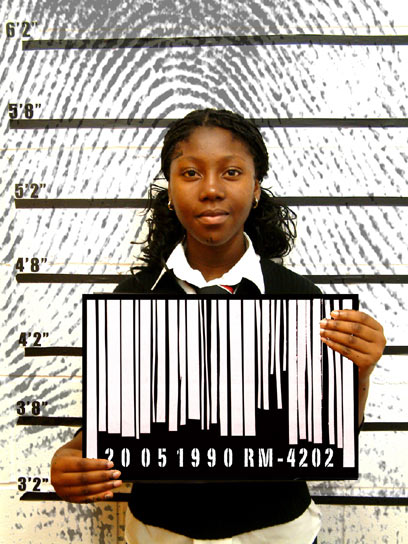
This got me thinking about the role that assigning serial numbers plays in dehumanizing prisoners. These numbers are presumably assigned to help track prisoners in the system since using names might become confusing if you have 1,000 incarcerated individuals named John Smith. Yet the numbers also must represent the routinization and rationalization of the large bureaucracy that is our prison system. The numbers have plenty of other meanings too. I found this wonderful photograph created by a young person which I think illuminates this discussion.
"Prison" by Siever Karim, 2005. As part of the Image & Identity Young People's Conference
Siever’s offered the following statement of his work:
‘My ideas were based on conformity, and the suppression of cultures and personal individuality by being a number, wearing a uniform, being trapped in the cages of the social machine. I created my own police height chart and got my classmates to stand in front of it. I also made digital barcodes to symbolise the gathering of information which can be accessed so easily today.’
What a brilliant way to underscore the depersonalization of our modern culture. So powerful. I also think of that barcode as representing the commodification of human beings across our society (and in particular in prison).
Finally, I found a searing and upsetting description of the system of identifying prisoners at Auschwitz. I highly recommend reading this because it offers yet another perspective about how serial numbers are used as a way to dehumanize.
During the Holocaust, concentration camp prisoners received tattoos only at one location, the Auschwitz concentration camp complex, which consisted of Auschwitz I (Main Camp), Auschwitz II (Auschwitz-Birkenau), and Auschwitz III (Monowitz and the subcamps). Incoming prisoners were assigned a camp serial number which was sewn to their prison uniforms. Only those prisoners selected for work were issued serial numbers; those prisoners sent directly to the gas chambers were not registered and received no tattoos.
Initially, the SS authorities marked prisoners who were in the infirmary or who were to be executed with their camp serial number across the chest with indelible ink. As prisoners were executed or died in other ways, their clothing bearing the camp serial number was removed. Given the mortality rate at the camp and practice of removing clothing, there was no way to identify the bodies after the clothing was removed. Hence, the SS authorities introduced the practice of tattooing in order to identify the bodies of registered prisoners who had died.
This post is not a particularly cogent one, my apologies. I was struck by the Blagojevich press item and this got my mind rambling…
Uncategorized | prison culture | Comments Off on Serial Numbers and the Un-Making of Human Beings…
On Giving A Poetry Reading at Arthur Kill Correctional Facility
by Phillip Mahony (NYPD)
It is not my desire
to forgive,
or theirs
to be forgiven by me.
To understand each other
is more important
and much less pleasant.
It takes courage even to try,
because from up close,
from this close,
one sees that
the walls between us
are not made of stone,
but of circumstance.
We are not as far apart
as we’d like,
How should I begin?
Look the murderer
square in the eyes
and realize:
that too could have been me.
Uncategorized | prison culture | Comments Off on Poem of the Day: On Giving A Poetry Reading At Arthur Kill Correctional Facility
“It is the job of thinking people not to be on the side of the executioners.”
― Albert Camus
by Erik Ruin
People always ask me how/when I came to be so passionate about ending incarceration. I usually respond that my process of conscientization was a gradual one. It was through a million small and large experiences that I came to prison abolition.
Michelle Alexander, author of the New Jim Crow, often tells a ‘light-bulb’ moment story when she gives talks. She interviewed a young black man who was sharing a story of being harassed and framed by the police. He seemed to be a perfect candidate to join her ACLU class action lawsuit until he shared that he had been arrested in his past. At that point, Alexander tells her audience that she had to send him away because they could not take the chance that his credibility might be impugned as a witness because of his previous criminal record. She usually ends by saying that she has since learned that the majority of young black men in the community that she was working in find themselves caught in the net of the criminal legal system. I haven’t done her anecdote justice so you should listen to her tell it instead (it starts at 10:00).
As I said earlier, I have no eureka moment to share about when I first became aware of the ravages of mass incarceration and the futility of prisons. I was young when I first had to decide whether I would rely on the criminal legal system as the vehicle for seeking accountability for the harm that I had experienced. Instinctively, I recoiled. I had experienced the trial of a good friend’s killer and I wanted no part of that for myself. Since I wasn’t going to pursue criminal legal sanctions, I was left with no other alternatives. All I had at the time were my anger, fear, and self-destructive tendencies.
It was perhaps during that period that I began to yearn for another way — for some alternative to punishment and retribution. I’ve written before about my earliest encounter with the concept of restorative justice through experiencing the reaction of a mother towards the person who had killed her son (my friend). I didn’t become a proponent or practitioner of restorative/transformative justice then but it must have left an imprint.
While I have never been incarcerated, I have spent hours visiting, writing, and connecting with people on the inside. In a strange way, I was lucky to be exposed to the humanity of prisoners through one of my favorite students who did a bad thing that landed him behind bars for several years. I say that I was “lucky” because I already knew who he was before he was locked up. I knew him to be funny, kind, insecure, quick to anger, infuriating, you know… I knew him to be human. He was my initial link to prison and perhaps that allowed me to be able to see all of the others who were imprisoned with him as human beings too. This quote by James Baldwin (one of my favorite writers and thinkers) expresses my own philosophy: “People who treat other people as less than human must not be surprised when the bread they have cast on the waters comes floating back to them, poisoned.” Our unwillingness to see prisoners as human beings harms us as much as it does them. The understanding that we are all connected makes it so much easier to demonstrate compassion for others and ourselves. That’s been my greatest lesson so far and I could not have learned it without the gift of having met and knowing people who have been deprived of their freedom. And so the realization for me that prisons must be dismantled has come slowly and has washed over me almost without my knowing it. But here I am today – a prison abolitionist. And I have to wonder: what took so long?
Uncategorized | prison culture | Comments Off on Conscientization, ‘Light Bulb’ Moments and Prison Abolition…
 Uncategorized | prison culture |
  Comments Off on Poem of the Day: To the police officer who refused to sit in the same room as my son because he’s a “gang banger”