Feb 21 2012

The “Magic” of A Peacemaking Circle
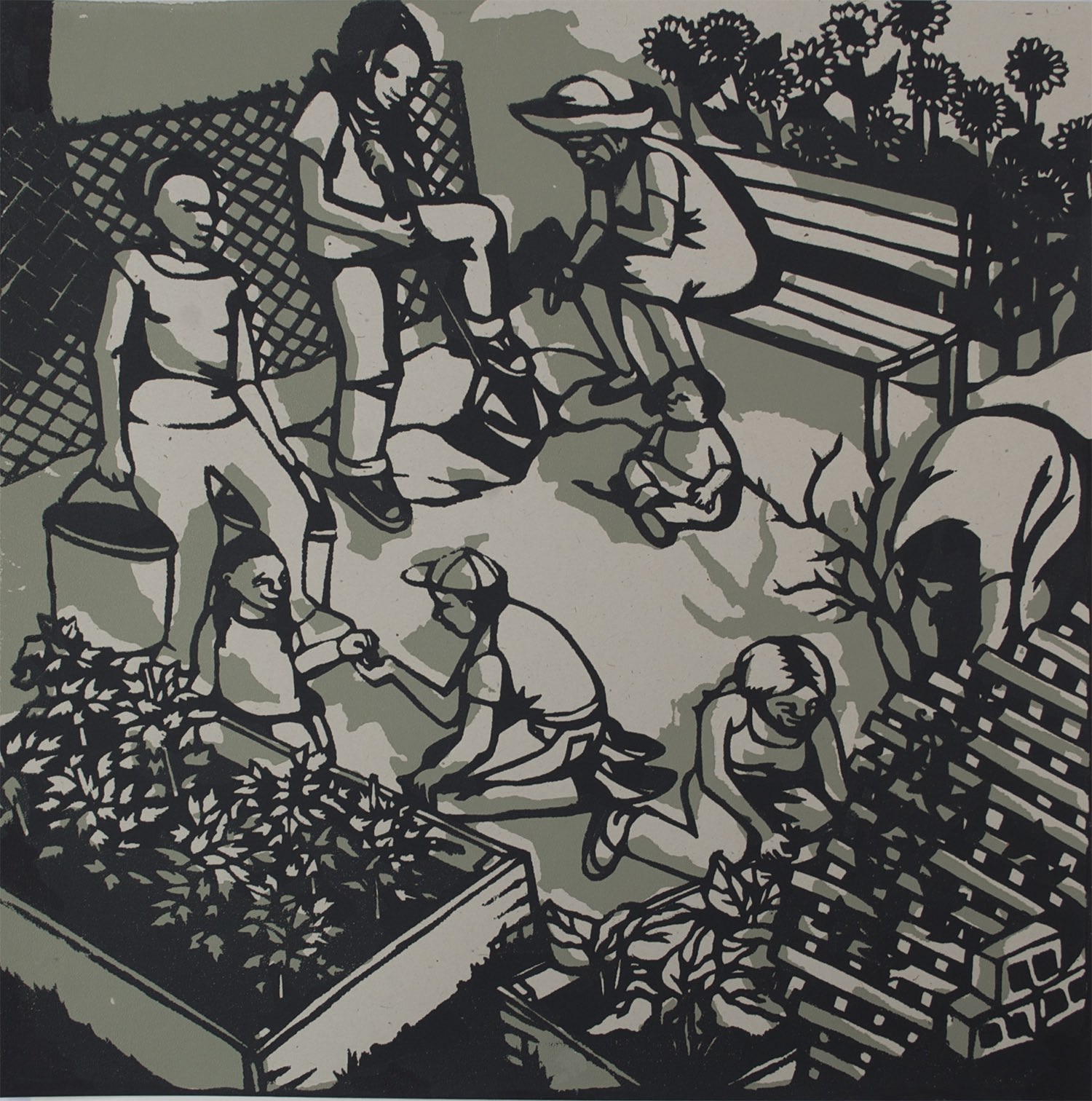
By Bec Young - Just Seeds Artists' Cooperative

This is a piece written by my friend and former colleague Clay Chalupa. Clay is a gifted counselor and mental health professional. I wanted to reprint this piece here because I am often asked about the value of peace circles. I think that Clay does a wonderful job of illustrating the value of circles in this excerpt of a piece she wrote last February.

Recently I have been working with adjudicated youth on probation who have been given mandated community service hours rather than being placed in juvenile detention.

I am often asked how we utilize restorative work for youth who already have been arrested and are often struggling with staying in school. What role can restorative circles play in helping youth in trouble with the law repair the harm that they have done to the community?

The effectiveness is so apparent when one is given the opportunity to be a part of this programming that it makes it almost hard to explain. The shift often comes quickly—as a sullen youth arrives looking as if he would rather be anywhere but here after a long day at school. “Oh no. Not another class where I am expected to participate and act respectful. How long do we have to be here?”

Then they see the Ceasefire men arrive to join us. “Oh no. Now we are going to be lectured about how if we keep getting into trouble we will end up behind bars in a prison.” “Okay. Give us our orange vest and we will go out and pick up garbage in the park.” No. That is not what we will be doing. We are going to do meaningful community service. But first, we are going to explore and strategize what that means.

The “magic” starts when we take our place in the circle. I explain briefly that we are sitting in the circle because each one of us will have the opportunity to speak as we pass the talking piece around. No one is the EXPERT. We are all part of the whole. We are all sitting equal distance to the center that holds the truth, the answer, the story. If we are not ready to speak, we can pass. Still, to be a part of the circle we will all actively listen.

“That’s it?”

Well…it may not appear to be profound…and yet, in every circle there are myths that are deconstructed, relationships formed, voices being heard. A few examples:

A photo was passed around of a tall black man with locks and his cap falling off to one side. He looked like he was passed out with one hand covering his face and it seemed he might fall out of his chair if started, as he was slumped down with his shoulders sliding off the back of the sofa.

“I’m going to pass this picture around and have everyone look at it and write whatever thoughts you have about this man. Where do you think he lives? Does he have a job?
What kind of food does he eat? Does he own a car? Did he go to school? Would you want to know him?” “Does he look kind?”

Each person spoke when they were passed the talking piece. Comments were abundant with judgement. And not very positive.

“He looks high on ganja. He looks like he might be homeless and broke. The man is not kind–I wouldn’t go near him. He looks lazy.”

After everyone spoke, I explained that the man was an award-winning, highly sought-after musician who travels internationally and extensively. He is someone who values prayer, meditation, and compassion more than his career. He is generous and intelligent. The picture was taken by someone in Paris as he was jet-lagged and was waiting for a concert to begin after a sound check. He was sleeping.

“Oh wow. We shouldn’t be judging people.”

“Well, I think we have to make judgements sometimes—it is part of our human nature and it can keep us safe and help us make decisions. But perhaps, we can remain open in our judgements to learn more about people and not make assumptions from one glance.”

This started one of the best and honest discussions about racial profiling and being labeled as a troublemaker. The youth talked about how they have no place to go to meet with friends as they are often stopped and searched and told they cannot loiter. Still, where can they go on a hot July night at 9 pm without money?

__________________________

In another circle we talked about mandated anger management. It has been enlightening to me that many of these programs talk about anger as if it were an unnatural, depraved emotion that can or should be exorcised from people. I read a quote from Audre Lorde: “ My anger has meant pain to me but it has also meant survival, and before I give it up I’m going to be sure that there is something at least as powerful to replace it on the road to clarity.”

Again, another thought-provoking circle ensued. Anger is human. It can be used as protection, as a motivator, and fuel, as a warning signal that something needs to be changed. “Maybe WE could go to a CAPS meeting and talk to the police and ask them what we are supposed to do when we are unfairly harassed and searched.”

This led to more exploration regarding accountability and how youth who are disconnected from their communities and thought of as “problems”—how can they feel accountable for their actions? How can they care about their community that doesn’t seem to care about them?

These questions and stories came from the youth who only a couple weeks earlier, had walked in saying, “What are going to do? How long do we have to be here?” Now they come into our space and tell me that they know friends at school who want to come to our program.

We cannot address problems and issues if we do not recognize and listen to one another. That is what we are doing here. And together we are going to develop real-life strategies and tool-kits to get through. Together—our community.

Feb 20 2012

One of the ‘Throw Away’ People…

Today is National Occupy Day in Support of Prisoners. I am glad that folks around the country are coming together to bring needed attention to the plight of those we lock in cages. We should be in solidarity with prisoners every day.

"Words Break Down Walls" by Molly Fair (Justseeds)

A pen pal of mine who has been imprisoned for the past 10 years once told me that he saw himself as one of society’s “throw away” people. His words have stayed with me. They have pushed me to write letters to incarcerated people even when I have been at my most exhausted. It seems a small thing: a letter. I have learned however that isolation is one of the most difficult parts of being behind bars. The sense that you have been forgotten can sap you of all hope. We are only human in relation to other humans. Our need to be connected to one another is often overlooked but it is essential. Prisoners remind us of this on a daily basis.

So today, if you are not planning to take part in any of the actions that are being planned as part of the National Occupy Day in Solidarity with Prisoners, I make a humble request. Please consider becoming a pen pal for an incarcerated person. Organizations and projects like the Write to Win Collective (here in Chicago), Black and Pink, and Razor Wire Women provide you with an opportunity to connect with prisoners who would appreciate corresponding with you.

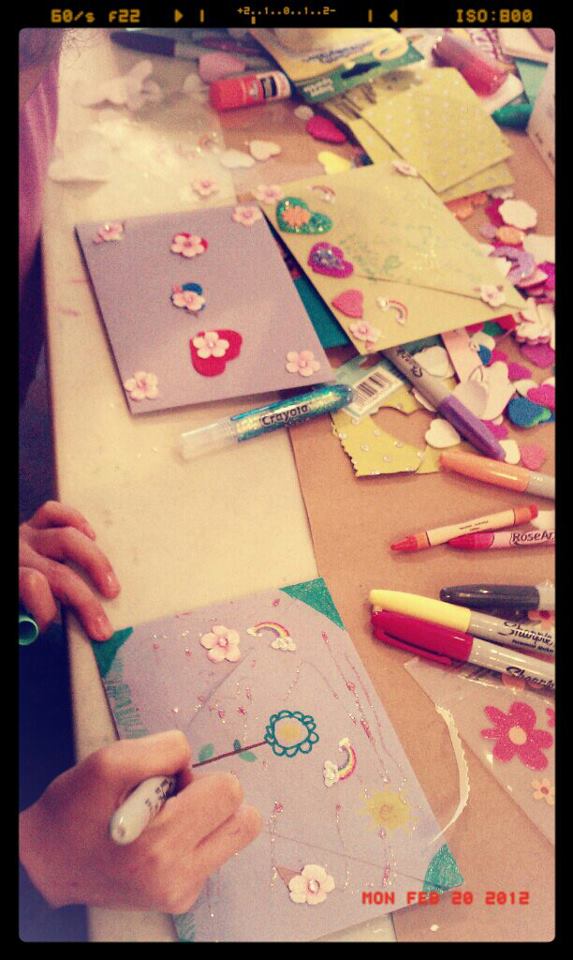
I haven’t been well over the past few days. My energy is low so it would be easy to just pull the covers over my head and stay in bed. Instead I’ll be spending my afternoon in a local arts center making cards and writing letters with young people who have incarcerated relatives. “Showing up” is the best way to express solidarity so that’s what I will be doing. As I am writing my letters today, I will keep Jimmy Santiago Baca’s poem in mind:

Letters Come to Prison
by Jimmy Santiago Baca

From the cold hands of guards
Flocks of white doves
Handed to us through the bars,
Our hands like nests hold them
As we unfold the wings
They crash upward through
Layers of ice around our hearts,
Cracking crisply
As we leave our shells
And fly over the waves of fresh words,
Gliding softly on top of the world
Flapping our wings for the lost horizon.

1976, Arizona State Prison-Florence, Florence, Arizona.

by Sarah Rhee

Update: A special thanks to my friends who came out this afternoon to help and participate in our card-making event at Rumble Arts Center. I was so moved by the beautiful sentiments expressed in the cards. We heard from a woman who told us that she had been incarcerated seven times and knew how important it was to receive mail while locked up. Here is a photo taken by the amazing Sarah Rhee of some of the terrific cards created by a couple of wonderful girls.

Feb 19 2012

Poem of the Day: Shakedown & More

Shakedown & More
by Paul Mariah (1937-1996)

Silver is missing
From the messhall;
All

Prisoners suspect.
Cells torn open
Like wounds

Setting out
In search of
The germ,

The spoon stolen,
Each frisked
As he returns

To his cell.
Shakedown for
Contraband.

All known hands
Are checked
For shivs.

One lives in
Terror that it’s
Not marked

For him. Still
It may be found
As a ring on

Newly wedded hand
Or as a worse attack
A knife in the back.

Soon after Paul Mariah arrived in the San Francisco Bay Area from an Illinois prison in 1966, he became a leading figure in gay literature. In his writings, lectures, and poetry readings, Mariah continually struggled for recognition of the rights of both gays and prisoners.

Feb 18 2012

Musical Interlude: One in the Chamba

“One in the Chamba” by Almighty RSO is from one of my favorite albums. The song addresses the killing of two young black men by the police. The rappers are talking about keeping “one in the chamba” to stay safe from the terrorism of murderous police officers.

Here’s an excerpt from the first verse:

A brother caught a bullet, now he’s dead
Chopped by a cop who seen him trouble enough to bleed him from the head
And that’s goin out the foul way
Straight up murder, word of mouth is that he done him in the hallway
And like always a lot of controversy
But of course he got away scott-free and yo, it hurts me
And it makes me angry just knowin that a cop can’t stop
Reach, pull the trigger, no speech
Laid off for two weeks and then he’s back on the streets
No investigation
Just a paid vacation

You can read the rest of the lyrics here.

This is the original version of the song from 1992:

This is a remix.

Feb 17 2012

Laura Scott, Female Prisoner, #23187 Part 7

Last week, I wrote about Laura Scott‘s 1907 trial in Los Angeles County. I am still searching for information about her ultimate sentence in that case. I know for sure that she was not re-incarcerated at San Quentin after she was found guilty in that trial. She may have served time in jail but I have not yet been able to confirm that.

The next time Laura Scott’s name appears in the news is in 1908.

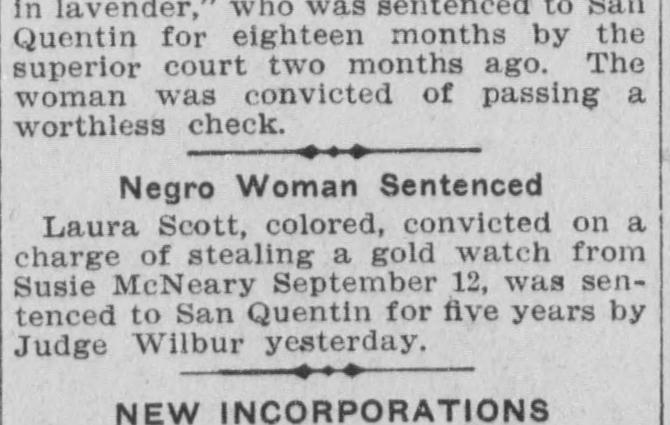
So once again, we have Laura getting caught stealing a watch. She clearly had a thing for them. Based on news reports, she stole a watch from Ms. Susie McNeary on September 12th 1908. She was found guilty by a jury on November 11th.

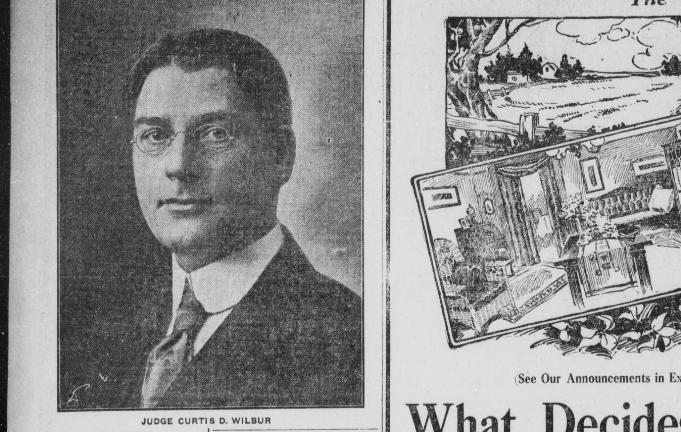
Having already been incarcerated for grand larceny in 1905 and tried and convicted of larceny again in 1907, it is unlikely that a judge would have gone easy on her in terms of imposing a sentence for her crime. Judge Wilbur [on the left] sentenced her to 5 years in San Quentin Prison on November 16th. On November 20th 1908, Laura Scott enters San Quentin Prison. She spends nearly 4 years locked up until she is discharged from prison on June 20, 1912. At that point, Laura Scott’s trail grows cold in California. One has to wonder if she decided to leave the state to find new opportunities. I would love to know what became of her.

Over the past few weeks, I have greatly appreciated the e-mails that some of you have sent to me letting me know that you appreciate reading about Laura. In the next couple of weeks, I plan to write about the Alabama of Laura’s childhood and about the Los Angeles that she and her friends inhabited in the early 20th century. I hope that these descriptions will help us to better understand the context of Laura’s life. Our childhoods impact us a great deal and I can only imagine how growing up in Alabama during Reconstruction might have shaped Laura’s character. It will be interesting to speculate on this in the coming weeks. Stay tuned!

Feb 17 2012

“I Can Breathe Again…”

I came home yesterday to find a Valentine’s Day card in my mail box. It was a surprise. I didn’t expect it. I had already received a few cards from my best friend and other loved ones on Tuesday. Those were welcome and heartwarming of course but this one well…

There is a boy I knew a long time ago. That boy is now a man. He did a very bad thing. He paid a steep price. He spent his formative years behind bars. And I wasn’t sure if he would survive those years.

I wrote him many letters. They were filled with hope in the unseen and with love. I received many letters. They were filled with rage, desperation, fear, hope, anger, joy, desperation, rage, boredom, fear, hope, and love.

“I’m suffocating here, Ms. K,” he would write. “I’m going to die here.”

He didn’t die there. The card that I received yesterday attests to that. He was my student in the 11th grade and then I was sitting across from him in Rikers Island barely able to see his face because my eyes were filled to the brim with tears. I was despairing.

I have to be honest, I sometimes thought that he might end up entombed in the concrete of a NY prison cell. I wasn’t sure if he would make it through. I just kept on writing those letters and reading the ones he sent to me.

Now 18 years later, I am standing in my hallway reading a card and my eyes are once again filled to the brim with tears. I am overjoyed.

Inside the Valentine’s Day card is a poem that I recognize, written in my own hand. It is a poem I sent him years earlier. It has been returned to me with a note scribbled in the margin: “You were right…I can breathe again.”

Feb 15 2012

On Chris Brown, ‘Forgiveness’, and Accountability…

I just came across an article this morning with the headline “Chris Brown Doesn't Deserve Forgiveness For Beating Rihanna.” Marlow Stern, the author of the article, describes Brown’s physical assault of Rihanna while taking issue with the Grammy Awards’ public celebration and embrace of him. The thesis of the article is that Brown has not been publicly remorseful enough for his vile actions. On the contrary, he appears to be defiant and acting as though he is the aggrieved party. The article also addresses the rumors of Rihanna having rekindled a relationship with Brown. Their alleged reconciliation is explained as fitting the pattern of other high profile examples of relationship violence.

This is not a post about the dynamics of relationship violence. I have spent many years of my life working in domestic and sexual assault organizations so I know a little about these issues. The issues are complicated, fraught with emotion, deeply personal and also public. This is also not a post about “forgiveness” which is deeply personal and should not be demanded from those who are victimized.

Instead, I want to focus on a quote from the article by a victim’s advocate named Michelle Garcia:

“I don’t think Chris Brown has done enough to take responsibility for his actions. What have we seen to see that he truly regrets his behavior or to actively raise awareness about violence against women?”

Those of us who are proponents of restorative or transformative justice wrestle with this question in one form or another every single day. Whenever I speak to someone about the value and promise of restorative or transformative justice, I am confronted with the question: “what if the person causing harm doesn’t want to accept responsibility for his/her actions?” And the truth is that there is no good answer. That doesn’t mean that we shouldn’t continue to struggle with the question though.

My life is divided by an invisible line – BSA (before sexual assault) and ASA (after sexual assault). I have lived many more years in the ASA period than I had in my BSA period. There was a time in my life when I wasn’t sure if I would be able to write that. People have said this before me and it is true: sexual assault is soul-murdering. It was no different for me. I spent 10 years after my assault mending my soul. It was a process characterized by tentative steps forward and violent steps back.

While my experience hasn’t given me unlimited wisdom, I do know this to be true: so many of us who are survivors seek “accountability” from a system that simply cannot deliver. The criminal legal system mandated that Chris Brown be put on “probation” and that he attend the dreaded and always terrible “anger management” classes. As we have been able to see through his temper tantrums online and in person, Chris Brown doesn’t seem to have his “anger” under control. In fact, those of us who are survivors of domestic and/or sexual violence know that these are not about anger. These actions are about displaying power and asserting control.

So the public is left unsatisfied and seething because they believe that Chris Brown should be contrite. Many want to see “evidence” that he has “changed” or “learned his lesson.” But the current system cannot deliver and that leaves all of us worse off.

I long for some non-hysterical dialogue about how we are going to develop structures in our communities to hold people accountable for the harm that they cause others. I would like some in-depth conversation about how we are going to hold the institutions responsible for state violence accountable in our society. I am desperate for people to focus less on Chris Brown and more on their own role in fostering a culture that makes Brown believe that it is acceptable for him to beat another person. Chris Brown is not an island onto himself. He doesn’t exist in a vacuum. Chris Brown is unfortunately us.

So each of us has a stake in figuring out how we are going to build a system that truly addresses harm and is accountable. If we make sure to keep survivors and marginalized populations at the center of our analysis, I think that there is good chance that the new system that we build will be better than the one we have.

Feb 14 2012

Prison Culture is Now on Pinterest!

I’m excited to share that Prison Culture is now on Pinterest. Check it out and follow!

If you don’t know much about Pinterest, here’s a basic description from their site:

Pinterest is a Virtual Pinboard.

Pinterest lets you organize and share all the beautiful things you find on the web. People use pinboards to plan their weddings, decorate their homes, and organize their favorite recipes.

Best of all, you can browse pinboards created by other people. Browsing pinboards is a fun way to discover new things and get inspiration from people who share your interests.

I am using Pinterest to organize and share various PIC related images. I am also using it to share other miscellaneous interests. One of my pinboards for example is a collection of images about the PIC. You have seen many of these on the blog and others are new. I will continue to add to this collection over time. If you spot any great images, please e-mail them to me at [email protected]. I will include them on the pinboard.

Another pinboard that I have started is a collection of black prisoner photographs. I am just at the very beginning of this process but already I am finding it incredibly interesting. I hope that you will follow Prison Culture at Pinterest.

Feb 13 2012

Slavery By Another Name Airs Tonight on PBS

Watch What it Meant to be a Convict on PBS. See more from Slavery by Another Name.

I’ve written quite a bit about the convict lease system on this blog and also about chain gangs. Below are just a few posts for those who are interested in the topic.

The Slaves of Turpentine: A First Hand Account of Convict Leasing

Resistance to Convict Lease System: First Hand Accounts by Women Reformers

Chain Gang Blues: Black Labor, New Slavery and Imprisonment

They Tell Me Joe Turner's Come And Gone: Music, Prison, and the Convict Lease System

I’ve seen the documentary and it is very very good. I highly recommend watching it on PBS tonight at 9 p.m. Eastern and 8 p.m. Central.

Feb 12 2012

From Plantation to Penitentiary: Music as History & Testimony

I have written before about the role of music in the lives of imprisoned black people particularly in the South by highlighting Angela Davis’s analysis of the song Chain Gang Blues. However, it was only a cursory consideration of how music described the Southern black experience of incarceration in the early 20th century.

Many people are familiar with prison worksongs without perhaps knowing much about their origins or purpose. In reviewing the book “Wake Up the Dead” by Bruce Jackson, Craig Ruskey describes the nature and value of prison worksongs:

Prison inmates were put to work in the various institutions where they were housed. Working in the cotton or tobacco fields, road and chain gangs, or clearing forests, there were different types of songs for each type of labor. A team would choose a leader as their singer, usually a man with a clear voice who could easily be heard. ‘Proper’ singing wasn’t necessary but the volume of the voice was. Sometimes, teams or crews of as many as eight men were put to work cutting a tree down, with each member of that team supplied an axe. The reason the worksong was so important to the team was simple; with eight men swinging individual axes at the same target, without a rhythm to work by, havoc would be the natural outcome! Simply put, it was a matter of the downbeat for one team to swing, and the upbeat for the other team to swing. In an eight man team, four men would follow the lead voice on the downbeat, so as they would swing their axes into the base of a tree, the opposite team would be singing a refrain and pulling their axes away from the tree. Road gangs and chain gangs would usually work with hoes or picks and in a straight line. Again, the leader would be the man with the clearest voice and he would start a song by singing the first line, then the entire team would use that rhythm and sing the second line. Field workers had songs of a more personal nature as they worked individually, singing primarily for their own enjoyment and to pass the time.

“Go Down Old Hannah” is a song that seems to have originated from black prisoners. Here is a recording of the song made at a Texas Prison Camp by the Lomaxes.

Former prisoner and blues legend Leadbelly recorded his own version of this worksong.

He explained how he first came across the song:

They called the sun Old Hannah because it was hot and they just give it a name. That’s what the boys called it when I was in prison. I didn’t hear it before I went down there. The boys were talking about Old Hannah – I kept looking and I didn’t see no Hannah, but they looked up and said, “That’s the sun.”

I hope to write more in depth about prison worksongs as American cultural artifacts in the future. Today I want to focus, instead, on the ways that Southern blacks who had been imprisoned expressed their reenslavement after Emancipation through song. I contend that these songs of the early to mid 20th century represent testimonials about the injustice of the criminal legal system for blacks.

The convict lease system and the chain gang were so prevalent in the South that they inspired many songs besides Chain Gang Blues. One of these songs titled “Standin’ On the Corner” has been recorded by several artists and has been reinterpreted many times. The song dates back to the early 20th century and in it, the singer usually describes how he was “Standin’ on the corner, doin’ no harm,” when “Up come a policeman and grab me by the arm.” He is taken to a judge, who winks at the policeman and says “Nigger you get some work to do,” and sends him “shackle bound” for six months on the chain gang.

Below is one version of the song that I could find on Youtube. It isn’t my ideal version but it offers an opportunity for those who’ve never heard the song to hear it performed for the first time.

In the post-Emancipation South, black people knew that they could be picked up randomly for anything. The Black Codes criminalized “vagrancy,” unemployment, and all kinds of other things. As such, the theme of wrongful imprisonment permeates many of the prison-inspired songs that were collected in the late 19th and early 20th centuries in the South. One famous song titled “Penal Farm Blues” describes the experience of being snatched up and imprisoned for no apparent reason:

Early one morning : on my way to the penal farm
Baby all I’ve done : ain’t done nothing wrong

Loaded in the *dog* wagon : and down the road we go
Oh baby : oh baby you don’t know

Into the office : then to the bathhouse below
And with a light shower : baby we change our clothes

All last night : baby it seemed so long
All I’ve done : I ain’t done nothing wrong

I’ll tell you people : the penal farm is a lonesome place
And no one there : to smile up in your face

You can listen to Scrapper Blackwell’s version of the song below:

These songs of prison and captivity shaped what we have come to know as the blues. As I mentioned in my earlier post about Chain Gang Blues, Angela Davis suggests that imprisonment was a central theme in blues music. This is borne out over and over. One of my favorite musicians, the great John Lee Hooker (who Bonnie Rait re-introduced to the mainstream in the 1990s) recorded his version of Prison Bound in 1949. In the song, he tackles the important ideas of the separation from loved ones and the sense of abandonment that can come from being incarcerated.

When they had my trial, baby
You know you couldn’t be found
When they had my trial
Baby, you could not be found
But it’s too late to cry, baby
Your daddy’s prison bound

I have lamented the fact that current hip hop artists seem to shy away from creating art that reflects substantively on either their personal experiences of incarceration or on prison reform more broadly. This makes me appreciate the prison-inspired music of the early 20th century all the more. The songs are historical artifacts that shed light on our collective past. I wonder what artifacts future generations will be examining to understand our current epidemic of mass incarceration. It’s hard to think of any songs from our era that might endure in the way that Chain Gang Blues has.