Sep 09 2011

New Resource: Attica Rebellion Zine


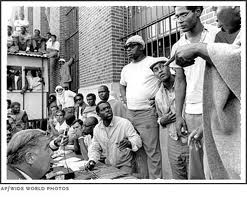
Today is officially the 40th Anniversary of the start of the Attica Prison Uprising. You can read some background about the Uprising in a post that I co-wrote at Daily Kos a couple of weeks ago.

Last night, we hosted a terrific event that included reflections about Attica by Michael Deutsch who was one of the lawyers for the Attica Brothers as well as readings from poetry and prose by Attica prisoners and witnesses. For this event, we created a zine that represents an abbreviated version of the Attica 101 Primer that we released last month.

You can download the zine HERE. I hope that you enjoy it.

Special thanks to my partners in creating the zine including Lewis Wallace, Micah Bazant and Katy Groves.

Sep 08 2011

Another Day at Juvenile Court…

By Chris Stain

Max (not his real name) is sitting with his head down and I think that he is clasping his hands on his thighs. I can’t tell. I am beside his mother and we are both sitting silently and stoically. We are waiting for the judge to give her disposition on the case.

This is Max’s second time in juvenile court this year. He has violated the terms of his probation. I am there this morning to offer some support to his mother. She is worn out. She is tired of Max and wants him out of her house. I think that she is hoping that the judge will sentence him to the Department of Juvenile Justice (our youth prison system). I think that she would be relieved. I am seething inside and I have no right. He isn’t my son. I have not had to “put up with his mess” (her words) for 16 years. She is really tired and I have sympathy. I met Max just this February and I am already feeling a sense of weariness.

Max needs money. His mother is working as a night nurse. She is single and has four children to raise. She is doing her best but it is really hard. Max needs money. He tells me that he can’t find a legit job. He needs money. I have no good answers for a 16 year old black boy who is barely in school about where to find a job in this climate. I am exhausted today. Depleted.

Juvenile court feels to me like the saddest place on earth. I am not in touch with my emotions today. All I feel is numb. What are we going to do for the Maxes of the world? They need concrete help and soon. They can’t afford to wait for a year, a month, a week. At 16, a week is a lifetime. The President is giving a “jobs” speech tonight. It turns out that I am going to have to miss it since I am hosting an Attica-related event. I don’t have to hear it though to know that it will offer no solace for Max. There will be no proposals to spend even $100 million dollars on young people like Max.

Is it time to get discouraged yet? I feel I have no choice but to push forward. There was another call today from a young woman asking for some help. She wants to come by to talk with me tomorrow. She says that she was referred by another young woman who I helped last year. So I have to push through my despair again. I have to buck up because there is more work to be done. Honestly though, I want to go to bed, pull the covers over my head, and just weep. There is no time for that…

P.S. Max was given another chance. The judge heard our pleas to allow him to return to a community-based intervention. I hold out hope for Max.

Sep 04 2011

Lonely…

i am lonely.
all the people i know
i know too well – Carolyn Rogers

Yesterday I received an extraordinary e-mail from a woman whose partner is incarcerated. I’ll call her Tina. I haven’t asked for permission to quote the e-mail so I won’t do so here. I want to talk instead about Tina’s general argument. She was responding to my latest post about loss being a critical component of the incarceration experience. She suggested that I was correct but that I should couple loss with loneliness. As I read her words, I thought “yes, that’s right LONELINESS.” Loss and Loneliness – for those on the inside but also for those on the outside too.

Michael Smith, a guard at Attica prison who was held as a hostage in 1971 during the rebellion, offered these words recently:

“I think that prison not only locks inmates away from society but also locks society away from inmates. People don’t pay attention to what’s going on in prisons. We think it’s not an issue if it’s locked away. They don’t think about how much its costing society in other terms.”

The costs of incarceration are in fact high. But in some ways, they are immeasurable, incalculable… How does one quantify grief, anger, and loneliness? We cannot.

I want to offer some words of support to Tina. I want to tell her that I sympathize with her plight. But I am finding that the words won’t come. The ones I have seem inadequate, too small somehow to convey the depth of my feelings. When I have a difficult time finding the words that I need, I often turn to poetry.

I have not had a partner who has been incarcerated. I have however been lonely, I have felt alone. I have felt misunderstood. I have felt not understood. Those aren’t the same things… I opened this post with lines from Carolyn Rodgers’ “Poem for Some Black Women.” Rogers is one of my very favorite poets and “Poem for Some Black Women” illustrates loneliness in a way that I cannot:

“when we laugh,
we are so happy to laugh
we cry when we laugh
we are lonely.
we are busy people
always doing things
fearing getting trapped in rooms
loud with empty…
yet
knowing the music of silence/hating it/hoarding it/loving it/treasuring it
it often birthing our creativity
we are lonely”

Tina, you see, other people understand being lonely too. I have been there. Shrinking myself to try to conform to others’ expectations of me, for me. So many of us have felt alone in a crowd too. Here again Rogers is instructive:

“we grow tired of tears we grow tired of fear
we grow tired but must al-ways be soft and not too serious…”

You are told to be “strong” for your daughters. How annoying that must be. Considering you ARE being “strong.” You are working. Working hard to keep it together. You feel invisible in your accomplishment.

Michelle Clinton wrote a poem called “For Strong Women” which has a lot of resonance for me and I hope for you too. Here’s a section of the poem:

“I have needed some one to be kind to me,
like a sad, sad, misty & gray dream,
my hand outreached, waiting,
yet not believing I deserve anything…
For those simple times,
when I cannot take care of myself…
What?
What do we do?
What do you do?
WHAT CAN BE DONE
to ease the fear
& growing self-pity
(LIGHT A CANDLE/READ A BOOK/TAKE A LONG HOT BATH MASTURBATE OR SMOKE A DOOBEE/TAKE A LONG HOT BATH)

Wait.
And tomorrow when there are people to comfort you,
or you find those damned keys,
Return to the same well versed competent woman you are.
Hold your head up.
Breathe deeply.
Return to your life unmarred, recovered and complete.”

Tina, thank you for your e-mail, for your outstretched hand. I reach back to you and offer mine and Carolyn Rogers’ too.

“we know too much
we learn to understand everything
to make too much sense out
of the world,
of pain
of lonely…”

I hope that you learn to make less sense of the world, of pain, and of lonely. I hope that you heal. Peace to you.

Sep 02 2011

Healing and “Collateral Damage:” Prison is above all about loss…

About three weeks ago, I was privileged to keep a circle for the family of a young man who is serving a recently-imposed sentence of 7 years in prison. I am friendly with the young man’s sister and she was the one who asked me to organize a healing circle for the family. I was really blessed that a friend of mine who is a wonderful circle keeper partnered with me. The key to keeping a good circle is preparation and it took us almost a month to set this one up. We had to talk to everyone who was going to participate before we could actually keep the circle.

After speaking to everyone involved, it became clear to us that the main emotions that folks wanted to process were grief and anger. I want to talk a bit about both.

I haven’t written about this particular circle because I needed time to process it for myself. Also, I had to get permission to write about this circle (even though none of its participants would be named). I received permission from everyone involved last week.

There were so many tears shed.

The emotions almost could not be contained in the circle. Family members and friends of the young man shared the anger that they felt towards him. They were furious that he would do something “to get himself locked up.” Sobbing, his best friend raged: “He knew that they were out to get us. They want to put all black men in the pen. Why help them do it?” So there was anger.

However this anger was rooted in a deep sense of hurt and of grieving. The incarcerated young man is locked up far from home. It won’t be easy for his family members to visit. There was so much sadness about this. Sadness about the disconnection that would be experienced. Fear that this lack of connection would deeply alter the family. How would he be able to reintegrate once he is released? Would he come back home a “hardened criminal?” his mother asked. His younger sister worried that prison would “take his heart.”

Part of what we discussed towards the end of the circle was how family members might constructively and simply support each other and the incarcerated young man through this ordeal. A decision was made that two people from the circle would arrange to visit him once a month at minimum. We made a plan for this together.

We also strategized about how his younger siblings could talk about their brother’s incarceration. His younger siblings are 9, 12. and 15 years old. Everyone offered their ideas for how they might address their brother’s situation with their peers and others. We practiced talking about what had happened and encouraged them to use their own voices to describe this circumstance.

Finally, I want to say a few words about shame and incarceration. As we debriefed the circle, my co-keeper mentioned that she felt that we had dropped the ball in not introducing the idea of “shame” in the healing circle. I have thought a lot about this over the past few weeks and I am very ambivalent about this criticism. Michelle Alexander often discusses the concept of “shame” in her presentations about mass incarceration as the new Jim Crow. I agree that incarceration is indeed often enmeshed with shame. However, in the case of the family that I was working with, I don’t know that our particular healing circle could have really properly addressed shame. Frankly, I don’t think that the family was feeling particularly ashamed. I think that they just needed space to vocalize their fears, hurt, anger, and grief. And perhaps even more importantly, I think that they needed a place to start making concrete plans to help lessen those fears, that anger, and hurt. So I am still mulling over my friend’s constructive criticism.

I am writing about this experience here on the blog because I think that these are stories about incarceration that are obscured in debates about policy, systemic change, and social justice. These “small” stories of individual people who are struggling daily to repair their families which have been ravaged by the “plague of mass incarceration” are central to the experience oof incarceration in our communities. Yet we think of them as “collateral damage” if we think of them at all. Here in Chicago, these people are our neighbors, co-workers, family members. They are us… It seems important to point out within a landscape that can appear bleak and hopeless that we can all still be “keepers” for each other.

Aug 31 2011

Guest Post: 911

Special thanks to my friend Dr. Erica Meiners, educator, prison abolitionist and great ally for this guest post. Erica is the author of several publications including Right to Be Hostile: Schools, Prisons, and the Making of Public Enemies and Flaunt It! Queers Organizing for Public Education and Justice. Erica is also the co-founder of St. Leonard’s high school, a program that educates formerly incarcerated adults.

Early in the morning on the 5th of July, I am in bed with my lover, L, fast asleep, generously anesthetized from a summer day.

We are nude in this unairconditioned apartment, and the building, often overflowing with people, is quiet tonight – just two people upstairs, and M and N downstairs in bed with their yappy dogs. I live in a typical two story Chicago building with a “shotgun” style hallway running through each floor, rooms on each side, and kitchen in the back.

Around two o’clock in the morning L yells, “what’s going on” and I wake up. Over the airplane engine sound of the box fan, the floorboards creak, we fall out of bed, and a figure halts in the doorway of our bedroom and all three of us freeze for just a half a moment, and then the body disappears down the hallway with L in pursuit, yelling HEY STOP!

At forty-one, I have had many things taken from me without my consent, and in the spectrum of violations, someone in my house without my consent, and the theft of my laptop and other items is relatively minor. Also, and probably most important to me, I had backed up my work issued laptop that would take a person working at minimum wage at least 200 hours to purchase.

But still, my heart is beating fast and I can’t find my glasses and I am scared and I keep running through my brain different scenarios of what could have happened.

Reluctant to run down the alley nude and without her glasses, L returns, and we get dressed and hum and hah about calling the cops.

Even in this facebooked, craigslisting and tweeterate world, there are no other options to name and publicize what has been taken, to try to get it back and to figure out why it happened. M and N have to get up before the sunshine for work tomorrow, as do the other folks that live around us, so we fester, alone and disoriented, reluctant to wake friends and neighbors.

L votes against calling the cops, but I need a police report to explain the loss of my fancy MacIntosh to my day job, so we wait a half an hour thinking that this will mean that perhaps every loose brown kid in the neighborhood won’t get shaken down or spotlighted by the police helicopter. We (perhaps problematically) assumed “kid” simply because of the height and the way the body was carried, and even if we could have named “race,” the cops will not target the white kids in the area. We breathe, get a drink, and then call the cops and sit on the front steps outside the house to wait and they arrive, a squad car and a paddy wagon, within minutes.

One of the cops tries to be empathetic and makes a comment about how traumatic it is to have someone break into your house.

I think but do not say, yes, sure, but having two large dude-cops in my kitchen is also stressful for me. I want them with their bodies and uniforms and sweat and stilted attempts at solidarity out of my kitchen. I can’t remember my phone number so L takes over giving them information, and I look at my life and see everything a little differently and try to be reassured–the Stonewall was a riot against police brutality poster and the homo sweet homo needle-point art. I think, I am twenty years older now and so what if I have weed in the house?

One of the cops asks if there is a gun in the building. The other cop takes up this question, in this hot hot hot hot kitchen, and states – “well, handguns and rifles are legal now”…. Unstated seems to be ladies like you could use some protection.

With my vision and coordination, and a handgun, I would have shot the kid, L or more probably myself, and this would really have helped the situation.

An excellent our public safety solution: arming ourselves. They classify the crime as a home invasion and leave, slightly admonishing us for not calling 911 earlier so they could search the neighborhood for the perpetrator.

A few days later, in the yard talking through the theft with the queer family, N who grew up in Tennessee in a house where her eight-seven year old mother, Mz M, still answers the door in with her rifle, says she wants us to get a gun. If she has not already on previous extended stays with us brought one, Mz M might even bring her gun with her on the next visit. The table engages in a heated discussion about guns, with two folks on the pro-weapon side, a couple of us on the no-guns and no-cops side, and a few that would, of course, always call the police because what else is there to do? Curiously, the pro-gun duo is very closely aligned with the no-cops folks, as none of us trust the police to protect us or our interests. These are people I love and know intimately and what makes people feel safe is so complicated.

And what do I want? Much, much, much more than 911. Weeks later, I still want to yell at the little shit who bust into my house and stole my stuff and freaked the daylights out of me. I want my stuff back. I want to know who did this and why.

As an abolitionist, one who is invested worlds without policing and prisons, this is the complex place. I write of this experience now with humor, months after the event when the feelings have moved, because I want something else, not 911, and I expect us to build it.

Aug 28 2011

First Person: Another Day Coming by William Healy

by Nicholas Ganz

As part of my ongoing effort to feature the voices of prisoners on this blog, I wanted to share excerpts from an essay written by William Healy, a prisoner at the Indiana State Penitentiary, titled “Another Day Coming.” The essay appeared in Black Voices from Prison by Etheridge Knight published in 1970.

…I am hesitant to say anything more about prison because I feel unequal to the task of explaining my imprisonment in order that another might glean from this telling an understanding of the universal encounter with penitentiary life.

What word is there that can duplicate the prison experience? Or reproduce the feeling a man has of being swallowed up by the earth; of being removed from the rolls of the living, yet knowing there is no defense against this feeling — nothing he can take to cure the malady caused by his displacement? How is it possible then for me to write about it? Being aware at the beginning of the difficulty of the chore does not quicken my eagerness to begin.

So now I am confined to this cramped cubicle, just large enough to die in, thinking mean thoughts about nothing in particular, because in prison there is nothing much to think about. My meanness is scattered all about the cell: Sliding off a prison cot, piled high in corners, my accumulation grows to resemble a World War II garage waiting for a paper-collection drive to end.

[…]

So this is prison! Its storied existence is a legend commercialized by book and film, a fictitious narrative depicting prison as a place full of men hard and calloused beyond belief, who have committed acts against a society which, in turn, has sentenced them to this place where a man’s life is given up to serving time.

Yet prison’s self-image is perpetuated not by the man lodged in penal institutions (though many men have died here because of it, believing the legend), but through an atmosphere which demands the continuation of both guilt and punishment. The great tragedy of our penal system, also its interior weakness, is its promise to be always indifferent, never conferring upon an individual the needed conditional absolution — that an adjustment within his life, in terms he understands and wants, might be tried through programs that are designed for his eventual release, instead of holding him for the grave.

When you consider that 90 percent of everyone in prison now will be released some day, this attitude implemented now would awaken a real self-interest in these men about their own lives; and such a program could also be used to measure progress and determine when a man could be released. To enforce an authoritarian position upon the imprisoned, with its rigid controls, only benumbs the spirit needed to resolve guilt and increases the intolerance of the future that he inherits anyway. There is just no excuse for making sick people sicker and therefore more of a threat to society when they return to it.

Aug 26 2011

Guest Post: How To Convey The Horror???

I am blessed to meet amazing people through the work that I do. I was lucky to make an e-connection with Nancy Heitzeg through Daily Kos some time ago. As of this month, I am proud to be one of the new contributing editors of the great series that she co-launched over at the Daily Kos called “Criminal Injustice Kos.” Nancy was kind enough to submit this piece to Prison Culture. It first appeared as a CIK diary. It is as powerful today as when it was first published at Daily Kos.

Nancy A. Heitzeg is a Professor of Sociology and Race/Ethnicity at St. Catherine University. She blogs as soothsayer99 and is the Editor of Criminal InJustice Kos is a weekly series devoted to taking action against inequities in the U.S. criminal justice system. Criminal InJustice Kos is published every Wednesday at 6 pm CST. The following piece was written after another recent trip to Louisiana State Penitentiary at Angola – Dr. Heitzeg has previously written about LSP Angola in “Visiting a Modern Day Slave Plantation” Interview with Angola 3 News Part I January 2010   and “The Racialization of Crime and Punishment” Interview with Angola 3 News Part II February 2010.

Criminal InJustice Kos appears every Wednesday at 6 pm CST at Daily KOS

How To Convey The Horror????
by soothsayer99

These pages are written in no spirit of vindictiveness, of all who give the subject consideration must concede that far too serious is the condition of that civilized government in which the spirit of unrestrained outlawry constantly increases in violence, and casts its blight over a continually growing area of territory. .. No comment need be made upon a condition of public sentiment responsible for such alarming results….

Ida B.Wells -Barnett , A Red Record, 1895

Every week in Criminal InJustice Kos, we try to further awareness of the racist, classist monstrosity that is otherwise known as the prison industrial complex. This beast encompasses the very law itself, as well as a vast correctional enterprise ranging from police to prosecutors to correctional officers to private corporate interests that profit from a seemingly endless supply of mostly black and brown neo-slave labor.

Often we make our case, as I do every day in one university class or another, with “facts” and statistics and cold data and, occasionally with a specific story of some egregious abuse or injustice..

But how to convey the under-lying aggregate horror that haunts us — that prison is a genocide, a legalized outlawry, another piece of that red record??

How to pierce through the plethora of numbers and public justifications and lies to expose this for what it really is — a raw ugly racist wound that can never be healed but only excised??

How to make you feel the urgency, the pain, the devastation of families and communities, and the decimation of a people???

And yes how to persuade you to join us in making it stop???
We use the words – slavery. lynching — we write and speak about the racist and class-bound criminal injustice system, the fact that slavery is not abolished by the 13th Amendment, that the promise of due process and equal protection and voting rights have all been undone — here, here and here..

But dare we explore the depths of what these words mean?? The ramifications then of what we must do now??

Today I am going to say it all plain — yes in words but mostly in feelings, in stories, in emotions, in what I have experienced.

I am asking you – with my whole heart – to really look and not turn away….

Prison in the United States is a direct outgrowth of slavery, a system designed and re-designed to exploit a largely black captive labor force — first with prison as plantations and convict lease labor all supported by legal segregation and extra-legal lynching, and then later as the prison industrial complex.

But these systems — all of them – have always about more than mere economic exploitation of mostly black labor. They are about a people as property subject to the most brutalizing punishments — the lash, the bit, the bell – collar, the spur, the chain , the most degrading sexual exploitations and mutilations – rape, castration, medical experimentation without benefit of anesthetic, and endless evolving efforts to dominate and regulate the reproduction of black and brown people. All of it — slavery, convict lease, lynching morphed into state-sponsored capital punishment, plantations turned into the prison industrial complex — is about, as Dorothy Roberts aptly puts it, Killing The Black Body.

Yes, poor whites, other people of color and white women are also swept up in these systems of ruthless control. Beaten brutalized raped aborted lynched imprisoned. They always have been. But in the paradigm of punishment, the loci of domination have always been built upon that peculiar legacy in this country of controlling the black body.

Prison remains a site where black and brown reproduction is stymied and where sexual exploitation persists. Just as the reproduction of black and brown women was regulated via forced sterilization and both positive and negative incentives to suppress pregnancy,so too the prison serves as a site of pseudo-castration, a way of cutting off a large segment of the population from sexuality, family and reproduction. Look at the numbers and do the math — I in 9 Black men between the ages of 24 -35 in prison, 1 in 15 Black men over the age of 18, 1 in 36 Latinos, 1 in 100 Black women between the ages of 35-39 in prison. Future generations denied; current generations disrupted as 1 in 15 Black youth have at least one parent in prison.

Dorothy E. Roberts makes this observation:

Over the last two decades, the welfare system, prison system, and foster care system have clamped down on poor minority communities, especially inner city black neighborhoods, thereby increasing many families’ experience of insecurity and surveillance. Welfare is no longer a system of aid, but rather a system of behavior modification that attempts to regulate the sexual, marital, and childbearing decisions of poor unmarried mothers by placing conditions on the receipt of state assistance. The federal government encourages states to implement financial incentives that deter welfare recipients from having children and pressure them to get married.

The contraction of the U.S. welfare state, culminating in the 1996 federal welfare reform legislation, paralleled the expansion of prisons that stigmatizes inner-city communities and isolates them further from the privileges of mainstream society. Radical changes in crime control and sentencing policies led to an unprecedented buildup of the U.S. prison population over the last thirty years. By the end of 2002, the number of inmates in the nation’s jails and prisons exceeded two million. Today’s imprisonment rate is five times as high as in 1972 and surpasses that of all other nations. The sheer scale and acceleration of U.S. prison growth has no parallel in western societies. African Americans experience a uniquely astronomical rate of imprisonment, and the social effects of imprisonment are concentrated in their communities.

Beyond the suppression of black and brown reproduction, the prison is the current extension of the long ugly obsession with black sexuality and its ultimate expression in violence and mutilation. Slavery, extra-legal lynching and now the prison are marked by hegemonic white supremacist masculinity that has always derived its power from the “white gaze” and attendant violence in the form of rape sexual mutilation and castration. The wounded black man — emasculated literally as was the case in most lynchings or figuratively via the prison experience – and the ravagable black woman are endlessly now on naked display, subject to cavity searches at will, sexual assaults by other inmates and guards, sexual objects still.

It is no mere historical coincidence that observers of both capital punishment and the prison draw a straight line from the physical and sexual terrorism of lynching to the modern death penalty and mass incarceration. In From Lynch Mobs to the Killing State, Ogletree and Sarat clearly make the case that lynching only subsided as states took over the task of disproportionately executing errant blacks for the white mobs. Especially of course those accused of raping white women. These racial disparities are undisputed and the subject of Supreme Court cases ranging from Furman to Coker to McKleskey. And prison itself performs, amongst other functions, metaphoric castration and lynching.

James Cone, in The Cross and the Lynching Tree notes this:

It’s in the prisons. It’s in prisons. It’s all over. Prisons, I would say, is the most prominent. Crucifixion and lynchings are symbols. They are symbols of the power of domination. They are symbols of the destruction of people’s humanity. With black people being 12 percent of the US population and nearly 50 percent of the prison population, that’s lynching. It’s a legal lynching. So, there are a lot of ways to lynch a people than just hanging ’em on the tree. A lynching is trying to control the population. It is striking terror in the population so as to control it.

No one wants to talk about this ugly under-current. But it is there. Undeniably. Every time I go to Louisiana State Penitentiary at Angola, I see it there on full display. The eternal white male gaze. The countless “neutered” black men, the ones that it is safe for the public to encounter now, waiting without choice on Warden Cain or demanding white women in the gift shop/museum. The stories that emerge along the tour — of the closure of the outdoor visiting park because — gasp –inmates had sex with their wives and girl friends. The fact that inmates on lock down must now walk their 1 hour of exercise in those wire dog kennels with hands cuffed to a waist shackle, because allegedly an inmate flashed his “manhood” at a female guard in the tower.

This time there I saw another dimension. Our tour guide, the head of Classification at Angola, decided to give us — me and 20 female, mostly white students – what he described as “something extra”. “Something extra” not part of the typical tour. So without warning, we were taken into cell blocks on both Death Row and Camp J, the segregation facility where 20% of the population is on 23 hour a day lock down. We were taken to see the wild wounded black men in cages, those to be killed like Derrick Todd Lee, the convicted serial killer and raper of white women whom we were pointedly introduced to, and those who would die there anyway in a longer but state-sponsored death nonetheless. This incident was designed partly as threat to us renegade damn yankee abolitionist women, and partly as a taunt to the inmates about women they never would have. They were offered up to us and we to them under the voyeuristic watch of that omnipresent white male gaze. We were disrespected by no inmates and did our best to disrespect none in return — but being there itself was, wasn’t it?? But it was clear that we were — all of us – the ritualized objects of institutionalized sexual exploitation and psychic assault.

They owned us all that day – in that most disgusting display of white supremacist masculinity personally ever encountered. And the horror of that can only be felt like a kick to the stomach – it is more than mere words can convey.

Lock Down Raw — the real deal.. This is what prison, bottom line, is all about.

Despite these gruesome underpinnings, we speak of prison in such causal ways, as if it was necessary, as if it would protect us, as if it were sometimes designed to improve opportunities for inmates. So benign and if sometimes brutal, well then deserved and at best so sugar-coated. A recent article in the New York Times, Enlisting Prison Labor to Close Budget Gaps makes this claim. Rather than asking the obvious logical question — would reducing prison populations be the best way to cut correctional costs??, The Times article goes on to offer a multitude of legitimations and justifications for increased exploitation of inmate labor. Increased use of inmate labor not only alleviates state budget crises — it also according to “experts” offers inmates marketable skills.

Prison labor — making license plates, picking up litter — is nothing new, and nearly all states have such programs. But these days, officials are expanding the practice to combat cuts in federal financing and dwindling tax revenue, using prisoners to paint vehicles, clean courthouses, sweep campsites and perform many other services done before the recession by private contractors or government employees.

In New Jersey, inmates on roadkill patrol clean deer carcasses from highways. Georgia inmates tend municipal graveyards. In Ohio, they paint their own cells. In California, prison officials hope to expand existing programs, including one in which wet-suit-clad inmates repair leaky public water tanks. There are no figures on how many prisoners have been enrolled in new or expanded programs nationwide, but experts in criminal justice have taken note of the increase. ..

“Using inmate labor has created unusual alliances: liberal humanitarian groups that advocate more education and exercise in prisons find themselves supporting proposals from conservative budget hawks to get inmates jobs, often outdoors, where they can learn new skills. Having a job in prison has been linked in studies to decreased violence, improved morale and lowered recidivism — but most effectively, experts say, when the task is purposeful.

Well cleaning up roadkill might be an improvement over spending 23 hours per day in a cell, but the notion that prison training programs do anything to develop marketable skills for inmates is a damn lie..These inmates are not being trained to take your job or any job — they are doing our “dirty work” for pennies on the hour..

Much of this work is unskilled manual labor or assembly work. These are not marketable skills and certainly do not offer inmates any new advantage when faced with employers already disinclined to hire convicted felons. Educational and vocational programs are disappearing and those that remain offer inmate training that is minimal and often obsolete.

Two years ago, I was invited to give a speech at the Educational Achievement Recognition Ceremony at MCF – St. Cloud, the state’s level four prison for younger ( including juveniles certified as adults) and first time offenders. In addition to the stress of imagining how to construct an uplifting message for an incarcerated population, some of whom would be doing life; there was the sadness at who was there and what achievements were to be celebrated. Young black male. Some of the newsworthy crime story cases were there — an alleged “gang member” sentenced to life at 17, even with doubts about his direct involvement.. prosecuted to the fullest by then Hennepin County Attorney, now Senator, Amy Klobochar.

The theme of the program was the George Washington Carver quote: “Education is the key to unlock the golden door of freedom”, and in the midst of that tragic irony, I did my best to try to be uplifting mentioning great prison writers – to the chagrin of prison staff – Leonard Peltier and Mumia Abu-Jamal, Assata and Sundiata, Angela Davis, Huey P Newton and Stanley “Tookie” Williams, Piri Thomas and Wilbur Rideau, Malcolm X and Reverend Martin Luther King Jr. Hoping that a name would be familiar or strike a chord and somehow inspire.

And then the awards to the graduates, GEDs. Certificates in Masonry and Barbering and Wood-working. Over and over and over. That was all. Skills that might get you a better position working with MNCORR, when you were transferred out to Stillwater or Oak Park Heights.

Yes it good that there are opportunities for activity. Yes it is good that there are Educational Recognition Ceremonies in the gym with speeches and cake and an inmate band and yes even family and friends. But I thought of the graduation ceremonies I attend as a professor, where Bachelors and Masters and PhDs are awarded, with great and literal pomp and circumstance, with dignitaries and faculty in full academic garb, with so much limitless promise. This seemed so meager, so little and so late.

As I was leaving, I was given a gift, made by inmates in the wood-working class. While the wood work was exquisite, it took me some time to figure out what it was. It was a cribbage board that slid out from an elaborate train. A cribbage board – I hadn’t seen one since my grandfather, who was a player, died over 25 years ago, These are the skills taught in the 21st Century Minnesota Prison system, in many respects the best the nation has to offer. Trains, cribbage boards, items of a by-gone era, produced with a skill set that is approaching obsolescence. Made in wood shop by young black urban males, that no system took the time to teach when they were actually free.

Another generation of wounded black men, with no end in sight.

And I wept.

I have never really been to prison – I mean locked up in a cell unfree to go.

There are contributors here to CIK who have been, as well as those who go in to serve, to share their knowledge of the law with incarcerated peoples.

You all have my undying respect and gratitude for your willingness to share your knowledge, your stories, and your expertise. Thank you.

I have a only glimpse of prison and that glimpse both verifies and surpasses anything I have read in books, anything that can be documented with data.

But maybe because I was not captive to it or focused on the specifics of legal salvation for some, I was able to see through to the core of it and take away the dirtiest secrets because I was free to bear the pain. Free to be a witness.

Yes prison is a slavery — in all the senses that the word conjures – racist sexist classist degrading dehumanizing rape mutilation genocide. It is a needless stealer of bodies, of labor, and of lives.

It must end..

There can be no talk of racial justice this country while this abomination persists. There is no reforming, fixing, remedying of anything while this remains. Indeed, there can be no talk of justice at all, until we confront what Joe Feagin has rightly named, “slavery, unwilling to die.”

There must, finally, be Abolition.

I wish i had the words to convey the full horror of what I have seen, what I know to be true.

I wish I knew how to move you to Rise Up!!! – Rise Up in Resistance! to this.

I can only pray, as Sister Helen Prejean does in the preface to The Death of Innocents: An Eyewitness Account of Wrongful Executions,

“I hope that what you read here sets you on fire.”
Aug 25 2011

Tiawanda Moore is Brave

Cross-posted at the Chicago Taskforce on Violence against Girls Blog

I described my initial sighting of Tiawanda Moore back in June this way:

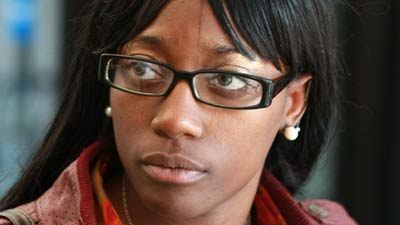
The first thing that strikes me when I see Tiawanda Moore is that she looks so very young. The second thing is that she reminds me of my cousin Fatime. She has the same fine features and beautiful dark skin. She is slight in build and is wearing glasses. Every black person in the U.S. has a sister, friend, cousin who looks just like Tiawanda Moore.


Yesterday when I saw and spoke with Tiawanda, I observed something more – her courage and dignity. For nearly two years, this young woman has endured so much. First she was sexually molested by a police officer and then when she sought out justice for this offense, she found herself in the clutches of the State’s Attorney charged with two class 1 felonies for eavesdropping facing up to 15 years in prison. Tiawanda Moore is brave.

Yet every single media story that I have read since she was acquitted of all charges yesterday either opens with the words “former stripper” or mentions this somewhere in the article. Radley Balko picks up on this in a blog post published yesterday. He writes:

One other thing. It’s a little odd that most media accounts of this case describe Moore as a “former stripper.” It’s actually the first three words in the Sun Times story. Maybe I’m wrong, but it’s hard to envision the article starting that way if Moore were a former nanny. Or school teacher. Or bus driver. So what’s the point? Even if Moore’s sexual assault allegation was the only newsworthy part of this story, the implication is that her former job is relevant to her allegation. Is the implication that strippers probably act provocatively even when they aren’t working—-indeed, even when they aren’t strippers anymore—and thus should expect unwanted sexual advances from cops? Is it that strippers are inherently untrustworthy? That they’re more likely to make false allegations of sexual assault? (If anything, I would suspect that strippers have built up a fair amount of tolerance for unwanted advances.)

But that of course isn’t why this story is in the news. It’s in the news because Moore became frustrated in her attempt to file a complaint, and so recorded what she thought were Chicago police officers’ attempts to rebuff her, and was consequently facing a felony charge and up to 15 years in prison. The validity of the allegation that set all of that into motion isn’t really at issue. (Indeed, the resolution of Moore’s complaint is apparently “sealed.” Which is a problem in and of itself.) So even if you buy into the fairly offensive notion that Moore’s former occupation calls her harassment allegation into doubt, the “former stripper” label is completely irrelevant to whether or not she should have been arrested and charged for recording the cops.

I would submit that it is not “odd” that Ms. Moore’s employment as a stripper is always foregrounded in the media coverage. Young black women are often portrayed as sexually promiscuous. This has a longstanding history. If you recall the Duke Lacrosse case, the alleged victim was also frequently described in media accounts as a “stripper.” In the Dominique Strauss-Khan case, Nafissatou Diallo was alleged to have been a prostitute. There is an inglorious history in the press of women who bring charges of sexual assault often being painted as sexually “loose” in some way. So Mr. Balko is not wrong to assume that if Ms. Moore had been a former teacher or nanny that this would not have been the opening statement in an article covering this trial.

There is something more to the press’s fixation on the fact that Ms. Moore worked as a stripper. This description of her is offered as a kind of shorthand. As though it suggests something about her character and perhaps should lead us to question her credibility. It’s as if this is the main thing that we ought to know about who Tiawanda Moore is.

Chris Drew, who himself is facing eavesdropping charges, has been a supporter of Ms. Moore. He attended both days of the trial and was present when the jury read its verdict yesterday. He wrote the following about Tiawanda in an e-mail blast that he sent out to his supporters:

Ms. Moore is twenty years old and very much still trying to discover herself in this world. The Tribune calls her a former stripper but she is first a young woman struggling to survive in a depressed economy. She is too young to have established a career out of anything yet. She has every right to expect justice from our system and she is a brave fighter for women’s rights. She stood up to the intimidation of Chicago police to lodge her complaint of sexual abuse. Anyone who listened to the testimony Tuesday and Wednesday at her trial knows that took a very brave spirit. We should expect more from the newspaper of record in reporting behind the scenes. They should examine in depth the way Cook County State’s Attorneys Office shields police misconduct.

She fought against a culture of intimidation other women of any background might face when they try to lodge a complaint against the Chicago Police for sexual misconduct. She won putting the Cook County State’s Attorney on notice that they should not be shielding police who violate citizen’s rights with malicious prosecutions of this type. Her win is a win for all women and all citizens who expect justice from Cook County. Her attorney argued that she was being intimidated out of her right to file a complaint by police who were breaking their own rules in doing so.

I teared up when I read this mainly because it is so TRUE. But also because I felt a sense of hope to read these words coming from a man who is so very different from Tiawanda Moore. Chris Drew is an older white man, an artist. He is someone who has already lived many years and it seems that in this case it has brought him wisdom. Tiawanda Moore is young, black, and very different in many other ways from Chris. Yet he can see through those differences to simply embrace Tiawanda’s humanity. It means that we have hope for transformation. While the media continues its relentless assault on the images of young black women in the U.S., on an individual level many (including Chris Drew) resist these portrayals.

Chris offers something else in his words about Tiawanda Moore. He provides a context within which a young black woman with limited opportunities finds a way to survive. Young women do what they have to do to survive. Chris forces his reader to consider stripping as a rational form of employment and dares us to judge Ms. Moore without having lived in her shoes. He is basically saying to us: she was a stripper, so what? He also frames her as a “fighter for women’s rights.” To me, that is the proper context within which to view Tiawanda Moore. What she did in standing up to the police and the state tells us more about her resilience and character than does her employment. Most of us are not primarily defined by where we work. We define ourselves mostly in relation to who we love. Perhaps we see ourselves first as mothers, sisters, spouses or friends. We define ourselves by the struggles that we join as organizers, citizens, activists. We define ourselves differently depending on the day or the context. These things are complicated rather than being straightforward. The media shies away from the complicated preferring black and white descriptions. So I offer them an easy description of Tiawanda Moore: Ms. Moore is BRAVE. Thanks Chris for giving voice to this!

Update: Here is a recap of what happened at the trial yesterday.

Aug 24 2011

Guest Post: Now that Tiawanda Moore is free, what lessons can we learn?

This is a post by my friend and often “partner in cahoots” Melissa Spatz about the Tiawanda Moore case. Melissa is the co-founder of the Chicago Taskforce on Violence against Girls and Young Women along with me. She is also the day-to-day coordinator of the Taskforce. Melissa is a long-time organizer, a lawyer and a writer based out of Chicago. This is cross-posted at the Taskforce blog. I am proud to publish it here at Prison Culture.

On August 18, 2010, Tiawanda Moore went to the Office of Internal Affairs to file a complaint, alleging that a police officer had sexually assaulted her. Getting the runaround from the officers at Internal Affairs, and feeling threatened and intimidated, she pulled out her Blackberry to get proof that they were refusing to help her file her claim. As many of you know by now, Ms. Moore was charged with “eavesdropping” on the police, a charge that can bring up to 15 years in jail.

Today, I’m so happy to announce, she was acquitted, and her nightmare is over.

But there are lessons to be learned from this, and changes that are needed, and I think it’s important that we take the time to think about what happened here, and what it says about the need for systemic reform.

I was in court today, along with my good friend and colleague Mariame Kaba and a small group of supporters. The closing arguments we heard spoke volumes about the injustice that this young woman – and I fear, young women in general – experience at the hands of the police and the states’ attorney.

“THEY WERE STALLING, INTIMIDATING HER, BULLYING HER NOT TO MAKE A COMPLAINT.”

Ms. Moore’s attorney, Robert Johnson, spoke eloquently about her experiences of injustice. His description of what had happened to Ms. Moore, based on the testimony and the tape itself, which had been played for the jury, filled in some of the details on her harrowing experience at Internal Affairs that you may not have heard.

First, he said, when she made the appointment, she was told to bring any witnesses who could support her allegations. She brought her boyfriend, but he was immediately told to go home or go to McDonald’s to wait for her; no interview was held. The police urged her not to file a complaint, insisting that the assaulting officer was “a good guy.” On the tape, there’s a promise that what happened to her will never happen again (proving, as Robert Johnson pointed out, that they believed that she had been assaulted). There’s the insistence that instead of filing a complaint, she should “go a different route.” (On cross examination, the officer admitted, correctly, that there is no other route for victims of police sexual harassment in the system.) And there’s the fact that when she became concerned and wanted to speak with another officer, the police locked the door and told her she could not leave.

Imagine how scary this experience must have been. Imagine the power dynamics in the room, of this 19-year old young woman trying to plead her case to two police officers, and getting this kind of response.

The only conclusion you can reach is the one Robert Johnson reached:

“The plan was to kill this complaint from the very beginning…. They were stalling, intimidating her, bullying her not to make a complaint.”

HERE WE GO AGAIN, FRAMING THE VICTIM AS THE PERPETRATOR

And what did the State have to say about what happened? Brace yourself, because here’s their theory.

Tiawanda Moore, they said, was on a “fishing expedition.” They alleged that this young woman came in all the way from Indiana, not because she had been assaulted by a police officer and wanted to make a complaint. No, the real reason according to the State was that she “wanted them to say the case was going nowhere. That’s what she wanted them to say.”

What? Didn’t she say on the tape itself that she’s concerned about how many other young women have been sexually assaulted by this officer? Absolutely, said the State, and that is just proof that she was “editorializing,” by which I suppose they meant she was trying to make her case for public consumption.

If this sounds crazy to you, like the world’s gone mad, consider the State’s conclusion as to the power dynamics at play when she went to file her claim. Is it the police that are in a position of power? No.

“It is her that is in control…. You can’t push Tiawanda Moore around, she’s not going to let you.”

After all, the State’s Attorney added, “What motive do the police have to protect this officer?”

“JUST ANOTHER DAY IN INTERNAL AFFAIRS”

Now that we can breathe a huge sigh of relief that Tiawanda Moore won’t be facing jail time for this travesty, I am left with a deep fear that what she experienced may in fact be, to quote the State’s Attorney, “just another day in Internal Affairs.”

The concerns raised by groups like the ACLU, and activists like Chris Drew, over the Eavesdropping Law are important and valid. Our avenue for defense against all types of abuse of power by law enforcement must be protected. Citizens should be able to record police abuse, and to use recordings to hold the police accountable for such abuse in court. Period.

Beyond that, though, let’s not lose focus on how the system failed this young woman at every level. It is important that we remember that Tiawanda Moore’s terrible experience with the system as a young woman survivor of violence was most likely not a fluke. Instead, her experience points to what young women are up against, and the need for systemic changes.

Young women in Chicago are at risk of sexual assault by the police. Tiawanda Moore is certainly not the only young woman to allege that she has been sexually assaulted by a police officer. In Chicago, and in other cities as well, young women have come forward to say that they have been assaulted by their local police officers. Here in Chicago, there have been rallies in support of survivors of police violence, and groups such as Women’s All Points Bulletin – whose director, Crista Noel, was present in court as well to support Tiawanda Moore today – are working to draw attention to these cases, and to provide crucial support for women.

And can we really believe, as the state alleges, that Internal Affairs is deeply committed to supporting survivors of police violence? Literature from Chicago Activists Against Police Sexual Assault, a new group that is holding rallies around the issue, quotes these statistics from a 2007 study by the Mandel Legal Aid Clinic at the University of Chicago.

  • The odds that a Chicago police officer charged with abuse will receive any form of meaningful discipline are 2 out of 1,000. But as the U.S. Dept. of Justice has found, only 1 in 10 citizens ever even report police abuse for fear of reprisal, and distrust of the investigatory process.
  • Between 2002 and 2004, 85% of abuse complaints were dismissed without ever interviewing the officer.
  • 75% of Chicago police officers with multiple charges of abuse never receive any discipline whatsoever
  • Brutality complaints are 94% less likely to be found as having sufficient evidence by the Chicago Police Department (CPD) than in the nation as a whole.

Yes, it does sound like what happened to Ms. Moore was what might be expected on any typical day.

And now we can add the State’s Attorney into the mix. For months, the Taskforce has called for the State’s Attorney to drop these ridiculous charges against Tiawanda Moore. They refused. Today’s closing arguments made it clear that the State’s Attorney cannot be relied upon to protect young women from police violence. The topsy turvy world view that was presented in court today – a world in which young women supposedly have power over the police – was startling and frankly, frightening.

We all have a lot of work to do if we are going to make Chicago safer for young women. Systems change at every level is called for. What are your thoughts about what needs to be done?

Aug 24 2011

The Trial(s) of Tiawanda Moore

Imagine that you are a 19 year old young black woman who is talking to a police officer in your home about a domestic disturbance and you find yourself being groped and sexually molested by that cop instead. For good measure before he leaves your home, he hands you his telephone number and tells you to call him. Imagine that you then decide to file a complaint against this same officer so you call the internal affairs bureau and share your story of sexual misconduct by the police with an intake officer. You answer countless questions and you are given a date one month later to come to the department to file an official complaint. You are told to bring your evidence and a witness so you make sure to do both. You drive down from Indiana where you now live to Chicago where the appointment is scheduled. Once you arrive at the station, you are told by officers that the witness, who happens to be your boyfriend, is not needed and that he should leave or go to McDonalds to “grab a cup of coffee.”

You are alone and two officers take you into a room where they proceed to ask you to recap what happened during the incident. The officers tell you that you might want to reconsider filing the complaint and that they might be able to “explore other routes” to address the issue. You start to feel uncomfortable when they inform you that they might have to come to your place of employment to interview you. You decide to ask if you can leave the room and you are told that you cannot. The police officers themselves leave the room and you decide at that point that it would be best if you turn on your phone to record the subsequent conversation…

This is what happened to Ms. Tiawanda Moore and today after months of delay the jury finally has her case and is deliberating her fate.

We arrived in room 308 at 9 am sharp this morning anticipating closing arguments in Ms. Moore’s case. To get a sense of the atmosphere of this courtroom, you can read this blog post about the last time that I was here. The atmosphere was unchanged this morning — it is still sterile, cold, with hospital lighting. I was there with my colleague and friend Melissa Spatz. Sitting behind us were Tiawanda Moore and her partner Marcus. We were later joined by supporters of Ms. Moore, Crista Noel and Chris Drew. For two hours, we watched a revolving door of young men of color appear before the judge. At 11 am. two hours after we had arrived, the jury filed in. There were 7 women and 6 men on the jury. 9 white people and 4 people of color. Once the jury was seated, the judge informed them about the schedule for the day. They would be sent right back to the jury room for lunch and return at 12:30 to listen to one rebuttal witness from the State and then closing arguments. We left to grab lunch and returned to the courtroom around 12:15.

During closing arguments, one of the Assistant State’s Attorneys, Ms. Malloy, argued that “it is illegal in Illinois to eavesdrop.” She suggested that the recording that jurors heard during the one-day trial was evidence of the fact that Ms. Moore did eavesdrop on the officers. She suggested that the officers were unaware that she was making this recording at the time and were only tipped off when they noticed the “bars” on her phone. She told the jury that the state must prove that:

1. the defendant knowingly used an eavesdropping device.
2. the defendant recorded a conversation without the consent of all parties.
3. the defendant recorded law enforcement officials while they were working in an official capacity.

If the state proved these three things during the trial, then Ms. Malloy told the jury that they must find Ms. Moore “Guilty” under the eavesdropping law. She told the jury that this was a “simple case” and that the jury instructions were “straightforward.” She ended with the following words: “The only just result is that you will find the defendant guilty of eavesdropping.”

Then it was Ms. Moore’s attorney, Robert Johnson’s turn. Mr. Johnson argued that under a section of the Illinois eavesdropping law, it was NOT a crime to record someone if you have “a reasonable suspicion that a crime might be in process.” He read the text of the statute to the jury:

“…under reasonable suspicion that another party to the conversation is committing, is about to commit, or has committed a criminal offense against the person or a member of his or her immediate household, and there is reason to believe that evidence of the criminal offense may be obtained by the recording;”

Mr. Johnson said that Tiawanda went to the department to report sexual misconduct by a police officer. Instead she was confronted by officers who suggested to her: “We should go a different route with this.” He convincingly argued that “the plan was to kill this complaint from the very beginning.” The officers were according to Mr. Johnson “stalling, intimidating her, bullying her not to make a complaint.” On the tape that was played during the trial, officers can be heard telling Ms. Moore: “We’re almost positive that it’s not going to happen again.” Mr. Johnson asked the jury to use their commonsense in asking why the officers would tell Ms. Moore such a thing if they (a) didn’t believe her claims and (b) hadn’t already reached out to the officer who was being accused prior to meeting with Moore (if this did happen it would be against the rules of IAB investigations). Mr. Johnson told the jury that Ms. Moore “is guilty of no crime” and that “it was reasonable for her to believe that they (the officers) were up to no good.”

Finally, another Assistant State’s Attorney, Ms. Murtaugh, got up to offer the State’s rebuttal to the defense’s closing argument. It is impossible for me to convey how surreal and insane the rebuttal provided by Ms. Murtaugh was. First, she was under 5 feet tall and had the highest pitched voice I have heard in a while. She literally bounced around as she gave her closing and was yelling at the jury. She began by saying that the “content of the tape is not the issue. The issue is that the words were taped.” By the time Ms. Murtaugh ended her tirade (and it really was a tirade), Tiawanda Moore had been accused of being a liar, of being “assertive”, of having gone to the police department on a “fishing expedition.” Jurors were told that the eavesdropping laws were essential to protect their privacy rights as citizens. She yelled pointing to the jury: “the eavesdropping law protects you.” Ms. Murtaugh admonished the jury not to “rush to judgement.” It was a truly stunning and unconvincing performance.

Now we wait for the verdict. A young woman’s life hangs in the balance. She was charged with two Class 1 felonies and if she is found guilty she can be sentenced to up to 15 years in prison. Tiawanda told us today that her birthday is October 5th. She is looking forward to turning 21. I hope that the jury sees fit to give her an early birthday present: a verdict of NOT GUILTY.

Update: Just got news that Tiawanda Moore was acquitted!!!!! Great news. Thanks to everyone who took an interest in her case. More later.

Here’s a local Channel 7 report on her acquittal today: