Aug 20 2011

George Jackson Was Killed 40 Years Ago Tomorrow…

Correction: Jackson was killed on August 21, 1971. I thought today was the 21st but it is actually the 20th.

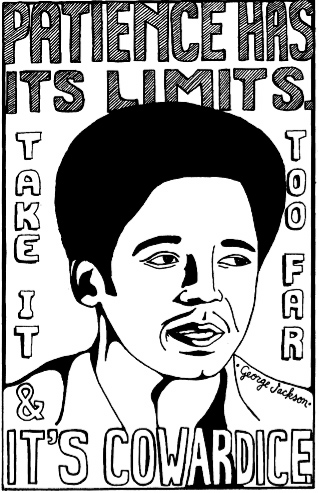
George Jackson may be one of the most well-known political prisoners in the U.S. His book, Soledad Brother, offered a powerful analysis of the American prison system and was declared contraband when it was published. It still made its way into the hands of many prisoners including some of the leaders of the Attica uprising. He was killed by guards at San Quentin prison 40 years ago today allegedly during an escape attempt. No one believes that he was actually trying to escape.

The following program by the Freedom Archives does a terrific job of recapping the life and significance of Jackson. I recommend it highly.

George Jackson – 40 year commemoration from Freedom Archives on Vimeo.

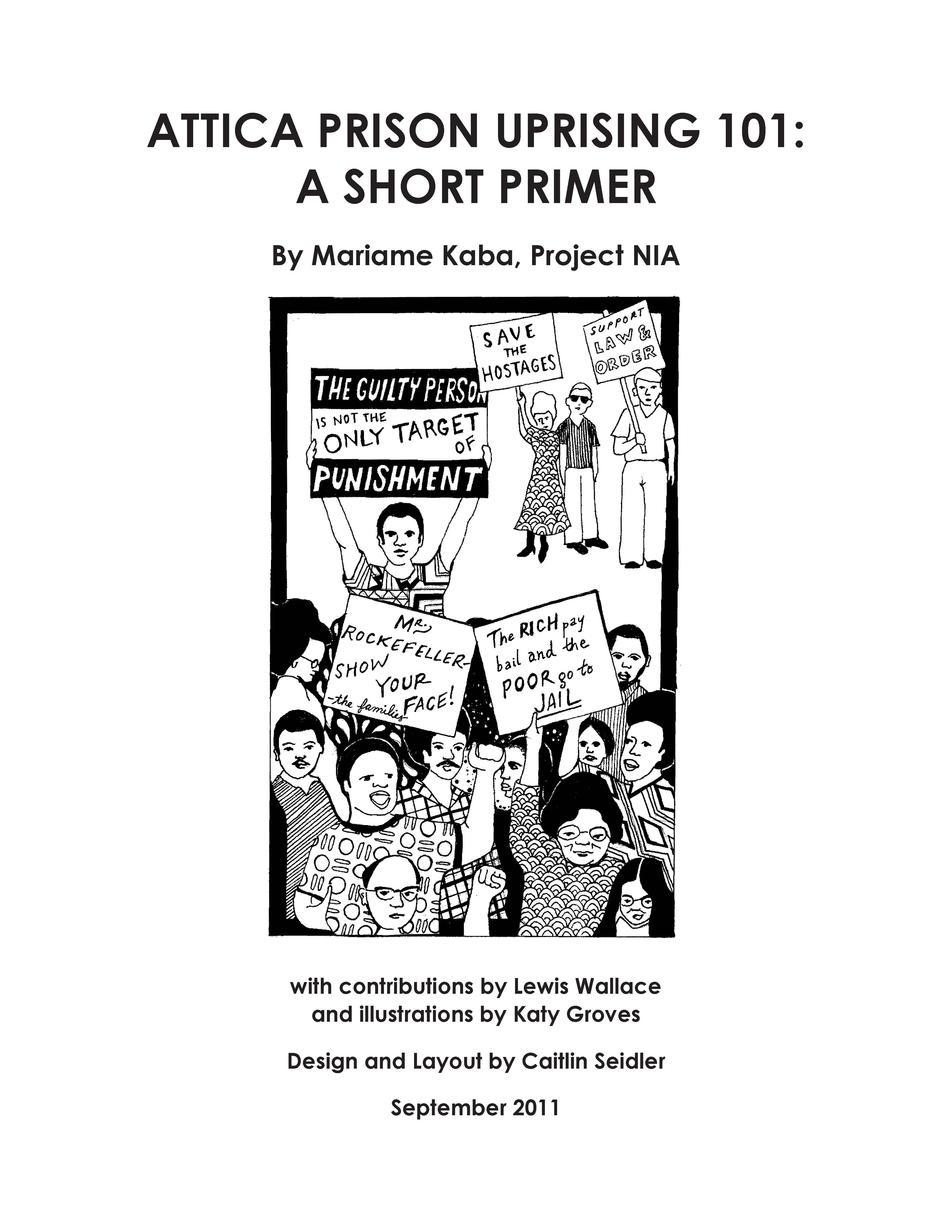
** Note the image of Jackson in this post was created by my friend Katy Groves for the Attica Prison Uprising Short Primer that we just released this week. You can see more of Katy’s illustrations about Attica in the appendix to the primer here.

Aug 19 2011

Coming this September: Criminalizing 12-Year Olds in Chicago For Enjoying Fresh Air at Night

The Mayor of Chicago and our city council took time away from actually creating jobs for the people to approve without debate a new citywide curfew ordinance for youth ages 12 and under.

From the Huffington Post:

Unsupervised minors aged 12 and younger will now need to be in their homes by 8:30 p.m. on weekdays and by 9 p.m. on the weekends in order to avoid a fine of up to $500 or community service. Three offenses within a one-year period will be subjected to a $1,500 fine in addition to community service

At a time in Chicago when parents/guardians who are lucky enough to have employment have to work two jobs just to survive, the politicians in this city are basically levying another tax on families. How many 11 year olds in Chicago are responsible for basically caring for their younger siblings? Thousands. Yet if these same young people are outside of their homes “unsupervised” then they are subject to arrest and fines now? This is perverse and disgusting.

Here’s a quote from our dumb mayor on the new ordinance:

“I advocated for curfew laws while serving President Clinton because I believe the safest place for a child is at home,” Emanuel said. “I commend the aldermen for getting this ordinance passed. This is another tool that will help fight crime and help children from becoming victims of crime.”

Infuriating and so uninformed. Actually, Mr. Mayor, the LEAST safe place for children in America is the home. You can actually just go to the Department of Justice website to review the data from their national survey of children's exposure to violence. Children are overwhelmingly victimized, assaulted, and harmed by ADULTS who they know and most often at HOME. Those are the facts. Any attempt to address so-called youth violence ought to begin by addressing ourselves to the adults who perpetrate violence AGAINST young people.

This new ordinance purportedly is intended to “protect children.” How completely ridiculous… In fact, the actual empirical evidence DOES NOT support the assumption that curfews have any effect on youth violence or crime.

Instead of passing symbolic ordinances, our city council should have been busy finding funds to support the 3,000 summer jobs that were lost from last year. We should be organizing to throw all of these elected officials out of office as soon as possible.

Note: NPR just did a a story about whether curfews are actually effective or whether they are just another form of racial profiling.

Aug 17 2011

New Resource: Attica Prison Uprising 101 – A Short Primer


This publication about the Attica Prison uprising of 1971 is not intended to be a curriculum guide, but a brief primer for educators and organizers. It includes a timeline of events (with primary sources); testimonies from Attica prisoners; poetry by Attica prisoners; sample activities for youth; and other suggested resources.


We do not claim to have addressed all of the complexity of the rebellion in this short document. This is by no means intended to be the definitive word about the context and meaning(s) of the rebellion. We simply offer this resource as another in the long line of publications that have been produced about the Attica uprising. We do so knowing that we will omit a lot important information. This is unavoidable.

We had been looking for exactly this type of resource to foster our own popular education efforts and activism on the occasion of the 40th anniversary of the Attica rebellion. We didn’t find anything that quite worked so we took it upon ourselves to create what would be useful for us. A core value of ours is to share information with others in order to facilitate movement-building to eradicate incarceration. As such, we share this resource with you.

This primer was produced by organizers and educators rather than by historians. While we tried to be objective, we are not neutral. We state this unabashedly and honestly. We sincerely hope that this material is useful to you if you plan to discuss the Attica uprising with your students, community members, and others. We encourage others in the future to add to our collective knowledge about the Attica Rebellion and its legacy.

Finally, we invite you to freely reproduce and distribute this primer. We ask that it be disseminated at no cost and that Project NIA be acknowledged as producing this resource. We love hearing from folks about how they have used our resources so make sure to drop us a line at [email protected].

Download the Attica Prison Uprising Short Primer Here

Download the Attica Prison Uprising 101 Illustrations Appedix Here

Special thanks to the following people who contributed to making this primer a reality…

Caitlin Seidler has once again lent her considerable talents to designing and laying out this resource. Caitlin’s commitment to social justice is unrivaled and she has our deepest gratitude.

Lewis Wallace has been integral to the development of our work at Project NIA. He is a terrific organizer who is committed to the abolishment of prisons. We would like to thank Lewis for all of his contributions to this project.

Katy Groves is a fierce advocate and ally to youth in conflict with the law. She is tireless in the struggle for criminal legal reform. Our thanks to Katy for her incredible illustrations.

Finally, this primer is dedicated to the memory of all who died at Attica, we will not forget.

Note: Please join us for a series of events about the Attica Prison Uprising this September.

P.S. Look out [in the next couple of weeks] for an Attica Prison Uprising Zine that we are creating along with our friends Lewis Wallace and Micah Bazant specifically for an upcoming event in September. It will be available for downloading.

Aug 16 2011

Guest Post: Violence, Healing, and Transforming Justice

This is a guest post by my friend of longstanding Dr. Ann Russo.  Ann is a professor in the gender and women’s studies program at Depaul University.  She was formerly the director of that program and has now founded a new project called “Building Communities, Ending Violence” at Depaul. “Building Communities” uses peacemaking circles and safety labs to address violence. Special thanks to Ann for writing this excellent post.

__________________________________________________________________________

In the last month, I’ve read a few inspiring stories about people who, in the aftermath of violence, seek understanding, forgiveness, compassion, and social change, rather than vengeance, hatred and more violence.  One is the story of Rais Bhuiyan, a Muslim immigrant from Bangladesh, who was organizing to stop the execution of Mark Anthony Stroman, a white man on death row, who had attempted to kill him in 2001.  Stroman had shot Bhuiyan after having killed at least two others — Vasudev Patel, an immigrant Hindu man from India, and Waqar Hasan, a Muslim immigrant man from Pakistan.  Stroman saw himself as taking revenge for the attacks of 9/11.  Bhuiyan protested the use of the death penalty as a method to resolve the hatred, pain, and harm caused by Stroman.  In 2010, he created a website group, “World Without Hate,” as part of a petition campaign to save Stroman’s life.  Despite 12,000 signatures, Stroman was executed this past July 20.  Bhuiyan sought to forgive him with the understanding that his violence came out of ignorance, and to make a stand that killing someone is not the way to end violence.  When asked why, he responded,

“I was raised very well by my parents and teachers.… They taught me to put yourself in others’ shoes. Even if they hurt you, don’t take revenge. Forgive them. Move on. It will bring something good to you and them. My Islamic faith teaches me this too. … After it happened I was just simply struggling to survive in this country. I decided that forgiveness was not enough. That what he did was out of ignorance. I decided I had to do something to save this person’s life. That killing someone in Dallas is not an answer for what happened on Sept. 11.”

On his website, he writes, “hate only brings fear, misery, resentment and disaster into human lives. It creates obstacles to healthy human growth, which, in turn, diminishes society as a whole.”

This is one among many stories of people impacted by violence who, contrary to popular opinion, do not seek revenge.  They recognize that more violence does not create peace, and that the roots of the violence are much deeper than the individual acts.  Another story I found compelling is that of Marietta Jaeger-Lane who found herself with conflicted feelings of revenge and forgiveness in response to the man who kidnapped and murdered her daughter.  Her shift from rage to forgiveness was one based on her faith and values; she reflects that “however I felt about this person, in the eyes of the God I believed in, he was just as precious as my little girl.”  Interestingly, almost one year later, the man who kidnapped and killed her daughter called “to taunt her.” Because of the spiritual work she had done, she found herself responding to him from a feeling of  “genuine concern and compassion.”  As this “thwarted his intention to rile me up and then hang up.  . . .  . I asked him what I could do for him; he broke down and sobbed heavily. Our middle-of-the-night conversation lasted for 80 minutes. When the call finally ended, I was left hanging on to a silent phone.”  She has since become a strong voice against the death penalty.

These stories remind me of a story that Thich Nhat Hanh tells in his book, Being Peace (1987), about the many boat people, refugees fleeing Vietnam, who die striving to arrive at the shores of Southeast Asia.  Many young girls are raped by sea pirates in this context.  After hearing about one story of a twelve-year-old girl who “jumped into the ocean and drowned herself” after being raped, Hanh reflects on our inclination to only take the side of the young girl, and to want to kill or take revenge on the sea pirate.    He asks us to reconsider:

“If you take the side of the little girl, then it is easy. You only have to take a gun and shoot the pirate. But we cannot do that. In my meditation I saw that if I had been born in the village of the pirate and raised in the same conditions as he was, I am now the pirate. There is a great likelihood that I would become a pirate. I cannot condemn myself so easily. In my meditation, I saw that many babies are born along the Gulf of Siam, hundreds every day, and if we educators, social workers, politicians, and others do not do something about the situation, in 25 years a number of them will become sea pirates. That is certain. If you or I were born today in those fishing villages, we might become sea pirates in 25 years. If you take a gun and shoot the pirate, you shoot all of us, because all of us are to some extent responsible for this state of affairs.” (60-61)

Hanh reminds me that in creating a peaceful world, we must seek to stand in the shoes of those committing violence in the hopes that we might understand and change the conditions that underlie it.  No one is born a rapist or a murderer.  The question we must consider, then, is what are the social conditions and structures that underlie the violence in this society? And how can we contribute to changing these conditions. Bhuiyan, for instance, felt that Stroman’s violence came out of ignorance about Muslims and Arab peoples connected to the broader post 9/11 social context.  What is needed, then, is to address this ignorance through relationship-building and education, not more violence.  This does not mean taking away responsibility from the person(s) who commit violent acts; it does mean, asking why this violence happens, examining the conditions that perpetuate it, reflecting on how we ourselves might be contributing to these conditions, and then participating in transforming the roots of violence so that rape and violence are no longer imaginable.

Reflecting on these issues takes me back to a class I taught on violence against women in the late 1980s.   I had a young white man in my class who was relentless in his critique of feminism for not considering men’s perspectives, and who expressed venomous blame against women survivors of sexual assault.  As an adjunct teacher with little experience, I didn’t know what to do.  I was afraid to kick him out because of my precarious status at the university, and yet his behavior felt like its own form of violence against women.  At the last session of the class, after he berated me and the other members of the class for the final time, I asked him to stay after class with the plan to confront him.

He stayed after the class and began to pour out his anger.  I decided to listen first without interruption, rather than engage in a back and forth.  Within just a few minutes, we found ourselves sitting down as he began to tell me about being sexually abused when he was a child, the impact on him, his anger at himself, and his inability to talk about it.  He talked of the desire to commit suicide, of his self hatred and of his painful despair.  I cannot remember the full conversation, but at the end, we talked about strategies to cope with these feelings and I offered a few resources in the area for male survivors of sexual abuse.

I’m not excusing his behavior, and yet, through listening, an opportunity opened for a shift in the dynamics governing our relationship. I was able to hear more about the locus of his anger and hostility – the isolation, the pain, the self-blame he was carrying and for which he was seeking some relief, and he was able to see that I was not his enemy.  I also came to realize that I had also played a part in contributing to his isolation, pain, and anger, given the lack of attention in my class and in the broader antiviolence movement to the realities and devastating harms of sexualized violence against boys and men and its impact on all of our lives.  This experience taught me the importance of listening to anger and hostility to see what underlies it.  Refusing the compulsion to seek retribution requires each of us to understand the roots of violence in the social conditions of our lives, rather than solely in individuals; from Bhuiyan’s perspective, to “hate the sin, but not the sinner” and then to go further to address what underlies these acts.  With such an understanding we have a better chance of ending violence, rather than simply perpetuating and fueling it.

Aug 15 2011

Guest Post: Fieldnotes from la casa del Diablo

This is a guest post from my friend Dr. Laurie Schaffner. Laurie is a professor of Sociology with appointments in the gender and women studies program as well as the criminal justice program at the University of Illinois at Chicago. Laurie is the author of the excellent book “Girls in Trouble with the Law” and many other publications. She also serves as an adviser and ally to Girl Talk.

I thank Laurie for sharing her notes with Prison Culture.
__________________________________________________________________________

Since 2007, I have been spending time with folks involved in the juvenile legal system and the broader youth advocacy movement in Guadalajara, Jalisco, Mexico. In 2006, the state congress of Jalisco passed a new reform law. The idea of the change was to move from a paternalistic tutelage approach to infusing the system with a more transnational children’s rights perspective. At that time, I was curious to see how this new approach would come about. Interestingly, but not unpredictably, it was not working smoothly for either the traditionalists working with youth who were convinced that young people who commit crimes should be punished and rehabilitated, or us youth advocates who were persuaded that the legal system should not be utilized at all when addressing the social problem of vulnerable youth in crisis.

What follows are raw field notes. Field notes are a tool of witness that people, such as academics and poets and activists, use when they want to write down what they see when people are doing what we do—working, living, learning—what we do “on the ground,” “in real life.” They are useful to use later as “data” – to analyze and make claims about injustice or social trends, or to provide details for fiction and history.

I use //// to parenthize my own private thoughts, musings, things-to-do notes and the like. All field notes are only slightly edited, and I provide no interpretation. I will leave the analysis (your impressions) up to you at this point of the project.

I go back and forth from Spanish to English with no translation. I hope this is not too much of a challenge for readers. It can take years to learn each other’s languages, but often a brave and fruitful endeavor. Sometimes I find books that go into a French quote or reference in the middle of the page and get pretty irritated but it makes me realize how monolingual I am and that the norm in the rest of the world is to easily glide back and forth among several languages.

Thanks to William Schaffner and Memo Konrad for giving me good suggestions. May Betty Foster rest in peace, and a big huge welcome to Aleeya in the family!

* * *
21 enero 2008 01 Ninas en conflicto con la ley El Tutelar
1600 hours to 2200 hours

Image 1. My co-investigadora

Youth advocate and co-investigator Maria de Socorro de la Mora Carnalla

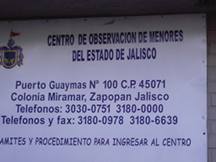
Coco and I went to meet the Director of the short-term detention facility for youth located in Guadalajara, known as el Tutelar. At that time, it was Licenciado Sergio Saavedra Medina, Director of the Tutelar, (according to his tarjeta: Director del Centro de Observacion, Clasificacion, y Diagnostico del Estado), which is actually (since the law changed) the Diagnostic Center.

Image 2. The exact name and address of el Tutelar
We decided our primary mission for this visit was multiple, but not exhaustive:
• To figure out where it was and what it was
• To introduce ourselves
• To get some basic information, such as, how many girls are there, and for how long?
• To find out what programs they are offered
• To figure out how we could participate in what is ongoing.

Coco and I met in Juarez Park in central Guadalajara to take a bus to the Tutelar (Ruta 633) /// which I realize stops like two blocks from my house///

We were both dressed a little more formally than for street outreach work with youth and it took like an hour to get there. Actually it didn’t really get there, it dropped us off and we had to walk about six long blocks before we found it.

The Tutelar is a huge multi city-block facility, walled off by one chain-link fence topped with shiny new barbed wire, the kind with little knives in it ///find out later it is called razor wire/// at the street level. About ten feet in from that first fence is another brick wall topped with barbed wire as well. Like most penal structures, it looks as if you couldn’t escape without inside assistance.

Image 3. A sign on the perimeter of el Tutelar
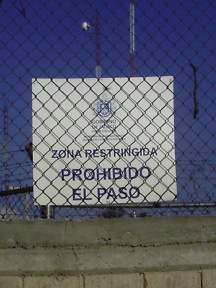
Also similar to detention centers world-wide, el Tutelar is set apart from residential and commercial activity on purpose—juvenile delinquents, out of sight-out of mind. There is a huge sort of warehouse, parking, storage space for ///el ayuntamiento? /// bordering on one side (Calle Puerto Guaymas) and what I thought was Periferico Sur on another. We didn’t circle the entire structure because it was so large, the street was all torn up, and we didn’t really have time.

That was because, although we arrived on time at 1600 hours for our appt, the Director had been “called away on an emergency.” The clerk called him up and told him we were there and then she said he was “on his way and would arrive in approximately one half hour.”

///which didn’t make sense—if he’d been called away on an emergency, wouldn’t he just not have been available?///

We decided to walk around the perimeter during the wait, but the Tutelar is too large to circumambulate ///circumnavigate?/// in one half hour.

Before we departed, we photographed the wall of announcements in the “lobby,” especially one obviously (?) made by a youth warning other “sexually active youth” to get tested for AIDS (see photos).

Image 4. Rules for entering the detention center.
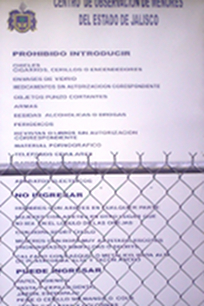
Hard to read, but the list of rules for what you can and cannot bring into the juvenile facility includes don’t bring in chewing gum, candy, weapons, pornography, alcoholic beverages, glass containers, sharp items; don’t wear platform shoes, (for men: earrings in any part of your body; for girls and women only: don’t wear earrings anywhere but in your earlobes, skintight clothing, shorts, miniskirts,) “ropa sport cholo;” however, you can bring in toilet paper.

Image 5. More rules for entering el Tutelar
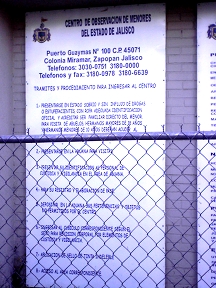
These images, obviously not taken by a professional photographer (taken by me, actually) are difficult to read in this reproduction. More rules here include orders to present yourself sober and not under the influence of any mind-altering substances, with appropriate clothing, identification, and proof or your relationship to the minor in detention. The other rules are bureaucratic in nature: secure proper permission for the visit, your papers must have the proper seals and stamps in ink, and the like.

Image 6. Sign made by youth in lobby of el Tutelar
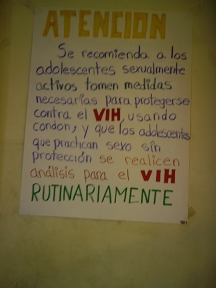
I liked this sign because it looked like maybe the youth made it.

First of all, of course, you have to speak to an armed guard, give him your paperwork, and (hopefully) get “buzzed in. Hopefully, because any visitor can be refused entry at any time for any arbitrary reason, unless you have a written order from your boss’ boss.

A small room, maybe 8 feet by 10 feet, the lobby at the Tutelar Is equipped with a huge Coca Cola machine, a bulletin board, and 4 chairs. As we were waiting initially, a group of people ///a family?///came walking in.

One man seemed about 50 years old and had long black curly hair, old ill-fitting jeans, and a kind of starter jacket—old, turquoise and black parachute silk material. I sort of thought he seemed like a Mexican hippy from back in the day. Of the four persons, he carried himself as the most entitled, not hunched, tentative, or humble. He spoke last, double-checking information in a clear voice. The woman/mother of the detainee spoke first, “Disculpe, podemos traer una cobija para //nuestro hijo///couldn’t hear exactly how she said it///

The mother appeared as a 30-ish senora with slacks, sweater, nothing matching, working class or poor, black ponytail. Her daughter //detainee’s girlfriend?// was dressed straight from the Saturday Calle Javier Mina tianguis—skintight jeans, large sneakers, babydoll t-shirt, après-ski jacket (baby doll, fake down, furry-lined hood), hair in ponytail, black eye-makeup. The third person was an older man, maybe grandfather. Several questions and answers were exchanged, something like this:

MOTHER: Podemos traer cobija aqui para el detinido? Podemos traer ropa tambien?

CLERK: Les dan cobijas y comida. Puede traer ropa, pero no mezclilla, color negro, azul, ///I can’t remember what other colors exactly, but there were definite colors not permitted//

DAUGHTER: Ah, yo se, tenemos aquellos pantalones cafes podemos llevarle.
HIPPY/OLD SCHOOL MAN (FATHER?): Hasta que horas estan abiertos? Cuando abren? Todos los dias? Aqui dejamos la ropa?

///I was thinking, how pathetic and unfair—they worry about bringing blankets, clothes, and food to their detained children. Probably the young person told them during visiting hours, “It’s FREEZING in here at night and I haven’t changed my socks in two weeks.” He probably told them he’s hungry all the time. Then I was remembering when Raul stabbed Aunt Margaret in Cuernavaca in 1976, how we had to bring sheets, blankets, nightgown, and food to her in the Red Cross. Same deal with Daddy in the carcel in Guatemala City///

El Lic. shows up and invites us into his office and begins to inform us of who he is and what happens here in el Tutelar.

This is a Centro Diagnostico, not a long-term facility, so the youth stay “only” 90 days while they are “diagnosed” and it is decided where they should go (home? La Granja ? (which is the long term facility).

The Tutelar, as it is still called, has 288 beds. The youth residents’ areas are formed into what everybody called modulars. Each of the 8 modulars has its dormitorio with 36 beds, bathrooms, cocina y sala; and, apparently, their DVD and television. Module 2 is for girls, Modules 3-4 are for “internos adolescentes libres—6 meses” which are youth that can come and go somehow. Modules 5-9 are for boys.

At that time, there were five girls assigned to this Centro Diagnostico, but one was away in the hospital porque ella dio luz. She will return with her baby. There were a total of 151 boys at the time of this visit (but the numbers changed throughout the interview—more about that later).

We asked, “Where are all the girls at? There are only five girls in the Guadalajara area in detention?” We were informed that “all the girls are at La Granja.”

El director emphasized that all youth can meet with the Director (himself) at any time. He seemed proud or wanted to have it be known that “his door is always open” ///which of course made me immediately think that he never allows anyone in there///

Next, we were told that there is a chronograma de actividades that includes obras de teatro, futbol, actividades de artes and culturales, and deportivas

I remember (we were both writing fast and furious during the interview) he ran down this daily schedule that was like, get up, bathe, make beds, have breakfast, go to school, recreation, can bathe again, TV, dinner, groups, sleep.

///As soon as he said that the youth can bathe twice a day, I thought to myself, “This guy has no idea what he’s talking about or what goes on here”///

We are told that the groups that come in regularly include Alcoholics Anonymous and religious visitors.

The youth are separated by various classifications that include edad, sexo, aptitudes, actitudes, y antecedentes.

Each youth has a team assigned to him/her: psychology, social work, teacher, and a preceptor tecnico who accompanies, orients, and guides the young person through the system experience.

They all have access to doctors—medical, psychological, and psychiatric.

He said that 90 percent of the youth are here for “el robo.”

Sounds great! ///NOT/// He made it seem like a pretty nice place with great people.

Image 7. Workers taking a break
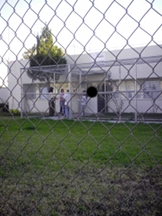
Then he said there was no way we could get a tour of the residents’ units/modulars, observe a program, or meet with any staff.

* * *
8 May 2008
After meeting with his boss’ boss, we return for the royal treatment with a complete tour and access to every inch of the Tutelar at our disposal. Here are abridged notes from that first day on the inside.

It is HOT! A sweltering, go anywhere you can find air conditioning or be in a pool kind of day, the luxuries very few Tapatios can actually enjoy. Trying to beat the heat, we show up at about 0800 hrs.

We are directed to another person, a woman, Director of a Sub-division, Facilities Management. She graciously takes us through the process of leaving all our bags, going through security alarm systems guarded by people with guns (which also included being in a private room with a woman guard who “pats you down”) and sort of opens to another door which deposits you at the beginning of a long walkway leading to the modulars and other buildings.

We asked to see the school, so we began there. The school consisted of about three cinder-block structures, approximately 15 feet by 20 feet each, with open air “windows” built into the brick walls.

A) it was HOT! The schoolrooms felt like kilns inside.
B) There was nothing but some chairs and tables, a few (broken down?) old computers, a library that consisted of about 20 books and a primary school curriculum
C) There were no youth anywhere in any classroom

///I believe the Mexican Constitution requires free mandatory public education for all Mexican citizens—check this////

The “teacher” seemed like a sweet little old lady, she explained that they had no books or curriculum, that the majority of boys could not yet read, most of the boys “just slept in and played futbol or went to job training,” and she was about to retire.

We move on to see the main kitchen where the meal are prepared, we tour the workshop areas where boys are learning to repair things—old broken down stoves, bicycles, refrigerators ///there was actually a whole room full of broken shit for them to learn on/// met with the social work department, the medical center, the legal department, the counseling department, and much more. …

We have pages of notes detailing this ethnographic and interview data, but for this short entry I wanted to share one particular observation that has haunted me for years.

As we are walking through the modular living units, I ask, “What about the gay, lesbian, bisexual, transgender, transitioning youth? What policies and procedures do you have in place to guarantee their rights and freedoms?” ///We had already requested a copy of the Policy and Procedures Manual///of course, one was never produced for us.

We were informed that there were no homosexuals here and that that kind of behavior was not permitted.

We continued our tour of the living spaces and began our tour of the medical facilities. We met one young man laying in a bed with a stomach ache, and another in a chair in the hall with a headache. We go through one room and into the next room that has six beds, six boys, all decorated with flowery blankets, lots of stuffed animals and clothes of shiny or flowery fabric strewn about, and a TV blaring. Six young boys look up at us in surprise and curiosity—all wearing make-up, skirts, dresses, doing each other’s hair, looking quite comfortable, actually. Relaxed, talking, comraderie, laughter were my first impressions.

I think I was as astonished as they were. I know our tour guide was taking aback, I think she forgot that they were here. All I could think was, “How could you tell us in one breath that there are no sexual subordinate groups here and then walk us through this module?” Then, of course, I realized they were housed in the medical modular and became worried for their emotional and psychological well-being.

Pues, ni modo, the tour continued on, and as all good research goes, one is left with more questions than which they began…
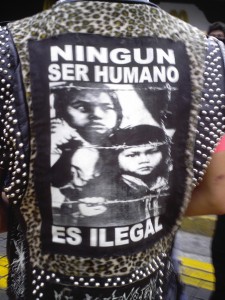
Image of a youth protester at a rally in Guadaljara
Aug 13 2011

Time Was Spent by James Shields

Addendum: I initially only published a part of this poem. So sorry about that. I was in the midst of my sporadic posting at the time. Here is the whole poem.

My name is James Shields. I was born in Winston-Salem, North Carolina, November 7, 1945, came to Massachusetts at the age of twelve. I settled in the Roxbury section with my mother, three sisters, and three brothers. I attended various schools in Roxbury.

I left school to acquire a job to support myself because my mother was unable to get things I desired, so I became a dropout. But soon I learned that I would need more than ambition and strong desire to work. I was in desperate need of more education in order to live a life of comfort as well as pleasure.

I became interested in writing because I saw a field through which I could present my ideas so that those who may be at the point that I was when I made the wrong decision in my life-style may become conscious through my written thoughts.

I believe the thoughts of the “new-breed writers” will increase the positive productivity of our public, moving them progressively forward. I say: We all as people have something to say. Let’s open the ears of our minds, because the liberation of our souls comes from knowledge we intake through the ears of our minds…On!

Time Was Spent
By James Shields

Time was spent wondering what the outcome of the trial would be,
and if in this court of the humane society,
can there be justice for me?

Time was spent in a cell with rats and roaches, with cracks in the wall.
In my face at night, the loose paint from the ceiling,
in my face it would fall.

Time was spent talking to brothers who had been kidnapped from society
to pay an unjustified penalty;
brothers who had fought hard in the war –
not for capitalistic gain,
but for what they believed to be their country.

Time was spent writing letters to people across the country
to aid me in this bid for freedom from this iron hell.
But aid came to me not, turning my mind into a piece of steel,
my blood into lead, my heart hollow with hate deeper
than a well.

Time was spent watching my brothers chained together,
sometimes ten in a straight line,
with looks of depression on their faces…
and hopelessness took over their minds.

Time was spent witnessing the funky judge’s giving out
to my brothers ridiculous time,
and watching them pimping lawyers
crossing them out of every dime.

Time was spent cursing loud, cursing hot, cursing strong and cursing heavy,
my blood filled with hate.
I never knew that I was a part of an inhuman practice;
I regret my vision came late.

Time was spent watching black women being left menless,
black mothers being left sonless,
black children being left fatherless,
time after time after time.

Time was spent trying to keep my family together,
while being behind a wall;
but they too were prisoners —
we were only experiencing different faiths, that’s all.

Time was spent stressing the importance of unity to my black woman in this situation of involuntary exile,
hoping she would not choose before I had a chance to
orient her on how to accept my new life-style.

Time was spent with my body hard nights, and extending into the mornings,
paining with ungratified passions
then comes the sound of the keys turning in my brain,
where my freedom AWAITS.

Yes, time was spent.

Aug 10 2011

Two Takes on Violence in Chicago: One from Kanye West and the Other from “the Interrupters”

Kanye West and Jay Z released their new collaborative music project this week. I downloaded the CD from itunes and I won’t offer my review because I don’t really think it matters. However, I did find one track titled “Murder to Excellence” particularly noteworthy. The song addresses “black-on-black crime” specifically murder and also makes reference to police brutality by focusing on the case of Danroy Henry.

As someone who laments the fact that mainstream rappers tend to avoid consequential topics like the prison industrial complex, structural racism, and sexism, I really should be happy that “Murder to Excellence” exists. Yet I instead find myself profoundly unsatisfied and even slightly depressed. Here’s one verse by Kanye that references Chicago’s homicide rate:

And I’m from the murder capital where they murder for capital
Heard about at least three killings this afternoon
Looking at the news like “damn! I was just with him after school”
No shop class but half the school got a tool
And “I could die any day”-type attitude
Plus his little brother got shot repping his avenue
It’s time for us to stop and redefine black power
41 souls murdered in fifty hours

Do you know what came to mind when I heard these lyrics? I thought this is “Self-Destruction” circa 1989 except immeasurably less conscious or sincere. For those of you who remember when that song was released in the late 1980s, we were two years away from the New Jack City era and the rappers involved in creating and releasing that track had the good judgement to call themselves the “Stop the Violence Movement.” We at least had a sense then that there was a community of like-minded people who were lending their voices and energy to the effort to curb community violence. No one really believed that a song would “stop the violence” but it did offer a rallying moment.

Here’s another Kanye verse from “Murder to Excellence:”

Is it genocide? Cause I can still hear his mama cry
Know the family traumatized, shots left holes in his face about piranha-sized
The old pastor closed the cold casket
And said the church ain’t got enough room for all the tombs
It’s a war going on outside we ain’t safe from
I feel the pain in my city wherever I go
314 soldiers died in Iraq, 509 died in Chicago

This verse provides a description of the violence that some communities in Chicago experience. I appreciate that it’s not Kanye or Jay Z’s role to necessarily offer any solutions or deep insights into the root causes of this interpersonal violence. I really do get that. This should ideally be a role that social scientists fill. Yet we have a stunning lack of public intellectuals in our culture who can translate academic research for the general public. So I find myself actively longing for others to step into this void. I wish that rappers could move beyond description and offer more analysis. This is desperately needed and could serve as an invaluable form of popular education. I know that it is unfair of me to ask rappers to do this when people with PhDs can’t.

Coincidentally, this week is also the premiere here in Chicago of a new critically-acclaimed documentary by Steve James called “The Interrupters. I have previewed clips from the film here over the past few months. I saw an unfinished cut of the film back in December when it was over 3 hours long. I then spent a day with other community organizers and activists providing feedback to the director James and the producer Alex Kotlowitz.

The documentary follows three violence interrupters from a local Chicago organization called Cease Fire as they try to prevent shootings in communities across the city [note: I have several critiques of the Cease Fire model which I will not address here today]. It is a film that asks how we can dramatically reduce homicides in American inner cities. The film is engrossing primarily because of the stories that it tells about both the interrupters (who are amazing people) and about the people who they try to engage. It also allows you to act as a fly on the wall observing (from a safe distance) parts of Chicago that most people ignore. The film is getting terrific reviews and as a work of art these are well-deserved. However, I have to admit that as someone who works daily to uproot violence, the film falls short for me. And you know what? There is nothing that the filmmakers could have done to change that. They were making a film about public interpersonal violence and in this they did a masterful job. The film that I want to see though is one about structural oppression and the role that the state plays as the chief purveyor of violence in our country and beyond. You can see then why the Interrupters could never truly satisfy me.

I am the wrong audience for both the film and the song because I want them both to do what they were not intended to do. Neither deeply examines and foregrounds the root causes of violence. And frankly, it is too much to expect that they could. It isn’t necessarily the role of artists to provide analysis or to engage the larger contexts within which their art lives. But again, I feel that our times need this context and this analysis desperately if we are to uproot oppression and create a “just” society. We need some films and songs about how we will “interrupt” structural oppression.

Earlier this year, in January, I wrote a post about my frustrations with respect to our endless “national conversations” about violence. I titled it “Everybody wants me to talk about violence but no one wants to hear what I have to say.” In that post, I suggested:

Yet what is always missed in the countless “national conversations” and recriminations that take place after such tragedies are perspective and honesty. The root cause of violence in the U.S. and across the world is oppression. Frederick Douglass famously wrote:

Where justice is denied, where poverty is enforced, where ignorance prevails, and where one class is made to feel that society is organized in a conspiracy to oppress, rob, and degrade them, neither persons nor property will be safe.

There it is. In one sentence. Clearly articulated. Eloquent. Easy to understand. And yet we ignore the truth and the wisdom of these words every day. We do so because it is easier to focus on quick fixes and band-aid solutions that will not disrupt the status quo and will not challenge the powerful. It is a sick game of willful ignorance.

If 50 youth under the age of 18 years old are killed by gun violence a year in Chicago, what about the 30% of youth under 18 who are living under the poverty line this year. Is poverty not violence?

What about the over 2200 youth in Illinois who are currently incarcerated in our juvenile prisons. Is youth incarceration not violence?

What about the thousands of youth in Chicago who drop out of school every year. Is educational malpractice not violence?

As London burns and people struggle to understand the reasons for this rebellion, I think that more than ever we need analysis and context in our discussions about violence. I worry though that both will continue to elude us.

Note: Here is an interesting take on understanding the roots of the London rioting by Casey Rain.

Aug 08 2011

Getting to Forgiveness…

For years, I used to dream of killing my rapist. My anger threatened to consume everything. When friends and family would try to offer comfort by imploring me to “forgive,” I became so enraged that I would cut them out of my life for days, weeks, months.

Yesterday was international forgiveness day so I wanted to write a post about the concept of “forgiveness” but I find that I am stuck. I am mainly stuck because I am reluctant to share my own personal journey in learning to forgive someone who did me great harm while I was still a teenager.

I have spent the past 25 years thinking about “forgiveness” in one form or another. My journey to “forgiveness” was a long hard slog. Looking back now, it is clear to me that my obstacle to forgiveness was that my perpetrator never offered an apology or acknowledgement of the harm that he caused. I wanted my suffering to be recognized. I wanted an apology. I never got one.

Apologies, sincere ones, are underrated. True apologies are acts of courage and humility because they put the person who is offering the apology at great risk. The person who apologizes must do so without knowing whether it will be accepted. In our society, he/she also risks being “punished” if they acknowledge that they have done something wrong or caused harm.

I have spent all of the years since my assault thinking about how we can condemn harm and seek accountability while caring for the person who caused it. This is important to me because we will never ever “bring to justice” every person who does harm in our society. It is impossible. Relying on the criminal legal system to provide “justice” or repair harm is a fool’s errand. We cannot under any system “prosecute” every perpetrator. Yet many survivors and victims become obsessed with seeking “accountability” through a system that simply cannot provide it.

What getting to forgiveness provided me was a way to release my pain. It offered a process through which I could acknowledge what happened to me without remaining trapped in the anger and hurt of the assault. Martin Luther King said: “We must develop and maintain the capacity to forgive. He who is devoid of the power to forgive is devoid of the power to love.” That quote really resonated for me. While I was plotting my revenge, I had closed off my heart. I could only feel anger, fear, and deep debilitating sadness. I could not give or receive love. I was slowly killing my self. Quite literally, I had to forgive to save my self. It was a profoundly selfish act. It has been written that “to forgive is to set a prisoner free and discover that the prisoner was you.” This was certainly the case in my life.

I have such compassion for people who have been harmed. It has become the singular purpose of my life to ensure that we find more humane and effective ways to provide true accountability for harm. I’ll end this post with some words that I found a few years ago. They have held up quite well over time. I hope that someone who is reading this today will find some solace in them:

“In a way, forgiving is only for the brave. It is for those people who are willing to confront their pain, accept themselves as permanently changed, and make difficult choices. Countless individuals are satisfied to go on resenting and hating people who wrong them. They stew in their own inner poisons and even contaminate those around them. Forgivers, on the other hand, are not content to be stuck in a quagmire. They reject the possibility that the rest of their lives will be determined by the unjust and injurious acts of another person.” – Gordon Dalbey – Letter to the Editor, The Christian Century (November 20-7, 1991)

Happy belated international forgiveness day to everyone!

Aug 05 2011

Torture and Homicide in an American State Prison: Harper’s Weekly, 1858

A big part of what keeps me posting on a regular basis is the feedback that I get from readers. I also love it when I get questions that make me think or lead me to do more research. A couple of weeks ago, I wrote a post about corporal punishment and torture in early U.S. penitentiaries. It got a very big response judging from the number of views that it has amassed so far. I’m not sure why so many people seem interested in this aspect of prisons and frankly I do not want to think too deeply about it. I hope it is because people are deeply disturbed by these images and ideas. I want this to be true.

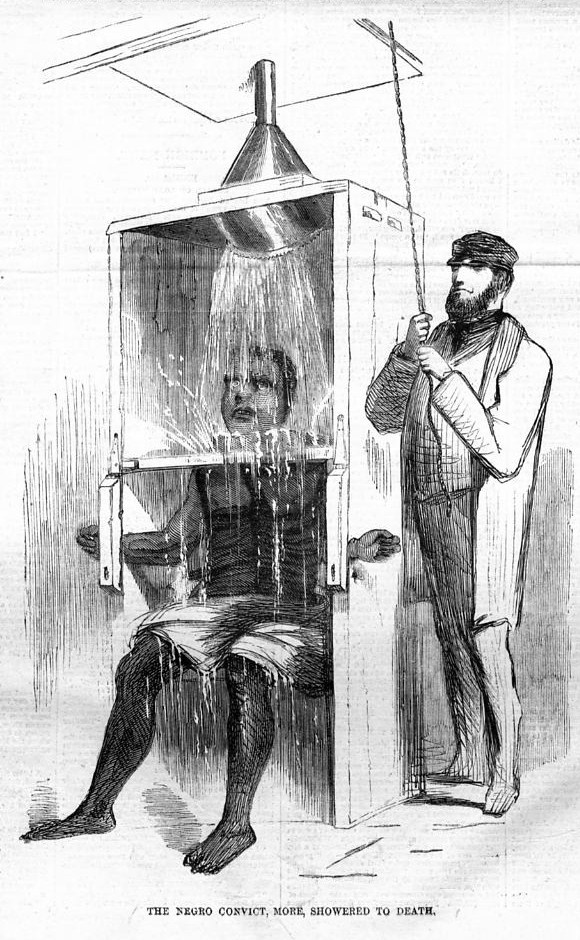
Anyway, a reader asked if I had any examples of the media of the time (19th century) inveighing against prison torture practices. In fact, I do. I have an original article from Harper’s Weekly dated December 18, 1858 titled “Torture and Homicide in an American State Prison.” I purchased the original article as a collector’s item mainly because of the illustrations that are included. I dug it out of storage earlier this week and will quote some of it below to illustrate how some media outlets covered prison torture in the 19th and early 20th centuries:

“We now present a far more fearful picture of the mismanagement of our public institutions for the confinement and correction of criminals. On 2nd inst. a convict named More, imprisoned in the State Prison at Auburn, was showered to death by prison officials. The circumstances of the case are simply as follows:

The convict, More, was a negro. He is certified to have been a man of naturally pleasant temper, but violent when crossed. On 1st inst. he was said to have been in a bad humor; he was seen, or is said to have been seen, to sharpen a knife, and to mutter threats against someone; on the strength of which he was, on 2nd inst. seized by several keepers or deputy-keepers of the State Prison, and by them dragged toward the shower-bath. Like most negroes, he entertained a lively fear of cold. He knew that the water of the shower-bath would be very cold indeed; and, after vainly appealing to the feelings of his captors to release him, he broke away from them and fled — be it remarked — to the shop where he was in the habit of working. At the door of the shop a convict arrested him; a keeper and his assistants swiftly followed: he was dragged by main force, and after many violent struggles, to the shower-bath; all the water that was in the tank — amounting to from three to five barrels, the quantity is uncertain — was showered upon him in spite of his piteous cries; a few minutes after his release from the bath he fell prostrate, was carried to his cell, and died in five minutes.

It is the homicide which we this week illustrate. The use of the shower-bath as a means of coercing criminals into submission to the orders of prison authorities began to be general about the year 1845. In that year a convict at the Auburn State Prison was whipped by order of competent authority, and died under the lash. The public indignation which was aroused by the event led to the abolition of whipping as a punishment in the prisons of the State of New York. It was preserved in other States, as, for instance, in Connecticut, in which State Prison wardens are authorized to this day to administer stripes — not over ten in number — to refractory prisoners. But in New York the cat was disused, and the shower-bath reigned in its stead.”

The article goes on for several pages to describe how the shower-bath works and to underscore several other forms of punishment that prisoners are subjected to at Auburn Prison. The expose also relies on research by leading experts about the physical and psychological effects of being subjected to the shower-bath. The article is definitely of its time as it distinguishes between whites who are believed to better be able to withstand the torture of the shower-bath and blacks who are seen as constitutionally unable to endure the practice. If you are interested in the history of American prisons, the article is worth reading and I am sure that it can be accessed through any library.

Below is an image of the shower-bath apparatus:

The article ends with these words:

“An inquest has been held on the body of the negro. Eight men composed the jury, six of whom are said to have been prison contractors. They refused to allow the prison physician to deliver his evidence, as he wished; and found the absurd verdict that the man’s death had been ‘hastened’ by the use of the shower-bath. It is clear that if any notice is to be taken of this poor convict’s death the District Attorney must move in the matter. It remains to be seen whether he will do so; or whether the civilization of the State of New York is to be disgraced by the torture and homicide, by State officials, of a poor convict in a State prison.”

Aug 04 2011

New Occasional Paper by YWEP: Bad Encounter Line

The Chicago Taskforce on Violence against Girls and Young Women is thrilled to share with you the latest Occasional Paper, by C. Angel Torres and Naima Paz of the Young Women’s Empowerment Project! The paper looks at the organization’s Bad Encounter Line, which they describe like this:

The Bad Encounter Line (BEL) is a way to report bad experiences you have had with institutions such as police, the health care system, public aid, DCFS, CPS, etc. In our research we noticed so many girls and transgender girls reporting bad encounters from systems that are set in place to help them. So we wondered is the same happening to boys as well; so we expanded the BEL to reach them as well, and as we have been receiving data we have learned that these systems are affecting all genders. Based off the BEL, we started a task force for street based youth and wrote a Bill of Rights that we want non-profits to sign so they have to be accountable to us and can’t get away with denying us help.

The paper is available for downloading – along with the Bill of Rights that YWEP members developed – on the Taskforce website.

The Taskforce thanks the Young Women’s Empowerment Project for their powerful and important work, and for their willingness to share it with us through the Taskforce. Everyone is encouraged to read what the young people from YWEP have to say about this issue, why it matters, and how they are taking concrete steps to address it.

Stay tuned for the next two papers, to be released this fall, both featuring youth voices….. The first, by youth and adult allies at the CRIME Teens Project in Bronzeville, describes their approach to addressing bullying, cyberbullying and teen dating violence. The second, by youth leader Tiara Epps of Beyondmedia Education, will be in the form of a video diary, and will share her learnings from the Chain of Change project.

If you are interested in submitting an abstract for the Taskforce’s next round of Occasional Papers, please email [email protected].