Sep 05 2010

Still More Voices of Youth Sentenced to Life Without Parole…

This is the third installment of selections from “Until I Am Free: Voices of Youth Sentenced to Life Without Parole” edited by Kevin Coval.  All of the selections offered here are transcribed exactly as they appear in the publication.

Finding My Voice (Who Knew)

by Gary Clark

Getting up one morning no thoughts awaited me.

No thoughts that this might be the last time

I would see my people free.

In the back of a police car heading for the station

We know you didn’t do it, the other guy did

we feel you know something, you were there

just say that, we will let you go.

This became the cops’ favorite rhyme.

I told the truth swear to God. I’m keeping it real.

I was not there.  I was not with dude.

Sitting in the station going through this quiz

where were you at? what did you do?

Those hours seemed like eternity

hours that seemed as long as the life sentence they gave me.

I stood by the truth, the lie detector test, threats, harassment,

intimidation, good cop and bad cop.

Mom’s gone. I’m all alone. I don’t know what to do.

I’m scared, my heart is beating, about to explode

shortness of breath, hands shaking. Cops said

over and over we know you didn’t kill anyone

just say you were there, we will let you go.

I told them the truth. I just wanted to go home.

The officers are saying do this and you can go home.

That’s when I said those words.

The officers fed me the details

to make the lie sound like the truth.

I ask the officers can I go home now?

He said no you are going to jail.

I started this journey so long ago

a shorty of 14 when life really went wrong.

July 19, 1984. 12 people plus two took life from me

without ever knowing me.  They say there is no change in me.

Can they see there is much more to me.

I am somebody’s child, grandchild, a little brother,

a best friend, nephew and favorite cousin.

Can they see peoples’ lives affected when they sentence me?

They took away my family and all hope of what I could be.

Juvenile life without parole is a life of stolen hopes

and stolen dreams.  Who knew when I woke up

July 19, 1984, this would be me.

Gary Clark grew up in Decatur, Illinois and was 14 at the time of the offense for which he received life without parole.  He maintains his innocence and is now 41 years old.  In prison he has earned his GED and held various jobs.  He also reads and likes to study history and religion.

What’s next

by Brandon Craighead

The past is not beautiful.

Searching for what I never had

lacking from Mom and Dad.

It’s tough growing up when no one believes in you.

Knowing they are gonna dismiss your achievements

no matter what you do.

Trying to glimpse my future

What’s next for me. Honestly

I don’t know.

Brandon Craighead grew up in various group homes, mental health facilities and on the streets in East St. Louis, IL.  He was 16 years old when he committed the crime for which he is serving life without parole.  He is now 29 years old.  In prison, he has received his GED, tutored other inmates, and worked various jobs.

Trying Times

By Marshan T. Allen

There are times when waving the white flag and surrendering to my adversary seems like the easiest thing to do.  I’m no pessimist however, every person has a breaking point and sometimes I feel like I’ve gone beyond mine. But I just can’t give up.  I refuse to accept the life captivity that awaits me.  I am a lone soldier fighting for life and liberty.  Without a wingman or air support.   I’m trapped behind enemy lines.  Surrounde by unfriendly faces in a strange and hostile place, no ally in sight.  I’ve tried contacting base but all lines of communication severed.  No one answers my may day calls or comes to rescue.  I’m on my own.  Thus I have two choices: Extricate myself or die! I choose the former, dying here, like this, is not an option? However, I am afflicted with exhaustion. Combat takes its toll on the best of soldiers.  I’m not trained to survive under these conditions.  My adversary has unlimited resources at its disposal.  The odd are against me.  I know I must fight valiantly and relentlessly if I am to prevail.  My mission: total liberation.  I won’t settle for anything less.  No matter how trying these times become, I am determined to fight to the end…

Marshan Allen was sentenced to life without parole as a 15 year old getaway driver in connection with a double murder. His judge said that Marshan was capable of “rehabilitation” and that if he had any choice, he would not give Marshan the natural life sentence mandated by law.  Marshan is 34 years old today, and awaits a new sentencing hearing.  He has received his G.E.D., a paralegal degree and completed a small business management course. He is now taking correspondence courses with the University of Ohio and works in the prison library.

Stood/Miss: The Song’s Request

by Joseph Wingard

I don’t know much about the law.

So, Lord please

Don’t let me be Stood/Miss

You’re telling me my 16 year-old-son

is about to be charged with 1st degree murder. How

Long has he been in your custody? He didn’t

Request to have me there before talking to you?

That’s all it took for you to relieve him

Of his youth and his future

Oh lord, please don’t let me

Stood/Miss

I only get to spend 5 minutes with him?

I should be allowed to spend just as much

Time with him as you people did.  That’s not

Fair to you?  If I sign a confession will you

Allow me to spend more time with him then?

Who is becoming irate? Oh now

I have to go and you’re giving

Me directions to a courthouse!

You get some damn sleep!

I am a grown woman.  But

I will be seeing you bright and

Early tomorrow you

Lord, please don’t let me be

Stood/ Miss.

Joseph Winguard grew up on the South side of Chicago and attended Curie Hih School until he dropped out and succumbed to a lifestyle that led to the robbery and homicide for which he is serving life without parole.  Joseph was 17 at the time and is 36 years old today.  In prison he works, reads ferociously and watched movies. He is also writing a screenplay that he thinks is going to be good.

Sep 04 2010

The Prison Industrial Complex 101: My Essential Reading List

I got an e-mail a couple of weeks ago from a young college student named Maggie who asked me to share a list of the essential readings for someone who is trying to better understand the prison industrial complex and how it works.

I thought that it was a terrific question and so I got back to her with a list of some books that I would suggest.  This is my essential reading book list in alphabetical order by author.  A warning: these texts are weighted toward sociology since that is my own orientation and training. This is by no means an exhaustive list. There are hundreds of other text that could be included.  In fact, I look forward to hearing from others about their essential reading lists.

I plan to offer a list of articles that I sent to Maggie in a few days. All of the ones offered here are books.

Alexander, Michelle (2010). The New Jim Crow: Mass Incarceration in the Age of Colorblindness

Ayers, William (1998). A Kind and Just Parent: The Children of Juvenile Court

Davis, Angela (2003). Are Prisons Obsolete?

Davis, Angela (2005). Abolition Democracy: Beyond Empire, Prisons, and Torture

Gilmore, Ruth Wilson (2007). Golden Gulag: Prisons, Surplus, Crisis, and Opposition in Globalizing California

Herivel, Tara & Wright, Paul (2002). Prison Nation: The Warehousing of America’s Poor

James, Joy, ed (2005). The New Abolitionists: (Neo) slave Narratives and Contemporary Prison Writings

Law, Victoria (2009). Resistance Behind Bars: The Struggles of Incarcerated Women

Pager, Devah (2009) Marked: Race, Crime, and Finding Work in An Era of Mass Incarceration

Parenti, Christian (2008, new edition). Lockdown America: Police and Prisons in the Age of Crisis

Perkinson, Robert (2010).  Texas Tough: The Rise of America’s Prison Empire

Sudbury, Julia (2005). Global Lockdown: Race, Gender, and the Prison Industrial Complex

Wacquant, Loic (2009). Prisons of Poverty

Western, Bruce (2006) Punishment and Inequality in America

There are a couple books that I have recently read that I really enjoyed and were really quick reads.  I would like to offer a shout out for them here as well.

Humes, Edward (1997). No Matter How Loud I Shout: A Year in the Life of Juvenile Court

Kerman, Piper (2010). Orange is the New Black: My Year in A Women’s Prison

Finally, I am currently making my way through one of the most fascinating books about prisons that I have ever read.  It is called Dress Behind Bars: Prison Clothing as Criminality by Juliet Ash.  I would not say that this is an essential reading book but I would suggest that those who already have a good foundation in understanding the PIC will find it engrossing and well–worth reading.  The book is an examination of state control of prisoner’s bodies.  It examines the origins behind various forms of prison dress styles from 1800 to the present. It unpacks the messages inscribed in these clothes and also underscores how the state seeks to control, humiliate, and exert its power through clothing.  The book also speaks to the way that prisoners themselves try to exert their own forms of resistance through their dress and how prison clothing has affected the broader public.  It is really a fascinating book and so I thought I would put in a plug for it here. I hope to blog more specifically about the book in the coming weeks.

Sep 04 2010

Crazy Prison Industrial Complex Fact of the Day 9/4/10

Eight black males are incarcerated for every one white male.  If whites were incarcerated at the same rate as blacks, more than 6 million men (5 percent of male working-age population) would be languishing in prison (Source: Western, Bruce. Punishment and inequality in America, 2006. p. 16).

Sep 03 2010

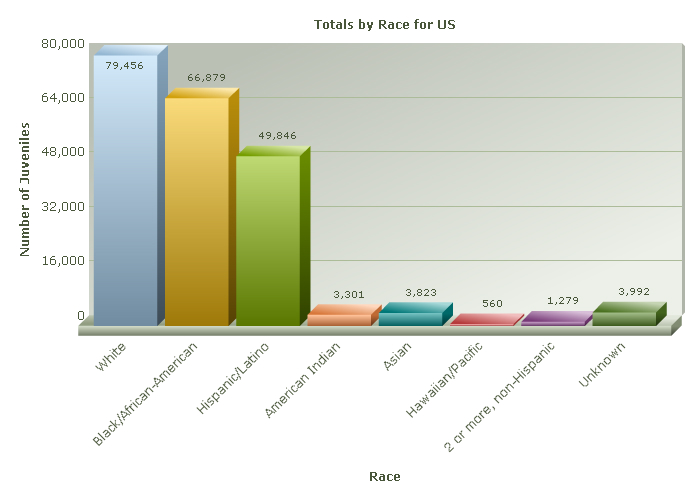
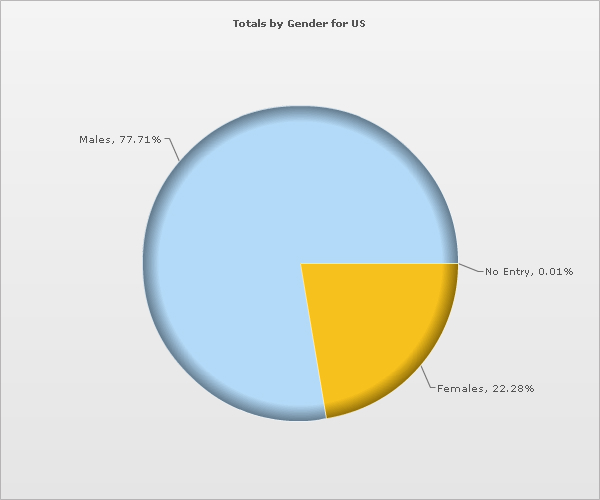
Census of Juveniles on Probation

I’ve been waiting for this information and they are now offering preliminary data from the Census of Juveniles on Probation. This is a snapshot as of yesterday and the numbers should be considered preliminary

Census of Juveniles on Probation by Race

For more details, click here.

Census of Juveniles on Probation - By Gender

Sep 03 2010

What exactly is the prison industrial complex?

The Urban Politico just featured an interview with Sarah Catharine Walker of the Second Chance Coalition.  The most interesting part of the exchange for me is this one:

When I mention prison industrial complex to most people, they look at me like some weird, conspiracy theorist. What does this term mean to you?

Personally, while I am sympathetic the Prison Industrial Complex concept I have not found it useful in a legislative advocacy. The term industrial complex is over-used and lacks clear definition. When a concept is too inclusive or amorphous it makes it difficult to attack specific issues. When I work with college interns I frequently hear the term Prison Industrial Complex, Non-Profit Industrial Complex, the Social Service Industrial Complex and the Military Industrial Complex. I think the term industrial complex offers too easy an out for advocates. It makes the work seem daunting and impossible. How does one take on the industrial complex. Perhaps more importantly, for me, the concept of the prison industrial complex is really a question of resource allocation. Where do we allocate our resources? In social support programs or in our justice system? We need to shift the conversation to focus on resource allocation that prioritize outcomes that support individuals, their families and the communities where they live. Our policies should support the outcomes we desire: public safety, reduced recidivism, healthy communities and families, and more efficient use of our resources. Our current policies often work against the public interest by creating a system of “perpetual punishment.” In truth, in MN, the coalition has worked to develop and establish partners in public safety. Increasingly with diminishing budgets and increased research on what is actually effective many law enforcement professionals and corrections professional would also like to see reduced barriers.

Over several months this year from January to June, my organization ran a Saturday Communiversity course about the prison industrial complex.  It was a free course offered to community members in a community setting.  We had excellent attendance and participation throughout. You can find information about that course here. I still have to update that blog with information from our final June session.  We’ll get to that this month.

Here is part of what I wrote about why the term PIC resonates with me:

Personally, I continue to find the term “Prison Industrial Complex” to be a good frame for discussing the issues that we have over the past five months.  This is why I continue to use it.  In particular, I rely on Critical Resistance’s definition:

Prison Industrial Complex (PIC) is a term we use to describe the overlapping interests of government and industry that use surveillance, policing, and imprisonment as solutions to what are, in actuality, economic, social, and political ‘problems’.”

Sep 03 2010

Teaching about Prisons and Abolition: the Latest Issue of Radical Teacher

The latest issue of Radical Teacher is devoted to teaching about prison abolition and it is excellent. I have been thinking a lot about teaching lately since I have now returned to the classroom this fall after a 5 year hiatus. I had been feeling burnt out with respect to teaching college students. I am stepping back in now feeling much more energized and excited.

In the introduction to Radical Teacher, the editors offer this window about their discussions in putting the issue together:

The conversations we had during meetings of the Editorial Board of Radical Teacher mirrored the debates on the left about how best to resist the PIC. Many members of the Board felt that the contemporary PIC abolition movement was utopian in the pejorative sense — a pie-in-the-sky faction ungrounded in the socio-political possibilities of this historical juncture. Others expressed the commonly held fear that prisons, though overly relied upon in the United States, are necessary institutions to house those members of society who have caused certain kinds of harm, such as murderers, rapists, and perpetrators of hate crimes. While those of us on the left might imagine ourselves to be less inclined to be persuaded by arguments for the necessity of prisons based on the racialized “threat” of the “criminal,” we sometimes have a hard time knowing where else to turn to address violence against queer people, people of color, immigrants, and others.

The honesty in this paragraph is wonderful. It is of course true that even those of us who consider ourselves to be progressive on a number of social issues still find ourselves struggling with internalized oppression. This is an inescapable fact of life. The important thing is to notice this and to struggle to overcome it.

Two friends of mine, Jessi Lee Jackson and Erica Meiners, also have a terrific essay in this issue. They wrote a piece titled “Feeling Like a Failure: Teaching/Learning Abolition through the Good the Bad and the Innocent.” The essay opens with two examples from the authors. I will include Jessi’s example here:

It is the 8th week of English class in our adult high school completion program, and we have just read a short excerpt from Angela Davis’s Are Prisons Obsolete? As a class, we review vocabulary words, and then, piece by piece, work to understand Davis’s argument for prison abolition. All of the students have firsthand experience of the system, and they agree that the prison system is clearly racist in its impact. But when we get to the point of discussing abolition — of shutting down prisons — the class quiets. The disagreements start. “I agree with abolishing the death penalty, but…” “But some people need to get locked up.” “I agree we need to change the system, but getting rid of prisons entirely,,,” “It’s too much…” “I don’t think we need to go that far…”

I find myself in the awkward position of being the only person without direct experience of being locked up, and the only vocal abolitionist. By the end of our conversation, I perceive that students have made up their minds and are united in their analysis: the prison system is messed up, but abolition is “going too far.” I wonder to myself what went wrong in our conversation. Why was I not able to present abolition in a way that challenged people to go further or question their assumptions about the necessity of prisons?

Jessi and Erica are both long-time anti-prison activists and educators. They bravely lay out their challenges in teaching abolition to students with experience in the criminal legal system. The examples that they offer are excellent because so many of us who teach about prisons and abolition have encountered similar resistance.

They offer this important insight in the essay:

We believe it is key to not rest with the what about the bad people questions or to ignore the feelings produced through and by the PIC, but to explore these fears by responding to the “bad” people statements with the question: “What would we do about violence without prisons?” We believe this is an important question, one that needs to be asked in multiple contexts. What are we doing about violence, both interpersonal and state-sanctioned? What are we doing to confront and defuse racist fears? This reframing renders visible how the original question, “what about the bad people?” masks the reality that prison offers a false answer to the question of violence, actually shifts resources and energy from meaningful and sustainable anti-violence work. Abolition frameworks point out that anti-violence work needs to be centered, not around identifying and caging bad people, but in responding to and preventing violence.

I think that this is a key reframing that provides a real opportunity to engage more people in discussions about abolition. Read the entire issue, you won’t be sorry. Over the next few days, I will be highlighting other selections from the issue.

Sep 02 2010

I’m back to teaching today so I will be taking a blogging break…

I don’t know what possessed me to agree to teach a sociology course this semester. I did this several months ago before I knew how much busier I would be than ever… So my course starts this evening and I have to actually work on my lecture… I will be back to blogging tomorrow.

Sep 01 2010

Adventures in Zero Tolerance Land #5: Suspended for “I Heart Boobies”

It seems that zero tolerance policies in American schools will provide me with something to blog about on a daily basis. Now comes the news that a young man has been suspended from school for refusing to give up his “I heart boobies” bracelet.

Here’s the story:

A Rocklin High School sophomore faces disciplinary action for wearing a controversial bracelet that proclaims “I heart boobies,” then refusing to turn it over to school officials.

Hunter Cooper, 15, said he wore the bracelet since the first day of school. His mother gave it to him after she picked it up from a doctor’s office. For five months before that, he had the pink survivor bracelet from Susan G. Komen. Then last Friday, school officials spotted him with the black “boobies” bracelet and asked him to remove it.

“I’m wearing it in honor of my grandmother,” said Cooper, who said his grandmother died before he was born. “I don’t see it as an offensive thing at all.”

The black bracelet with white lettering also trumpets other slogans, such as “wearing breast,” “save the breast” and “keep a breast.”

A Keep-A-Breast.org spokesperson said its breast cancer awareness campaign is targeting teens.

“This is a modern word, I think. I know plenty of people who use the word boobies,” said Cooper.

“We support the cause 100 percent,” said Rocklin principal Mike Garrison. He said several staff members at Rocklin High School have battled breast cancer.

“But, not the language on the bracelet,” said Garrison. “When you use the term boobies, we find, and many people find, the term offensive and inappropriate. We find it inappropriate to be wearing it on school grounds.”

Rocklin High officials asked Cooper to hand over the bracelet, but he refused. Cooper said he now faces Saturday school or one day of on-campus suspension for not complying.

A female student at Rocklin High reportedly attended Saturday school over the weekend and was disciplined after refusing to turn over her “I Heart Boobies” bracelet.

The principal would not discuss Cooper’s case or confirm if Cooper faces disciplinary action. Principal Garrison would not discuss the other student’s case either.

“We have not suspended any student or disciplined any student for wearing a bracelet or shirt that has that insignia on it,” Garrison said.

“I guess I was being too defiant because I didn’t hand it over,” said Cooper. “I don’t really think those are fair punishments.”

Cooper said his grandmother died from breast cancer five months after his grandfather died from lung cancer. Several other family members and friends have battled cancer. Cooper owns various bracelets as a show of support– including the well-known yellow Livestrong bracelet.

Cooper’s mother said she was disappointed with the way the school and the district handled the issue.

“Without having a discussion and handing out penalties first, I think that’s a real problem,” said Danielle Cooper. “They need to inform us as parents. I’d like them to handle the subject matter as mature adults. I’d like the staff to take a stand, one way or another. If they banned (the bracelets), and why they banned them, we should receive notice.”

Garrison said school administrators will be meeting Tuesday for a leadership meeting and will be discussing their position.

By Suzanne Phan, [email protected]

Thoughts?

Sep 01 2010

A Young Woman’s Response to Yesterday’s “Stand By Your Man” in Prison Posting

I received an e-mail from a young woman based on Monday’s blog post about hip hop’s “stand by your man” in prison problem. In that post, I highlighted a number of past videos and songs to buttress my argument about the cultural expectations that are being placed on young women of color to wait out the incarceration of their partners.

I asked the young woman who sent this to me for permission to share a part of her e-mail here and she agreed:

“I wanted to let you know that I live that life that you wrote about. My boyfriend is locked up serving a fifteen year sentence in prison. We have a baby together and I am 21. Everyone expects me to just wait for him to get out. I do love him but I also feel that he made a mistake and now I have to do his time too…I am at community college now and I am trying to make a better life. I just found your website because I was writing a paper about prison life for a sociology class this summer and now I read it all of the time. I just wanted to send you this e-mail because I don’t think that everyone should expect young girls to just have to wait for their men to get out of prison and for us not to live our own life too. It’s hard and not easy.”

The young woman also suggested another video to me that addresses the issue of the young women left behind in this epidemic of incarceration of men of color. She said that it was very popular among her peers. I am including it here. It is by a group called Aventura and the song is called “El Malo.”

Here are the first couple of stanzas of the song translated from Spanish to English:

The Bad One

He gives you his love
You sleep with doubts
Now you see that routine
Is not what it appeared to be
He’s sincere, contrary
To my defects but I’m still
The bad one that you can’t stop loving

You might be the cinderella
In the fairy tale that gives pity
And even if i’m not a prince charming
I’m your love and your dilemma
And just like in the novels
I’m the bad boy with a virtue

Aug 31 2010

Let’s Remove ALL Police Officers from Schools…

Researcher and Professor Aaron Kupchick has a new book out about school discipline issues and zero tolerance policies.

In his recently published book, Homeroom Security: School Discipline in an Age of Fear, Kupchik examines disciplinary practices in schools, practices that include assigned police officers, drug-sniffing dogs, metal detectors, armed security guards, surveillance cameras and zero tolerance policies.

Kupchik spent time inside four schools in two states observing teachers, administrators and students. Two of the schools are located in the Southwest and two are in the Mid-Atlantic region. In each state, one school’s student body is mostly middle-class white students and one school’s population is composed of mostly lower-income minority students.

Kupchik found discipline was doled out similarly in all four schools.

“When students got in trouble, the people in charge of discipline didn’t ask questions about why they got into trouble or didn’t try to solve their underlying problems,” he said.

Instead, disciplinarians followed what Kupchik calls excessive and counterproductive strategies for dealing with students’ misbehavior, one of the worst of which is the popular notion of zero tolerance, policies that assign a certain punishment to an infraction regardless of circumstance.

Here is Kupchik sharing the central thesis of this study.

I just found out about this book last week so I have not yet read it. I am hoping to get to it in the next couple of months. He was recently interviewed in Salon Magazine about his research.

I thought that this part of the interview was particularly troubling:

As part of my research, I interviewed students, and one of the questions that seemed like a good idea at the start was asking them whether they liked having the SROs [school resource officers] in their schools. For me, having gone to public schools without cops, this really seemed odd to me, to put police officers in peaceful schools. And the students were puzzled by this question, and I quickly realized that it makes no sense to them because it’s all they’ve ever known. It’s completely normal. It makes about as much sense as if you asked them, “Should your school have a principal?”

From a review of the book:

Homeroom Security outlines suggested strategies, rooted in empirical data, for making schools safer. Among them: mandatory tutoring rather than suspension, since students often act up in class when they have trouble understanding lessons, and involving students in rule creation.

Today, schools are notably safer than they were two decades ago. National statistics show rates of violent crime and victimization on the decline. Yet, school discipline tactics trend in the opposite direction, increasing and becoming harsher.