Dec 14 2010

Sagging Pants, Criminality, and Prison Clothing

Over the past few days, I have seen a couple of articles addressing the issue of sagging pants. Just yesterday, I read about a city council in Florida that has voted to fine people up to $250 for wearing saggy pants.

The city of Opa-Locka voted unanimously Wednesday night to fine people $250 if they don’t pull their pants up.

Opa-Locka city leaders decided to expand the current ban on saggy pants to include a $250 fine or 10 hours of community service for those who refuse to tighten their trousers.

Opa-Locka City Commissioner Timothy Holmes led the charge against the sagging crowd, saying the low-pants practice intimidates the public, provides a distraction in schools and is a blight on the community.

“Dress like somebody. Be somebody,” Holmes said. “It’s time for us now to try to teach our people how to dress.”

The ACLU has expressed its opposition to this new ordinance:

The American Civil Liberties Union of Florida also objects to the proposal. In a statement to Local 10, an ACLU attorney said, “Policymakers acting as ‘fashion police’ is a ridiculous waste of public resources. Laws like this disproportionately penalize African-American youth, increase contact between youth and law enforcement and will impose overly harsh penalties for victimless behavior.”

One might wonder what the sponsors of the ordinance were thinking about in advancing this policy. Fortunately, we can hear from the main sponsor Commissioner Timothy Holmes himself:

“That might get rid of some of the crime on the street,” Holmes said.

So fining people for wearing their pants “too low” will have the added benefit of improving community safety? This is in fact one of the arguments being advanced. I think that it was Dream Hampton who tweeted a few weeks ago that the banksters on Wall Street who tanked the economy to the tune of $14 trillion in lost wealth were all wearing belts and suits.

Notice the interesting way that Mr. Holmes associates the concept of illegality and criminality with this particular form of dress. As the ACLU rightly points out, the targets of this new ordinance will be disproportionately young men of color. Once again society is inscribing their identities as “criminal” above all. Young white suburban men will not be the ones receiving these fines even if they too come under the gaze of law enforcement for wearing “sagging pants.” Their identities are not synonymous with criminality and as such they are afforded the right to wear such clothing as a marker of “style.”

Sociologist Mary Waters coined the term “ethnic options” to underscore the fact that white people are able to decide when they want to identify with their ethnicities (irish, russian, italian) while people of color in the U.S. do not have the option of choosing when to be ethnic. They are always perceived as “ethnic.” I would apply this concept to the identity of “criminal” for young people of color. They never have the “option” of putting that label on or taking it off.

As has been pointed out in the past, the style of sagging pants is said to have originated in prison culture where prisoners are denied access to belts. So we can see that clothing crosses over from the inside to the outside. Over the past few weeks, I have read a few pieces about prison clothing. Most recently, the Seattle Times reported that in order to save some money Washington State had begun to issue recycled underwear to prisoners.

Officials with the state Department of Corrections have announced several new and creative ways to reduce costs, including giving inmates hand-me-down uniforms and underwear, buying them shorter socks and replacing self-serve cafeteria juice fountains with juice boxes.

Juliet Ash (2010) has written in her excellent book “Dress Behind Bars” that:

Penal institutions, under the authority of particular States, use dress strategically to diminish the imprisoned. Prison clothing takes many forms, whether as uniforms or in the neglect of the maintenance & distribution of clothing (p.3).

Who cares about prison clothing? some readers may ask. Yet we’ve all heard the term ‘clothes make the man.’ We care about prison clothing because it is an “embodiment of punishment.” We are concerned with prison clothing because it relates to the maintenance of fundamental human rights. It seems to me that everyone deserves access to clean underwear at a minimum.

The history of prison clothing and uniforms is a fascinating one. Just a couple of weeks ago, Slate published an interesting article about when and why American prisoners started dressing in orange jumpsuits.
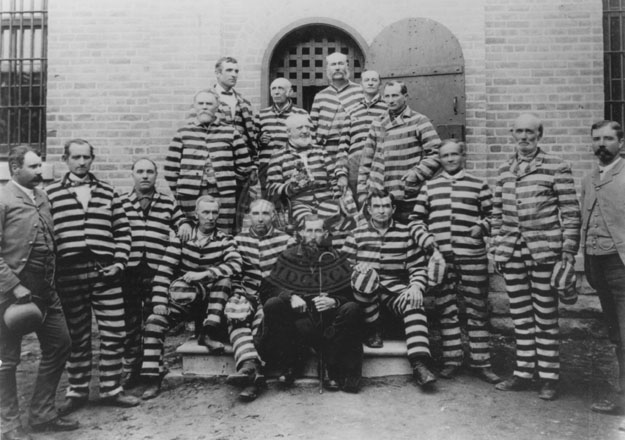
Many people probably think about the icononic American prison uniform as a black and white striped one. That stripped uniform emerged in 1815 at Newgate Prison. As Juliet Ash writes:

“The reason for its adoption was primarily the cheapness of the production of simple black-and-white striped cloth. Additionally the black-and-white horizontal stripes symbolically represented prison bars that not only surrounded the inmate but were also imprinted on the convict’s body and thus became an embodiment of imprisonment (p. 25).”

Prison clothing is not incidental to how we construct criminal identities in American culture. In fact across history, prison clothing is an embodiment of punishment. Because young people are always appropriating styles that they see as “cool,” they have adopted sagging pants as markers of “coolness.” Adults, as they have throughout history, are resisting young people’s self-expression. In this particular case of sagging pants, some have decided to criminalize the young people who wear them. It seems important to point out to these adults that this is supremely unhelpful and will not accomplish their goals. If anything, it is counterproductive and detrimental. I hope that examples like the Florida ordinance do not signal a national trend.

Note: The Crime Report has a good roundup about issues relating to sagging pants ordinances.

Dec 14 2010

Thanksgiving & Jail By Katy Savage

I love the internet. Sometimes you come across the most poignant things in the most unexpected places. I read this blog post in the Mormon Worker titled Thanksgiving and Jail.

Here are an excerpt:

I am out of jail. 2.5 million others in this country tonight are not. Maybe some got canned turkey on their plastic trays to day, to celebrate.

Our country has the highest incarceration rate of any country—one in 31 adults—and the highest number of people locked up in cages.

More black men are currently in prison in the U.S. than were slaves in 1850.

7.2 million of us are in jail, in prison, on probation or on parole.

But these were all facts that I already knew.

What I didn’t know is that the vitamin-depleted food tastes and smells like Purina Cat Chow, served with some slimy iceburg lettuce and “milk” with seven ingredients.

I didn’t know about the weight of those slit-windowed rooms, the sense of being buried deep even though we were on the fourth-floor cell block, of being so easy to forget, which is the real horror of a dungeon. I didn’t know “outdoor recreation” meant a rare moment in a high-walled, concrete courtyard.

I didn’t know books would be contraband, a near impossibility. When I saw how much these women loved to read, I told them I’d mail them some books, only to discover that to give these women books I would have to come in person during visiting hours and give one at a time. There is, of course, no library in the jail. The aim of the place is to punish, shame, and deprive.

I didn’t know about Gwen, with the worn face and quiet patience of an Appalachian farmer, who is sitting in a cage because her boyfriend left marijuana at her house.

I didn’t know that 19-year-old Katie has been waiting for a trial date for six months now so the State can figure out if she actually stole that Wii or not. Katie was going to nursing school and caring for her two-year-old daughter when she was arrested, and because her parents now have this little girl to care for they can’t afford bail. It’s like a debtor’s prison: the longer you’re in there, the less likely you’ll be able to afford to get out. Katie, who seems tough, capable, stoic, cries when she speaks of her daughter. She told me she thought she’d be fine when she learned her mother and daughter could visit her twice a week, but she fell apart when she instead was only allowed to speak through a telephone to their images on a television screen. This is the case for all of them in Muscogee County Jail.

In sum, I didn’t know is that “innocent until proven guilty” was such an outrageous lie. If a cop brings you in, you’re guilty. It doesn’t matter what any facts say, you will be punished. If you’re poor, your guilt is heavier, your punishment more severe. For my own convictions for “picketing” and “demonstration without a permit,” I was sentenced to forty days in jail or $300 fines. If I hadn’t had that $300, I would be there until 2011. Forty days or $300—clearly, the punishment for one who can’t pay is far higher. In this reckoning, each day’s worth of freedom, of being with loved ones and feeling the sun and breeze and earth, is worth $7.50.

Read the whole post here.

Dec 14 2010

Update on 5th Grader Who Was Suspended for Bringing Peppermint Oil to School

Back in July, I posted about another example of “zero tolerance” policies run amok from Long Island where a 5th grader was suspended for bringing peppermint oil to school.

Administrators at a Long Island school suspended a 10-year-old girl for bringing peppermint oil to class. A teacher’s assistant at John Mandracchia-Sawmill Intermediate School in Commack spotted fifth grader Sara Greiner offering friends a few drops of the cooking extract. “I told them it was just peppermint. You could put it in your water,” she told ABC. “No one ever told me that peppermint oil was illegal.” Greiner was sent to the principal’s office and issued a one-day suspension. The school declined to explain why she was punished, but in a letter to Greinier’s mother, Corrine Morton-Greiner, the principal wrote “[s]uch inappropriate and unacceptable behavior cannot and will not be tolerated.” Greiner’s mother is now fighting to remove the suspension from her daughter’s permanent record. “If a child offers a quarter of their peanut and jelly sandwich to another student is that student going to be suspended? Where do we draw the line?” the mother asked.

Well I was pleased to receive the following update from Sara’s mother about how she is doing now.

I am Sara’s mother, and one year later, I am amazed that there is still so much of this news item connected with my name. I found this article through “googling” my name to look for something completely unrelated.

I teach college, have taught in public and private schools throughout Long Island, and on this near-anniversary of this mystifying event, I decided to post an update about how my daughter is doing a year after this nightmare. Since I would not allow the system to harm my daughter’s name or reputation, my husband and I placed Sara in a private school a month after this ridiculous incident last January. It was the best decision we could have made. She is a merit roll student who ran for school president. She has been selected to participate in a People to People World Leadership Forum, only one out of eight students in her school selected for this honor. Today, my daughter stands strong against any type of bullying or false labeling. She is well-known among her peers in her current school for her tremendous kindness and her incredible artistic abilities. Sara volunteers as a mentor to first grade students, does active community outreach work through her religion class, and participates in local community theater. Sara aspires to becoming an inventor one day.

For any parents who feel like their children are being stigmatized or falsely labeled, I encourage you to protect the dignity of your children. Sara was a shadow of her sweet, energetic self after such an unjust reprimand from school officials. She felt ashamed and humiliated by the way the school treated her, but with our support, she has both a new perspective and a deeper appreciation for the need to stand against any form of injustice–no matter how minor it may seem at the time. We still use peppermint oil in our home–a product sold to us by a Girl Scout Troop leader in our community. Thankfully, this insane incident has just made our daughter a stronger person in the long run and led her to a school that makes her very happy and provides her with an extraordinary education.

I would like to say once again that zero tolerance policies and harsh disciplinary policies are damaging our young people’s educational outcomes. They are being pushed out of school as a result of brain dead policies that accelerate their entry into the prison pipeline. Thank goodness Sara had a mother like Mrs. Grenier to advocate and fight for her right to a good and non-oppressive education. Yet many, many young people do not have such parental support for a myriad of reasons. I am thrilled to hear that Sara is doing well and am grateful for the update on her situation.

Dec 13 2010

Domestic Terrorism Pt.2: Youth Criminalization & Police Power

I have previously addressed the issue of police violence as a form of domestic terrorism.  Recently I have been following the case of a young man named Jeremy Marks and I have no idea why this isn’t engendering more of a national outcry.

Jeremy is a black high school student who is accused of attempting to “lynch” a school police officer.  You read that correctly; “attempted lynching” is one of the charges against the young man. An article in LA Weekly provides key information about this situation:

On Dec. 2, Jeremy Marks, a Verdugo Hills High School special education student, was offered a new plea offer by the L.A. County District Attorney: If he pled guilty to charges of obstructing an officer, resisting arrest, criminal threats and “attempted lynching,” he’d serve only 32 months in prison.

That actually was an improvement from the previous offer made to the young, black high schooler — seven years in prison.

It is critical to understand how often the state tries to force people to accept plea deals against their best interest.  The courts are overrun and prosecutors consistently offer plea deals as a way to expedite cases.  However most defendants would actually be better served to take their chances in court given the fact that prosecutors in criminal cases have a high bar for successful convictions.  Proving that something happened beyond a reasonable doubt puts the burden on the state to make a credible case.

Here’s more about the Jeremy Marks situation:

Marks, 18, has been sitting in Peter Pitchess Detention Center, a tough adult jail, since May 10. Bail was set at $155,000, which his working-class parents can’t pay to free their son for Christmas. His mother is a part-time clerk at a city swimming pool, his father is a lab tech.

The first thing to understand is that Jeremy Marks touched no one during his “attempted lynching” of LAUSD campus police officer Erin Robles.

The second is that Marks’ weapon was the camera in his cell phone.

The third is that Officer Robles’ own actions helped turn an exceedingly minor wrongdoing — a student smoking at a bus stop — into a state prison case.

The altercation that has ruined Marks’ life occurred in early May at a Metro bus stop on a city street a few blocks from Verdugo Hills High School as about 30 kids were waiting to board a bus.

The reason that I blog so often about the school to prison pipeline and the impact of harsh school disciplinary policies is because of situations like the Marks case.  Having police officers in and around the vicinity of schools causes more harm than it does good.  Small altercations are transformed into “aggravated” assaults.   The presence of police in and around schools is NOT about increasing student “safety” instead it criminalizes many more young people.

Witness accounts say campus police officer Robles challenged an unnamed 15-year-old for allegedly smoking — it’s unclear whether he was smoking or just holding what has been variously reported to be a cigar, cigarette or joint.

When the 15-year-old resisted, Robles grabbed and shoved him, according to eyewitnesses.

In Robles’ sworn statement, she says she pulled the resisting boy to the ground as other students shouted “Fuck you!” and Marks called out the name of the gang Piru Bloods.

Robles testified that the minor who allegedly was smoking “is screaming, ‘Hit me, fucking bitch, hit me, you stupid bitch, hit me, you dyke!'” When that boy turned his body and possibly elbowed her, Robles says, “That is when I did strike him,” with her expanded baton, “about three times in the left leg.”

She further stated that she sprayed him with pepper spray. The kid then hit her hand, she dropped her pepper spray can, and another student grabbed it off the ground.

Students and Berry-Jacobs allege to L.A. Weekly that Robles then slammed the student’s head against the bus window — a violation of numerous police policies. After that, several stunned students got out their cell phone cameras to record what was unfolding.

Robles struck the 15-year-old’s head on the window so hard, eyewitnesses tell the Weekly, that the window was forced out of its rubberized casement and broken.

Robles has changed her story in documents obtained by the Weekly, as she describes which student allegedly called out, “Kick her ass!” — the phrase at the heart of Cooley’s case against Marks, and the basis of the “attempted lynching” charge against him.

This excerpt cited above has all of the elements doesn’t it?  It involves a young person (maybe, perhaps, don’t know) smoking marijuana.  So the police officer is presumably making the case that she is acting to support our country’s war on drugs.  We have a supposedly “resistant” student who is begging to be assaulted.  We have Marks who is apparently invoking “gang” affiliations.   We have an instance of homophobia as the officer is purportedly called a “dyke.”   All of this allegedly prompts the police officer to beat the 15 year old with her baton and pepper spray him.  As we know the Southern Poverty Law Center has filed a lawsuit claiming that students in Birmingham are regularly maced and pepper sprayed.  So apparently this is not unusual across the country.  Awful!  Then the cop slams this young person’s head against glass which prompts students to start filming the encounter.

You know that police officers HATE, HATE, HATE to see the cell phone cameras come out of witnesses’ pockets.  Recall that police tried to confiscate cell phones and recording devices at the BART station after the killing of Oscar Grant. Additionally, I have previously written about a case where a man was facing 16 years in prison for videotaping a traffic stop.

The L.A. Weekly report goes on to suggest that two student videos of Marks using his cell phone to film the encounter tell a very different story than the one that is being promoted by the cop and the prosecutors.

You can view the student videos here.  They show “Marks in a grayish shirt, getting out his cell phone as he stands in the background of the scene near a student in a white shirt.”

Here is the second student video:

From the L.A. Weekly story:

Marks tapes the final minutes of the MTA bus stop altercation as several students — not including Marks — loudly and repeatedly taunt Robles.

The videos appear to show that Robles had little ability or training to handle razzing from angry high schoolers. She holds the 15-year-old against the MTA bus as he repeatedly tries to slap and push her hands off, and she never appears to have him fully under control.

She turns several times to look behind her at rowdy students, several feet away on a low wall, who jump around and cheer for the student Robles is grasping.

The videos show the loudest and angriest student in a black shirt and sweatpants rushing a few feet toward Robles more than once, and another student in a striped shirt moving toward her — but not Jeremy Marks.

In the videos, Marks, in his grayish shirt, can be seen speaking once. He never joins the extended taunting or picks anything up off the ground.

One really has to feel some sympathy for this police officer who was obviously in over her head. She should not have escalated the situation over a smoking incident. Additionally it is clear that she is outnumbered and outmatched by the students who are all around her.

Obviously this whole fiasco has also taken a toll on Jeremy Marks and on his family:

Marks’ mother, Rochelle Pittman, has barely been able to sleep since the campus cops and Los Angeles County prosecutors began to single out her son as the bad actor that day.

Yet he had no physical contact with anyone during the bus incident, was shown on video to be among the quieter students watching the altercation, and spent much of the time taking pictures of it with his cell phone.

The family recently hired two new criminal defense attorneys, Mark Ravis and Karen Travis, to defend him.

It is difficult to relay the emotional, psychological, and financial costs of these types of incidents on the young people who are targeted in this way. To understand the full context of this story, the entire L.A. Weekly article is worth-reading.

Dec 13 2010

Supporting Girls in Conflict with the Law

by Ara Oshagan

On Saturday,  I spent the day with an incredible group of over 30 young women who are participating in the relaunch of a terrific project called Girl Talk.

We are preparing to participate in a bi-weekly film series along with creative art activities at our local detention center.

Recently the OJJDP published a summary about the needs of girls in trouble with the law. Research suggests that “girls are not more violent than before and confirm that girls engage in far less crime and delinquency than boys for nearly every offense. It was also observed that mandatory arrest policies and other changes in the juvenile justice system are associated with the higher arrest rates for girls.”

National studies have found that when girls do offend, the rate at which they are being processed through the criminal legal system has increased dramatically over a very short time. Nationally, minor transgressions are being formally policed at an unprecedented rate (Schaffner, 2007).

Among young women in trouble with the law, black girls are overrepresented within the system and they receive harsher punishment than white girls (Moore and Padavic, 2010).

Key Concerns for Girls in Custody

Challenges facing girls before detention and/or incarceration
Sociologist Beth Richie has made the case that a key to understanding and responding to women as offenders is understanding their status as crime victims . Laurie Schaffner (2007) extends this argument by suggesting that “young women adjudicated delinquent in juvenile court report suffering inordinate amounts of emotional, physical, and sexual trauma in early childhood and adolescence.” She contends that “a disproportionate number of girls come into the juvenile justice system with family histories of physical and sexual violence and emotional neglect” (p.1229).

Substance abuse is often used as a means of escape for young women who have had to deal with victimization and trauma. Ravoira & Lydia (2008) suggest that “male and female youth experience adolescence, trauma, relationships, peer pressure, cultural expectations and negative life experience in profoundly different ways” (p.10) . They point out that girls are more likely to attempt suicide than young men as well as to present with higher rates of mental health problems and depression than boys.

Challenges facing girls while institutionalized
Young women face many hardships and injustices in the juvenile justice system. According to Ravoira & Lydia (2008):

“The traditional policies and practices of confinement – including use of isolation rooms, shackles, staff insensitivity, loss of privacy, strip searches, rules that prohibit contact with siblings and children, prohibitions on use of make-up/beauty products, and use of bright-colored jumpsuits to indicate a specific problem area (escape risk, anger issues, etc…) or male clothing – can exacerbate girls’ existing negative self-image, depression, post-traumatic stress disorder, and may result in increased suicidal ideation and self-mutilation/self-harm” (p.10).

Another issue facing girls while in custody involves sexual victimization within juvenile facilities.  A comprehensive report was recently released about the incidence and prevalence of sexual victimization in juvenile facilities.

Sexual Violence & The Girl Prison Pipeline

The topic of sexual violence in the lives of young women and its connection to future incarceration is sometimes referred to as the Girl’s Prison Pipeline.  We can’t have conversations about young women in conflict with the law without addressing their histories with sexual violence.

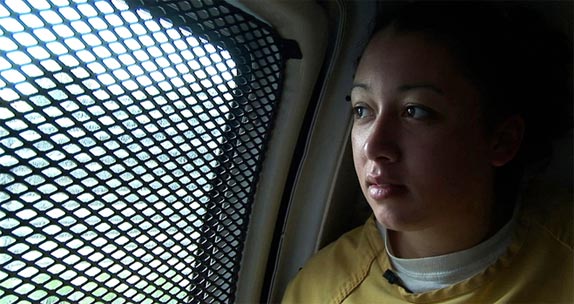
This brings me to a new documentary that I had the privilege of previewing.  The film is called Me Facing Life: Cyntoia’s Story.

The film is described this way on its website:

In 2004, Cyntoia Brown was arrested for murder. There was no question that a 43-year-old man is dead and that she killed him. What mystified filmmaker Daniel Birman was just how common violence among youth is, and just how rarely we stop to question our assumptions about it. He wondered in this case what led a girl — who grew-up in a reasonable home environment — to this tragic end?

Me Facing Life: Cyntoia’s Story explores Cyntoia’s life. The camera first glimpses her the week of her arrest at age 16 and follows her for nearly six years. Along the way, nationally renown juvenile forensic psychiatrist, Dr. William Bernet from Vanderbilt University, assesses her situation. We meet Ellenette Brown, Cyntoia’s adoptive mother who talks about the young girl’s early years. Georgina Mitchell, Cyntoia’s biological mother, meets her for the first time since she gave her up for adoption 14 years earlier. When we meet Cyntoia’s maternal grandmother, Joan Warren, some patterns begin to come into sharp focus.

Cyntoia wrestles with her fate. She is stunningly articulate, and spends the time to put the pieces of this puzzle together with us. Cyntoia’s pre-prison lifestyle was nearly indistiguishable from her mother’s at the same age. History — predestined by biology and circumstance — is repeating down the generations in this family.

Cyntoia is tried as an adult, and the cameras are there when she is convicted and sentenced to life at the Tennessee Prison for Women. After the verdict, Cyntoia calls her mom to tell her the news.

In the end, we catch up with Cyntoia as she is adjusting to prison, and struggling with her identity and hope for her future.

This description gives you the facts about the film and yet it does not convey the emotional impact of watching this documentary.  I would describe the film as being “suffocating” in terms of how it made me feel.  There were moments when I just lost my ability to breathe because I was choking with emotions.  At times, I was angry and at other times I felt despondent at the seeming intractability of this problem.  I was grateful to be a witness to Cyntoia’s journey and yet I felt powerless in the face of the challenges that she has to live with.  I cannot recommend this film more highly.    It demands for us to do more and to respond to its call to action.

I found the film so affecting that I agreed to be a co-organizer along with Community Cinema Chicago of a special screening of the film on February 19th.  The screening will take place at the Chicago Cultural Center and more information will be forthcoming.  If you live in other parts of the country, dates for other screenings of the film can be found here.

For more useful resources about girls in trouble with the law, click here.

Dec 12 2010

Prison Industries: A Very Short Early History

The origin of prisoner labor in the Anglo-American context dates back to the early jails of the 11th through 13th centuries.  The main purpose of inmate labor during that time was to pay the costs of incarceration — including the sheriff’s wages.

By the 14th century, the moral virtue of labor had been ensconced in the English tradition.  English laws began to criminalize “idleness” and “vagrancy.”  The English Statutes of Labor of 1348 and 1357 made “idleness of the able-bodied a crime.”  In the 16th century, workhouses for vagrants began to be established starting with one at Bridewell built in 1557.  This development introduced the concept of hard labor as a reformative program rather than simply as a way to pay for one’s own incarceration.

A little over 300 years ago is when the idea prisons as an alternative to other forms of punishment emerged. As such the concept of prisons is relatively new in human history.

“According to Carroll Wright, first director of the U.S. Bureau of Labor the earliest writing emphasizing inmate labor as a critical element of the prison regime was that of Mabillon, a Benedictine monk at the Abbey of Saint Germaine in Paris during the reign of Louis XIV.  Mabillon suggested that ‘penitents might be reclused in cells, like those of the Carthusian monks and there (be) employed in various sorts of labor.’  This idea was soon implemented in 1704 by Pope Clement XI, who established a reformatory for juveniles at Saint Michael’s in Rome.

The forerunner of a formal prison industry program dates from the prison at Ghent, which was constructed in 1775.  Viscount Vilain XIV, the builder of the prison emphasized labor as the primary agent for reforming criminals.  The prison industries selected were highly diversified and intended to minimize competition with free labor.” (ACA, 1986)

The U.S. system followed a similar pattern as its European precursor.  The first American jail opened in Massachusetts in 1635.  Early American jails also insisted that inmates pay for the cost of their incarceration.  However they did not really promote the idea of labor as a rehabilitative concept.

The first prisons were established in the United States in the late 18th century in states like New York, Massachusetts, and Pennsylvania.  In these prisons, labor was connected to the concept of doing penance but was mainly focused on the goal of economic upkeep (meaning that prisoners should pay for their own incarceration).

It wasn’t until after the Civil War that many more states began to open their own prisons.  Once prisons became more prevalent, prison industries became more formalized as people began to see the value of having a site for communal labor.  This emergence of prison industries was not uncontroversial.  Early prison reformers (who were often very religious) worried that the employment aspect of penitentiaries was resulting in the loss of  the penitence component underlying the initial concept of introducing a labor function to prisons.  Other outside forces representing business and unions also wanted to make sure the prison industries did not have an unfair advantage over “free” labor.

At the beginning of the 20th century, about 85 percent of all “inmates” worked in prison industries; by 1940 the figure had fallen to 44 percent — nearly a 50 percent decline. This decline was precipitated by greater opposition to prison industry from businesses and unions based on the charge of unfair competition.  A number of bills were introduced in Congress to restrict prison industries.  One of the most important was the Hawes-Cooper Act which Congress passed in 1929 to permit states to bar the importation of prison-made goods.  The Great Depression also added voices in opposition to prison industries since unemployment was so widespread across the country.  The Summer-Ashurst Act of 1940 made it a crime to ship prison-made goods in interstate commerce whether or not the receiving state barred their import.

Things remained pretty much stagnant around the concept of prison industries until the 1960s when many changes in corrections facilitated the re-emergence of the concept of labor, employment and industry within penitentiaries.  The 1967 President’s Commission Taskforce Report re-enshrined a work-oriented philosophy of rehabilitation and reintegration for prisoners.  This is a good date from which to mark the beginning of the contemporary re-emergence of prison industries.

As I hope that you can see from the very short description of a history of the emergence of prison industries, this concept has been contested from its inception.  There have been opponents of this idea from the very beginning.  The reasons that they offered for their opposition were different depending on the values that they sought to advance and on their self-interests.  I think that it is instructive to look back as we look forward.  It’s the concept of Sankofa.  The current fights that we have about the concept of the prison industrial complex are ones that have their roots in years of previous argument and struggle.  La Lucha Continua!

Dec 10 2010

Revisiting the Traged(ies) of the Derrion Albert Killing…

This post is precipitated by the news yesterday that a young man was convicted of first-degree murder for the killing of Derrion Albert.

For those of us who live in Chicago, particularly those who work with youth, September 24th 2009 is a day that we won’t soon forget.  16-year old Derrion Albert was killed and the national media descended upon our city like vultures.

The death of a young black male in Chicago is sad on its face but it would have garnered little attention beyond that of his friends and family if his death had not been captured on a cell phone video.  The video showed Albert’s fatal beating as he walked into a melee, allegedly two gangs fighting, on a Chicago street.  The video captured a group of young people striking him with boards and kicking him as he lay on a sidewalk.

When the national media descended on Chicago, we were subjected to the following type of reporting….  Joe Johns of CNN earnestly assuring the audience that Derrion was “not a gang-banger.” Presumably, this was meant as a signal to viewers that Derrion was deserving of our consideration and of our compassion.

I sat in a peacemaking circle with a young woman who I will call Shania in early October 2009. She was struggling to make sense of the senseless. Her animating question was “Why?” “Why Did Derrion Die?” Shania said that one of her closest friends had known Derrion and that her friend was devastated by his loss. Her friend wanted revenge; she was demanding that the young men who were accused of killing Derrion Albert be given the death penalty for their actions. And yet, Shania was conflicted. She wanted to comfort her friend who was obviously hurting from the loss of someone dear while not losing track of the humanity of those young men who had been accused of killing Derrion. On that October day, those of us in the circle who were adults struggled to provide any sort of adequate answer to Shania’s troubling and important question of “Why Did Derrion Die?”

Yesterday, the first of the young men being tried for Derrion’s killing was convicted:

His attorney painted him as a foolish schoolboy who stumbled upon a fight he had nothing to do with as he walked home from school.

But a jury took little more than half-an-hour to reject that argument and find the 15-year-old guilty of the first-degree murder of Fenger High School honors student Derrion Albert.

Caught in a notorious cell-phone video that showed him punching Albert, 16, in the face, the teen collapsed into his chair and slammed it into the wall as the guilty verdict was announced at the Cook County Juvenile Court Wednesday.

As Albert’s mother dabbed her eyes and slowly shook her head, the convicted teen’s aunt ran from the courtroom screaming, “Oh Lord, oh Lord, oh Lord.’’

The dramatic end to the two-day trial came more than a year after the cell phone video of the fatal Sept. 24, 2009 melee went viral and created shockwaves around the world.

During the trial, the boy’s attorney Richard Kloak, told jurors that his client was just 14 when Albert was killed in the 300 block of West 111th St.

Think about this… The trial took 2 days and a verdict was returned in 30 minutes. In that time, a fifteen year old, who was tried as an adult for a crime he committed at 14 years old, will be facing a sentence of 20 years to life in prison.

Here is what his lawyer is quoted as saying about the verdict:

“He’s only 15 years old,” Kloak said. “He’s got his whole life ahead of him, and he’s got to learn to deal with adversity.”

I don’t even know what to make of this sentence and I am not going to try to parse it. Suffice it to say that another young black man is slated to be sacrificed to the always ravenous prison industrial complex. It is a tragedy for the Albert family that their son was killed and it is a tragedy for this 15 year old’s family that they too have essentially lost theirs.

In the days following that circle with Shania, I struggled to think about how I could contribute to helping to foster spaces where youth and adults could grapple with some of the answers to the question of Why Derrion Albert died. I knew that it would be a matter of a couple of months before the national media left our city and that it was likely that Derrion’s memory would fade. I decided that a curriculum that would help adults to talk with young people about the root causes of violence might be a valuable and lasting contribution. Thus the Something is Wrong: Exploring the Roots of Violence Curriculum Guide was born. It was a collaborative effort and has since been used across the country by educators, youth workers, and others to help “young people channel their righteous rage” towards the actual sources of their oppression.

Where justice is denied, where poverty is enforced, where ignorance prevails, and where one class is made to feel that society is organized in a conspiracy to oppress, rob and degrade them, neither persons nor property will be safe. — Frederick Douglass.

The Frederick Douglass quote cited above speaks to the reality that violence is the glue that holds oppressions in place. It is impossible to understand violence without deeply probing and analyzing oppression and how it works. Violence is a real problem for many young people, though not always or even usually in the form of the sensational incidents that tend to dominate the headlines and create pressure for solutions. Youth encounter violence in every arena of their daily lives — at home, at school, through the media, or on the streets of their neighborhoods. Preventing violence before it happens means ensuring that young people have, at minimum, sound education, job opportunities, outlets for recreation, safe neighborhoods, supportive adults in their lives, protection from guns, good nutrition, access to affordable healthcare and stable housing.

In the Spring of this year, I returned to Fenger high school. Derrion’s school. The school that many of the young people who participated in that melee in September 2009 also attended. This time, I came as part of a celebration of peace with dozens of other people to run peacemaking circles and unveil a mural that was created by youth and adults together. As I kept a circle that included two public defenders, a Fenger teacher, and a number of students, I marveled at our capacity as human beings to overcome tragedy and to continue to hope in spite of the odds against us. The young people in that circle spoke about love for their neighborhood and their school and for each other. We celebrated our resiliency, The young people wanted it to be known that they had aspirations for brighter futures for themselves and their families. They did not want to be defined by the incident that had branded them and their peers as out of control savages. It was a good day. One of still many more to come…

___________________________________________________________

You can listen to Carolyn Elaine who is an amazing Chicago mosaic artist and Fenger high school graduate speak about why she came back to the school to lead a collective mural project. You can also see that way that peacemaking circles were integrated into the program.

You can see the Fenger Mural as it took shape here:

Dec 09 2010

T.I.’s ‘No Mercy’ and the Ambivalence of Change

There’s no mercy for me
No crying myself to sleep
No mercy for me
Nightmares have become my dreams
No mercy for me
Good morning reality
Will I wake we’ll never know
I’m late for my date with destiny
Let me go
Let me go
You’ve got to let me go
Right or wrong
Let me go
I’m on my path
Let me go

So the video for TI’s new song ‘No Mercy’ was just released. Here it is:

I have developed a fascination with T.I. ever since I read an article back in July where he talked about his recent incarceration experience. I knew of him before that but I didn’t really pay much attention. My recollection of first hearing about him is when he released his hit song Rubberband Man a few years ago. I don’t know the man personally of course but I have become fascinated by his plight as somewhat emblematic of the experiences of so-many other young black men in America.

Recently, Russell Simmons penned a blog at the Huffington Post titled “Black Male Multiple Choice: Unemployed, High School Drop Out or Incarcerated.” Unfortunately the essay is not hyperbole. He opens with this stark reality:

If a black boy is born in the US today, he will have a 33 percent chance of going to prison in his lifetime. Stated another way — one in three black boys born today will face prison time. It has become a sad normality, almost a backwards rite of passage, for black young men to enter the penal system and never return to our communities. And if we are “lucky” enough for them to return, they usually are much hardened criminals than they ever were before. Black men represent 8 percent of the population of the United States but comprise 3 percent of all college undergrads, 48 percent of inmates in prison and are five times more likely to die from HIV/AIDS than white men. 50 percent of black boys do not finish high school, 72 percent of black male dropouts in their 20s are unemployed and 60 percent of black male dropouts are eventually incarcerated.

It all feels overwhelming and deeply deeply intractable, doesn’t it? Ta-Nehesi Coates puts the crisis of black hyper-incarceration into even sharper focus by underscoring that fact that over 800,000 of the 2.3 million individuals in American jails and prisons are black men. The take-away point of his post is that:

African-Americans–males and females–make up .6 percent of the entire world’s population, but African-American males–alone–make up 8 percent of the entire world’s prison population.

It’s difficult to wrap one’s head around the magnitude of this injustice. This brings me back to a consideration of T.I.’s new song “No Mercy.” I find the title in and of itself to be thought-provoking. It  is true that we show “no mercy” for young black men in this country. Black children, in general, never have the privilege of inhabiting the identity of  “innocent.” In fact, their racial background immediately puts them in a position of being viewed and treated as “suspect” from birth.  This reality means that when young black children misbehave we are more likely to consider this as inherently part of their make-up.  As such, we are unwilling to chalk it up to being a mistake or to seeing the possibility for change.

More lyrics from NO MERCY

My mama loved me more than i do
She said you pap was jus like you
Trapped in a vicious circle
Jesus youngest disciple
Tell the judge if he throwed the book at me
Make it the bible

Start calling myself the king
For lack of a better title
Loyal beyond belief to my detriment
It’s so vital I change or blow opportunities
Like a choir recital
Now while I do not care who telling
Meanwhile selling powder puts food in the bellies
Well it’s unfortunate
The orphanage couldn’t keep up the mortgages
Kid go to school stupid they teachers ignoring it
Sorta just doomed, forced into being a goon, selling kush in a jar

There is so much in this verse. In just a few lines, we learn about his lack of self-esteem (his mother loving him more than he loves himself); his father who is trapped in a cycle of oppression; the judge who is focused on punishment rather than restoration; and the general struggle to survive in a culture that doesn’t want you to thrive.

Everybody’s standing and waiting an they’re hating
Gospels say they should forgive me
They’d rather hand me to satan
Blatant displays the day of hypocrisy
Boy you got to be kidding

Apparently this song was written after T.I. was released from prison last year where he was serving time for a weapons charge. He was planning for this new album to signal his re-birth and his redemption. Instead he is back in prison now for violating his parole by using an illegal substance. He embodies the cycle that so many young men experience. His success and money have not inoculated him. This is instructive. In the verse above, one gets the sense that T.I. is begging for compassion that he knows will not come. Our culture is so harsh and unforgiving. He knows that he will not find redemption since the culture fundamentally rejects the possibility for human transformation.

There is so much in this song. So much more to analyze and think about and discuss. What characterizes my experience in working with youth in conflict with the law is their deep sense of ambivalence about whether they want to change or to embrace a different reality. This sense of ambivalence permeates “No Mercy.”  The song pushes us to consider whether we will be facilitators of human transformation or obstacles to the possibility for change.

Dec 08 2010

Cradle 2 Prison Blog: Examining the Juvenile Justice System through Art

Since early 2010, Project NIA and the Jane Addams Hull House Museum have partnered to sponsor a comic arts project for youth to address the history and current manifestations of the juvenile justice system. This is part of the Museum’s new interactive exhibit called Unfinished Business: Juvenile Justice. Project NIA and the Hull House Museum first co-sponsored a comic arts workshop at the Cook County Juvenile Temporary Detention Center (CCJTDC) in August 2010. Teaching artist Elgin Smith worked with young men and women who are incarcerated at JTDC for several weeks to create art work that will be turned into a graphic novel to be released in the Spring of 2011. Below are a couple of the pieces that were created by youth during the workshops:

Created as part of comic workshop at JTDC (August 2010)

Created as part of comic workshop at JTDC (August 2010)

For the second part of this project, Project NIA and the Hull House Museum were joined by the Chicago Freedom School (CFS) to offer a comic arts workshop for youth on the outside. Nine youth worked with teaching artist Rachel Williams to create art which will also be incorporated into the final zine.

NIA volunteer and incoming CFS board co-chair, Eva Nagao was instrumental in coordinating the second workshop series which was held at the Chicago Freedom School over the course of 5 Saturdays in October and November.

Eva has created a new blog called Cradle 2 Prison: Examining the Juvenile Justice System through Art. The site will provide ongoing information about the workshops as well as other resources such as infographics and art that depict the juvenile and adult criminal legal systems. Special thanks to Eva for putting this together!

Dec 08 2010

Reflections on Being an Advocate for the “Guilty”

These are some musings that I have had over the past few weeks. I have been mulling ideas about what it means to be an advocate for the “guilty.” Two of my colleagues have recently inspired me to think about this idea more intentionally as it relates to my own work.

Yesterday, a colleague who teaches at a local law school shared that she tells her law students that she works “on behalf of the guilty.” She said: “I work with the young people who actually committed the crime they are accused of.” She was completely unperturbed as she relayed this. She was unapologetic about this fact. I took heart in her statement. I felt myself becoming just a little bit more hopeful too. While I have great respect for my colleagues who focus their work on exonerating the innocent, we are truly blessed to have people like her out there supporting youth in conflict in the law.

The reality is that there are young people who have committed crimes and they need support. They need zealous advocacy. Their value as human beings must be affirmed. They deserve our attention and our love. When making this case, one risks being accused of lacking compassion for crime victims and for eschewing accountability for harm done. First of all the majority of the “crimes” that young people are punished for are non-violent ones that do not involve another person. Drug offenses account for a large percentage of these “crimes.” Second most young people who have committed some sort of offense were themselves first “victims” of harm perpetrated against them. It is an unfortunate cycle of violence. Finally, I am above all a victim’s advocate and I do not believe that the current criminal legal system which is based on retribution serves victim’s interests well. Think about the fact that in criminal cases, it is the State vs. Defendant X. The victim is not at the center of the proceedings.

A couple of weeks ago, I was on a panel with another colleague who told an important story. She shared the story of a young woman who was incarcerated at the juvenile jail where she works. This young woman was jailed there for years while awaiting a transfer to an adult prison when she was of age. She told of this young woman’s immense leadership abilities and of her role as a nurturer of the other incarcerated girls. One day, without any warning, the young woman was transferred very early in the morning to the adult prison where she was eventually supposed to reside. She had spent 3 to 4 years at the jail but had not been given an opportunity to say goodbye to her peers or to her teachers and other staff who had grown to like and respect her. This was supposedly done to ensure that there would be no disturbances or “trouble” as she was being moved. My colleague ended her story by relaying that a newspaper article appeared shortly after the young woman left detailing the crimes for which she had been convicted. Apparently the details of this crime were horrific and everyone at the jail (staff, teachers, and incarcerated girls) was stunned. Could this be true? How could the person who they had gotten to know be the same person who committed this crime? But I thought she was nice… some of the other girls lamented. Who was the “real” young woman that they had interacted with? Was she the person they had admired and respected over the past 4 years or was she to be mainly defined through the crime that she had committed? The moral of this story is that people cannot solely be defined by the worse thing that they have ever done. People are complicated and grey.

Yesterday I was privileged to take part in a conversation about an upcoming film by Steven James and Alex Kotlowitz called “The Interrupters.” I won’t say too much about the documentary at this point. I will definitely blog about it closer to its official release date next year. The film focuses on three violence “interrupters” from an organization here in Chicago called Ceasefire. The stories of the interrupters serve as a lens through which we can better understand public interpersonal violence and how it plays out in urban America. Even more than that, it is the story of an important group of people in America — former prisoners — and how they can/do use their unique skills and experiences to help address the issue of public interpersonal violence in our cities. One of the most important skills that these “interrupters” bring to their very difficult work is an ability be meet people exactly where they are. We often talk about the importance of being nonjudgmental but few of us ever achieve this in our work or in our lives. These interrupters absolutely do. I suspect that this is because they have had the harsh spotlight of judgment aimed squarely at them for past transgressions. When we acknowledge ourselves as being both perpetrators and survivors then we can ultimately be more forgiving of other people’s foibles. We also find ourselves more willing to act without judgement.

The people that most of us interact with are not stereotypically “bad” or “good.” People are a little bit of everything all of the time. This should engender greater compassion in us. I think that it does.