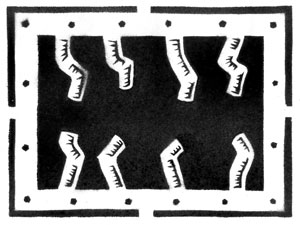
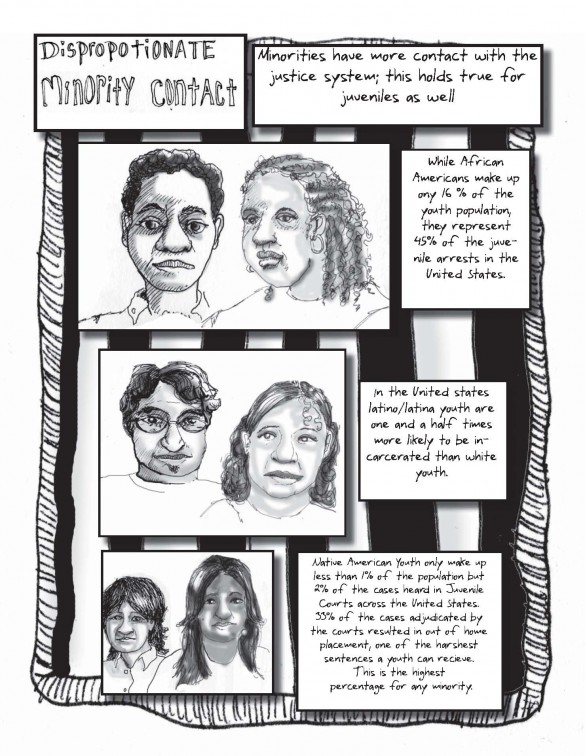
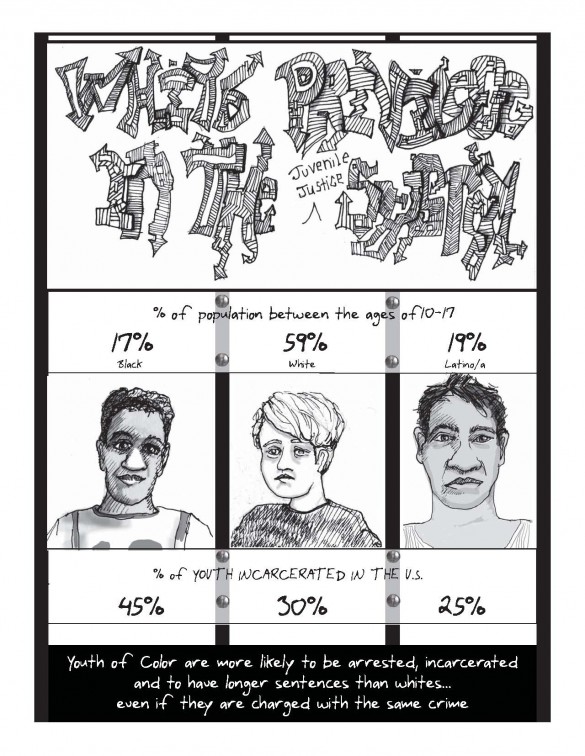
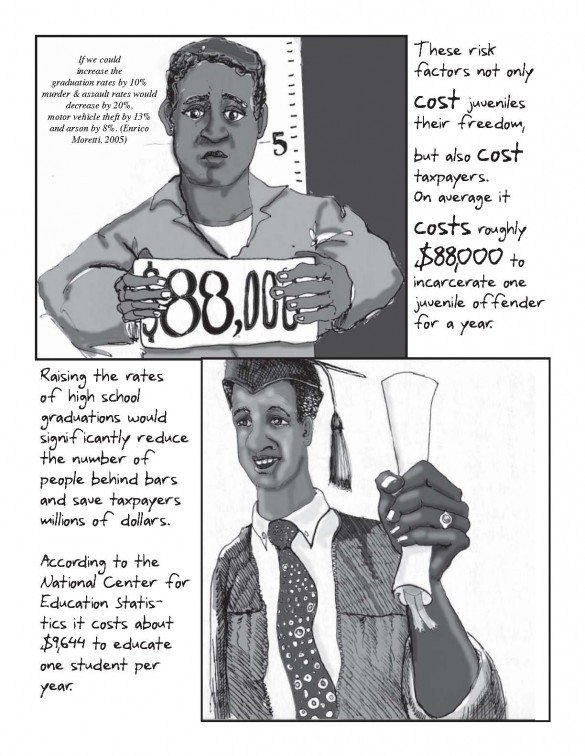
I am excited to share some preliminary images from a comic zine about disproportionate minority contact in the juvenile justice system. These were created by teaching artist Rachel Williams along with a great group of youth who participated in a comic workshop last year. Information about the comic workshop can be found HERE. Keep your eyes open for our entire zine series which will be released in May 2011.
Created as part of the Just Us Comic Workshop 2010 (Rachel Williams, Teaching Artist)
Created as part of Just Us Comic Workshop 2010
Created during Just Us Comic Workshop 2010
Uncategorized | prison culture | Comments Off on Disproportionate Minority Contact in Juvenile Justice System: A Comic Zine Project
I have gotten many very interesting responses to my post about Michael Vick and the ‘Myth’ of Reentry.
One of the questions raised by a commenter was about how the prison system has traditionally handled the issue of prisoner re-integration into society. I thought that this was an excellent question that deserves further investigation.
I came across this ethnographic description by Etheridge Knight of what happens once a prisoner is paroled in his essay “Inside These Walls” that I referenced yesterday.
Finally, when a man is paroled, he is given $15 in cash and a new suit of clothes (out of style) by the state. And most men leaving prison have nothing on which to rely until they can draw a paycheck. (During the years in prison he has earned an average of ten cents a day. A bar of soap costs twenty cents, in prison.)
Ninety-nine times out of a hundred, a man leaving prison is going to work on a blue-collar job, so the new suit of clothes is without utility. The fifteen dollars will hardly provide him with a place to stay — to say nothing of the personal necessities: work clothes, razor and toothbrush, etc. Because of all of this, a man who has a wife or relatives on whom he must rely us from the outset put into an embarrassing, self-demeaning position. A man who has no wife or close relatives is forced to seek out old friends, usually those in an environment which quickly shoves him back into criminal activities.
Small wonder then that 75 per cent of all ex-convicts return to crime. Men are put into prison for the protection of society, it is said, but is it being protected when 90 per cent of all the men in prison will at one time or another be released and when 75 per cent of them return to crime?
If this was the case in the mid-1960s, how could we update this description in 2011? I would be interested if any enterprising researchers could send along an update of Knight’s description for 2011. Pick the particular state that you want to focus on. Knight was writing about the situation in Indiana. So how much money are prisoners who are released today given (if any)? Are they provided with a change of clothes? How much does soap cost today?
Update: Special thanks to Oona for sending along this information about the current California system…
[H]ere is what I know about the California Dept of Corrections (and Rehabilitation)
When released from a California State Prison, the man/woman released receives the following:
If they have served > 6 months: $200
If they have served < 6 months: $1.10 for each day served in custody.
Subtracted from this amount is the ~$40 charged for the clothes on their back (a grey sweatsuit), unless they are lucky enough to have family/friends or one of the few community programs provide them with "dress-outs", ie normal street clothing mailed to the institution and given to the inmate on day of release.
The released person is then either picked up at the gate, or dropped off at a local bus station. If, for example, the released person must travel from Marin County, CA to Los Angeles County, CA, there goes 1/2 of their gate money.
I welcome testimonies from others about how things work in your state…
Update 2: A dispatch from Nequam…
There’s basically 2 systems in Texas. If you’re being released from a state jail facility, you’re given no money from the state. You will be given clothing that somewhat fits you. If you have money in your commissary account, this is provided to you in the form of a check. If you have no one to pick you up, you are taken to the bus station. If you are not from the immediate area of your release, you will be provided with a bus ticket. If you are living prison, all is the same except that you are given $50 upon your release and another $50 when you first report to your parole officer. If you have no family to return to you’re basically dropped off on the streets.
I received a letter this week from a young prisoner who I correspond with. As he described how he was doing, he stressed how bored he was in prison. This is the rub of the prison experience for so many. The monotony and the sameness of each day in prison is under-appreciated by the general public. This reality of prison life was first brought home to me in an essay that I read by Etheridge Knight called “Inside These Walls.” In the piece written in 1967, Knight offers a description of a day in the life of a prisoner at the Indiana State Penitentiary. He is writing this from first hand experience having been incarcerated at that same prison.
And what do these men do inside these walls? It’s simple, maddeningly simple: At six o’clock in the morning a whistle blows. They get up and wash their faces. At six-fifteen, a bell rings, and they march off to the prison mess hall and eat a breakfast of, say, oatmeal, prunes, bread and coffee. They leave the mess hall in a line and drop their spoons in a bucket by the door, watched over by a “screw.” They march to their shops — say the Tag Shop, climb upon a stool and dip license plates into a tank of paint until nine-thirty. A bell rings; they smoke. A bell rings; they go back to work.
At eleven-thirty, a bell rings again. They stop work, wash up, march back to their shelters. At twelve o’clock, a bell rings in the cellhouse; they walk to the mess hall where they eat, say, a meal of white beans, frankfurters, and cornbread. They leave the mess hall, drop their spoons into the bucket and, in line, go back to work. The morning performance is repeated. At four-thirty a whistle blows; they march to supper and then into their cellhouse for the night. Maddeningly simple.
Contrast this description of a day in the life of an inmate with a contemporary one offered by a prisoner named ‘Paul’ who I blogged about a few months ago. You will find Knight’s description written in 1967 strikingly similar to Paul’s in 2010. As Paul suggests in prison “every day is the same.”
I encourage anyone who is interested in better understanding prison life to read Knight’s essay in its entirety. In less than 20 pages, Knight paints an invaluable portrait of prison life for readers. He offers details about the physical structure of a cell, about prison guards, about the different departments within the prison, about incidents of physical brutality, etc… Tomorrow, I will feature an excerpt that details life for prisoners once they are released.
Uncategorized | prison culture | Comments Off on The Monotony of Prison Life: An Ethnographic Account
As part of my New Year’s resolution to feature more voices of prisoners here, I found this poem called Another Day in Stephen John Hartnett’s new book Challenging the Prison Industrial Complex: Activism, Arts, & Educational Alternatives. The poem was written by Erika Baro who is a member of the Writing Workshop at the Denver Women’s Correctional Facility. The piece was first published in Captured Words/Free Thoughts 6 (Spring 2009).
By Erika Baro
Laying in a pool of tears
Hidden by darkness
I wander lost between the hundreds
Of stars that decorate the night sky
As my voice whispers strangely
Driving me deeper into a madness
I cannot escape
I drift farther and farther away
On an infinite path to nowhere
But just as the last drop of hope slips away
A faint ray of light falls on my face
The sunrise dries my tears
And I realize I’ve survived
I will live another day
Uncategorized | prison culture | Comments Off on Poem of the Day: Another Day by Erika Baro
The warden said to me the other day
(innocently, I think). “Say, etheridge,
why come the black boys don’t run off
like the white boys do?”
I lowered my jaw and scratched my head
and said (innocently, I think), “Well, suh,
I ain’t for sure, but I reckon it’s cause
we ain’t got no wheres to run to.”
Born in Mississippi, Etheridge Knight grew up in Indianapolis. Given a twenty-year prison sentence in 1960, Knight wrote for the prison newspaper. He was released on parole in 1968 and ended up teaching at various Universities. Knight once wrote:
“I died in Korea from a shrapnel wound and narcotics resurrected me. I died in 1960 from a prison sentence and poetry brought me back to life.”
Uncategorized | prison culture | Comments Off on Poem of the Day: The Warden Said to Me the Other Day
There are a couple of reasons why I have resisted commenting on the case of the Scott Sisters in Mississippi. The first is that there has been terrific coverage of the case at Solitary Watch. The second is that this case is unfortunately not atypical. In fact, the truth is that the criminal IN-justice system destroys countless lives every single day in every state of this Union.
Josh MacPhee - Just Seeds
So instead of addressing the Scott Sisters’ case, I thought that folks might be interested in getting a better sense of just how awful Mississippi’s criminal legal system has historically been.
The end of slavery disrupted the South’s main labor supply. Mississippi was ground zero of white supremacy after the Civil War. This was in part because blacks greatly outnumbered whites in the state. This engendered a fear of a newly empowered “free” black majority that could claim social, political and perhaps one day economic power. Something had to be done to prevent the rise of the “free” black man.
Mississippi is the state that gave the country the “Black Codes” after emancipation. As David Oshinsky (1996) writes: “The Mississippi Black Codes were copied, sometimes word for word, by legislators in South Carolina, Georgia, Florida, Alabama, Louisiana & Texas” (p.21).
W.E.B. Dubois described the Black Codes as follows: “The original codes favored by the Southern legislatures were an astonishing affront to emancipation and dealt with vagrancy, apprenticeships, labor contracts, migration, civil and legal rights. In all cases, there was plain and indisputable attempt on the part of the Southern states to make Negroes slaves in everything but name.”
Vagrancy laws were the centerpiece of the black codes.
Mississippi provided: “That all freedmen, free Negroes, and mulattoes in this state over the age of eighteen years, found on the second Monday in January, 1866, or thereafter, with no lawful employment or business, or found unlawfully assembling themselves together, either in the day or night time, and all white persons so assembling with freedmen, free Negroes or mulattoes, or usually associating with freedmen, free Negroes or mulattoes on terms of equality, or living in adultery or fornication with a freedwoman, free Negro or mulatto, shall be deemed vagrants, and on conviction thereof shall be fined in the sum of not exceeding, in the case of a freedman, free Negro or mulatto, fifty dollars, and a white man two hundred dollars and imprisoned, at the discretion of the court, the free Negro not exceeding ten days, and the white men not exceeding six months.
According to Oshinsky (1996): “These codes were vigorously enforced. Hundreds of blacks were arrested and auctioned off to local planters. Others were made to scrub horses, sweep sidewalks, and haul away trash” (p.21).
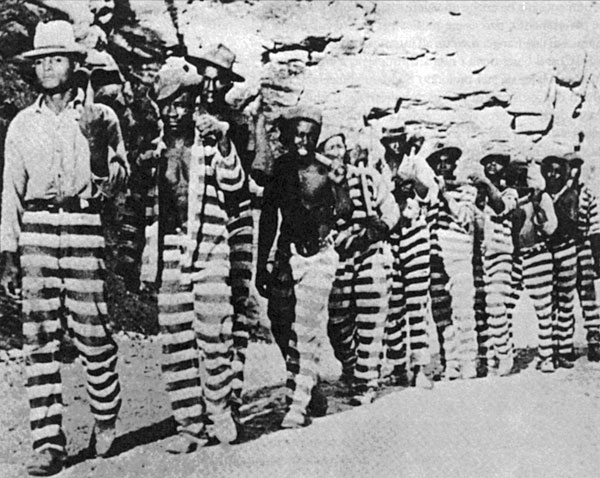
Prior to the Civil War and well after Emancipation, Mississippi had a reputation as a lawless, “rough justice” state. Duels among white men were common until the late 19th century and the courts had no hold over the population. Mississippi was the epitome of vigilante justice. The convict lease system in Mississippi was brutal and deadly. Oshinsky (1996) quotes the state’s former attorney general Frank Johnston as saying that convict leasing in Mississippi had produced an “epidemic death rate without the epidemic (p.50).”
It was against this backdrop that Parchman Farm was established in 1901. Below is a description of the Farm:
“Parchman’s twenty thousand acres covered forty-six square miles. Just inside the main gate was Front camp, which contained a crude infirmary, a post office, and an administration building where new convicts were processed and issued their prison garb. The men got ‘ring-arounds,’ shirts and pants with horizontal black and white stripes; the women wore ‘up-and-downs,” baggy dresses with vertical stripes…The plantation was divided into fifteen field camps, each surrounded by barbed wire and positioned at least a half-mile apart. The camps were segregated only by race and sex. First offenders were caged with incorrigibles, and adults with juveniles, some as young as twelve and thirteen. ‘Feeble-minded’ convicts were everywhere. Parchman housed prisoners like John Brady, an ax-murder with the mental age of a five-year old, because Mississippi did not recognize “idiocy” and “imbecility” as special categories in its criminal code. The result was a brutal, predatory culture made worse by the prison’s vast and isolated expanse (Oshinsky, pp.137-138).”
The Farm is memorialized in the great blues song Parchman Farm Blues written by Bukka White while he was incarcerated there. This is Bukka White's performance of his most famous song:
Here are the lyrics to the song:
Judge give me life this mornin’, down on old Parchman’s Farm.
Judge give me life this mornin’, down on old Parchman’s Farm.
I wouldn’t hate it so bad, but I miss my wife and my home.
Now, good-bye wife, all you have done gone, all you have done gone.
Well, good-bye wife, all you have done gone.
But I hope someday you will hear my lonesome song.
INSTRUMENTAL
Now, listen you men: I don’t mean no harm, I don’t mean no harm.
Now, listen. You men. I don’t mean no harm.
If you wanna do good you better stay off old Parchman’s Farm.
You go to work in the mornin’, just the dawn of day,
just the dawn of day.
Go to work in the mornin’, just at the dawn of day.
And at the settin’ of the sun that is when your work is done.
INSTRUMENTAL
I’m down on old Parchman’s Farm, but I sure wanna go back home, Wanna go back home.
I’m down on old Parchman’s Farm, but I sure wanna go back home.
And I hope some day that I will overcome.
Judge give me life this mornin’, down on old Parchman’s Farm.
Judge give me life this mornin’, down on old Parchman’s Farm.
I wouldn’t hate it so bad, but I miss my wife and my home.
It is worth remembering as we decry the current state of affairs in Mississippi that this state (like many others in the U.S.) has a long history of INJUSTICE. The Scott Sisters’ case has to be placed within the context of years of racialized surveillance in a state that has criminalized black people for generations.
State and local governments across the U.S. are going broke. In 2011, budget deficits in state houses across the country will necessitate increased revenue and/or spending cuts. As Republicans have made significant gains in governorships and state houses, conventional wisdom expects that they will focus on “spending” cuts rather than on raising taxes. New governors like Chris Christie in New Jersey, John Kasich in Ohio, and Rick Scott in Florida are all promising to cut their public employees and cut various public services.
Therefore it is not surprising to me to read the following article about a proposal to increase the use prisoners to respond to natural disasters.
The Missouri National Guard plans to start training some of the state’s prison inmates to help it during natural disasters and other emergencies.
Missouri Guard Maj. Tammy Spicer said that under the proposal, the inmates would become a more formalized part of the Guard’s disaster response. She said it would give the Guard a larger and better trained pool of workers to respond to emergencies.
The training would focus on skills such as filling and stacking sandbags and removing debris.
“We’re trying to do something better for Missourians,” Spicer said.
Inmates have been used in the past to help local officials during floods and other emergencies. Over the past several years, they have worked to shore up levies and fill sandbags along flooding rivers from near St. Louis to northwestern Missouri.
Then there is also news that female prisoners in New York States will be running a DMV call center:
Female prisoners at the Bedford Hills Correctional Facility in Westchester County are staffing a Department of Motor Vehicles call center. The facility employs 39 inmates, including 31 full-time and part-time customer service agents, six team leaders and two trainers.
The program has been going on for years at the Bayview Women’s Prison in Manhattan, but that has been converted to a re-entry facility for short-timers being released into the community and Bedford Hills has a larger inmate population with longer sentences.
The men’s Arthur Kill Correctional Facility on Staten Island also operates a DMV call center. Between the two, one million calls are expected yearly with a savings to taxpayers of $3.5 million annually.
In addition to saving money, it will provide job skills for participating inmates, said prisons spokesman Erik Kriss.
“They do earn a small stipend for doing this work and that helps them to afford items in the commissary and so forth and it gives them motivation,” he said. “Everyone needs motivation, whether you are outside prison or inside prison.”
The inmates who participate do not have access to DMV computers and are not able to access any customer data. Inmates convicted of a telephone related crime or credit card or computer fraud are not eligible to work at the center. Calls are monitored at random.
I expect that many other states will be starting similar programs if they haven’t already done so in the next few years. I expect that this is only the beginning of using prisoners to meet the needs of the public sector during our upcoming era of austerity.
Uncategorized | prison culture | Comments Off on ‘Austerity’ Means Prisoners as Our New State Employees
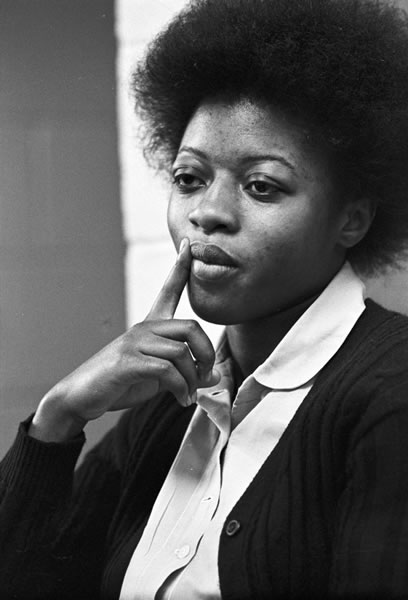
Following up on my post about the invisibility of women prisoners' organizing efforts and on the occasion of news that Sara Kruzan has had her sentence commuted, I thought that folks might be interested in revisiting the “Free Joan Little” movement as an example of successful cross-issue organizing that could provide a useful template for the present. First, a short summary of the facts of the Joan (pronounced Jo Anne) Little case.
At 4:00 A.M. on August 27, 1974, officers at the Beaufort County Jail in Washington, North Carolina discovered the body of guard Clarence Alligood in a cell. Nude from the waist down, he had been stabbed 11 times. His trousers were bunched up in his right hand. The fingers of his left hand enclosed an ice pick. The cell’s occupant, Joan Little, age 20, had been serving a seven-year sentence for robbery; now she was gone. One week later she surrendered to authorities. The story she told made headlines. Little, a black woman, claimed that the 62-year-old white jailer had forced her into performing a sexual act, and that she had killed him in self-defense.
Source: Joan Little Trial: 1975 – Sexual Advance Prompts Killing, A Quick Acquittal
Joan Little at Women's Prison
Here’s how Time Magazine described the trial in 1975:
In the dark-paneled courtroom in Raleigh, N.C., the 21-year-old black defendant testified in a voice that was so low that jurors often had to cup their ears to catch her words. She clutched a tissue but broke down in tears only once. Otherwise, Joan Little remained remarkably self-possessed through two days of painful testimony and cross-examination, sticking stoutly to her story that she had been defending herself from rape when she stabbed white Jailer Clarence Alligood to death with an ice pick in the Beaufort County Jail in Washington, N.C., on Aug. 27,1974.
Her appearance on the witness stand was the climactic moment in the five-week-old trial, which had become a cause celebre among feminists and civil rights activists (TIME, July 28). Citing mostly circumstantial evidence, Prosecutor William Griffin contended that she lured the 62-year-old jailer into her cell with a promise of sex and then killed him in order to escape from the jail, where she had spent 81 days after being convicted of breaking and entering.
Eventually, Joan Little was acquitted by a jury after 78 minutes of deliberation and returned to jail to serve time for her original offense which was a break-in. Ms. Little escaped in October 1977, a month short of possible parole.
She was recaptured in Brooklyn that December after a high-speed car chase. North Carolina’s request for extradition touched off wide protests among civil-rights advocates and others who said it would be tantamount to a death sentence.
After long court battles, Ms. Little was sent back to Raleigh to serve out her sentence plus time for escaping. She was freed in June 1979 and returned to New York. Source: New York Times
These are the broad contours of Joan Little’s 1974 case.
What I want to talk about today is the movement that was mobilized to free Ms. Little from prison. Jerry Paul was the lead attorney on Joan Little’s case. He and some early supporters of Little traveled the country telling her story at rallies, in the media, etc…. Even People Magazine published a story about the case. They used an organizing strategy that involved seeking the support of feminist organizations, anti-rape organizations, civil rights groups, black power activists, and the like. In an earlier post, I shared that Rosa Parks was a founder of the Joan Little Defense Committee in Detroit.
Paul was joined by Karen Galloway, the first African-American woman to graduate from Duke Law School, who signed up to join the legal team on the same day that she passed her bar exam (McGuire 2010, 214).
In 1975, Angela Davis wrote an essay in Ms. Magazine that brought national attention and even more supporters to Joan Little’s cause. In her book At the Dark End of the Street, historian Danielle McGuire provides a sample list of some of the organizations, groups, and individuals who organized to support Joan Little’s cause. These included: the Southern Poverty Law Center (with Julian Bond at the helm), the Women’s Legal Defense Fund, the Feminist Alliance Against Rape, the Rape Crisis Center, the National Black Feminist Organization, the National Organization for Women, the Southern Christian Leadership Conference, some local chapters of the NAACP (though not the national group), and Maulana Karenga, just to name a few.
Bernice Johnson Reagon, civil rights activist and founder of Sweet Honey in the Rock, penned a song called “Joanne Little” which became an anthem for the “Free Joan Little” movement. Here are the lyrics of that song:
Joanne Little, she’s my sister
Joanne Little, she’s our mama
Joanne Little, she’s your lover
Joanne the woman who’s gonna carry your child.
Verse 1
I’ve always been told since the day I was born
Leave those no good women alone
Child you better keep your nose clean
keep your butt off the street
You gonna be judged by the company you keep
Said I always walked by the golden rule
Steered clear of controversy I stayed real cool
Till along come this woman little over five feet tall
Charged and jailed with breaking the law
And the next thing I heard as it came over
the news
First degree murder she was on the loose
Verse 2
Now I ain’t talking bout the roaring west
This is 1975 at its most oppressive best
North Carolina state the pride of this land
Made her an outlaw hunted on everyhand
Tell me what she did to deserve this name
Killed a man who thought she was fair game
When I heard the news I screamed inside
Lost all my cool my anger I could not hide
Cause now Joanne is you and Joanne is me
Our prison is the whole society
Cause we live in a land that’ll bring all pressure
to bear on the head of a woman whose
position we share
Tell me who is this Girl –
and who is she to you?
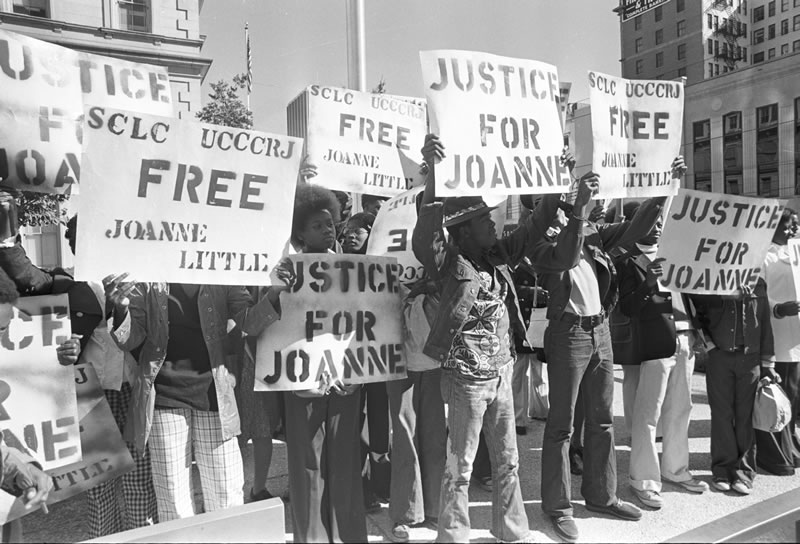
When Little’s trial began on July 15th 1975, 500 supporters rallied outside the Wake County Courthouse. According to McGuire (2010):
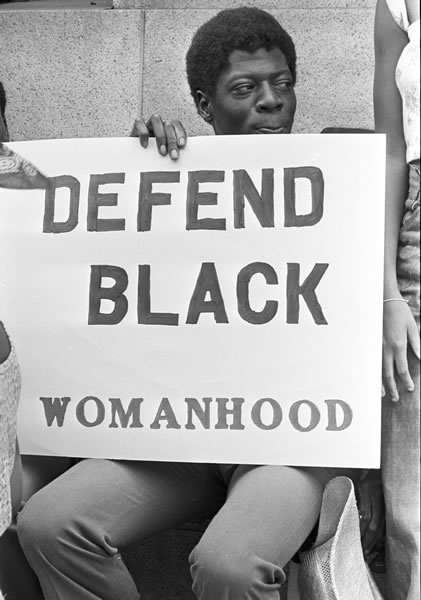
“They hoisted placards demanding the court “Free Joan Little” and “Defend Black Womanhood,” and loud chants could be heard over the din of traffic and conversation. “One, two, three. Joan must be set free! the crowd sang. “Four, five, six. Power to the ice pick!”
The Joan Little case affirmed a woman’s right to self-defense. But to me one of the most important aspects of the “Free Joan Little” movement was that supporters insisted that incarcerated women had a right to their own bodies. It was not socially acceptable to rape women in custody. Obviously, we are still a long way from preventing sexual assault in prisons even today but the Joan Little story played an important role in the continuing struggle for social justice.
One has to wonder what it would take to build a similar coalition of groups and individuals in 2011 to take aim at dismantling the unjust prison industrial complex. The “Free Joan Little” movement is instructive because it underscores that it is possible to come together to address prisoner injustice and to WIN.
Uncategorized | prison culture | Comments Off on ‘Free Joan Little’: Reflections on Prisoner Resistance and Movement-Building
Josh MacPhee over at Just Seeds has an ongoing series called “Judging Books by Their Covers.” His most recent post in that series focuses on the covers of books about prisons. Here’s what he had to say about this:
For the next month of so I’m going to focus on the covers of books about U.S. prisons. Something uplifting for the new year! I first became involved in prison-related activism (including support for political prisoners, whose books will also be featured in the upcoming weeks) in the early 1990s, and slowly have amassed a large collection of books and publications on prison issues (in order to keep this manageable, I’ve pretty much stuck to books with spines, leaving out pamphlets, magazines, and chapbooks, as well as keeping it U.S focused). In addition, a couple friends have pretty large collections as well, so I’ve photographed some of theirs (thanks Dan Berger!), and pulled a select few off the web. This week we’ll start with prison riots. And the daddy of the modern U.S. prison riot, Attica. Although it had begun to be an issue before, the Attica rebellion in 1971 awoke the American public to the fact that their were serious problems in the prison system, and a slew of both scholarship and sensational writing followed, including a series of reports like the ones to the right and below.
I participated in an online auction for a good cause last month and bid on a photograph that I really wanted. I am happy to report that I won the item and have decided to share it with all of you. This is a great photograph by Lynne Pidel of a mural in her neighborhood.
Shot by Lynne Pidel
I was drawn to this photograph for many reasons. What does it evoke for you?
Here’s one of the things that the photograph evokes for me…
Uncategorized | prison culture | Comments Off on Image of the Day: Shot by Lynne Pidel
 Uncategorized | prison culture |
  Comments Off on Disproportionate Minority Contact in Juvenile Justice System: A Comic Zine Project