Jan 24 2011

An Exchange with a Former Prisoner about the ‘Bad People’ and the Need for Prisons…

On Saturday, I received an e-mail from a former prisoner who apparently reads this blog. He had a lot of lovely things to say about it and I am grateful for the kind words. He also wanted to let me know that because I had never been incarcerated I was naive about prison abolition. I asked for permission to quote a couple of sentences from his e-mail to me and he agreed:

“I have read some of the essays that you write about prison abolition. I was locked up for 11 years and there are some monsters in prison. They definitely should not be roaming the streets…There really are some bad people there. The majority are not bad people but there are some monsters on the inside. We are always going to need prisons.”

If any of you have worked inside prisons or with former prisoners on the outside, I am sure that you will not be surprised by the sentiments expressed by this gentleman. My friend Jessi Lee Jackson who is an abolitionist writes about her experience with this issue brilliantly in an article co-authored with Erica Meiners titled “Feeling Like a Failure: Teaching/Learning Abolition Through the Good the Bad and the Innocent” which appeared in Radical Teacher last year.

It is the 8th week of English class in our adult high school completion program, and we have just read a short excerpt from Angela Davis’s Are Prisons Obsolete? As a class, we review vocabulary words, and then, piece by piece, work to understand Davis’s argument for prison abolition. All of the students have firsthand experience of the system, and they agree that the prison system is clearly racist in its impact. But when we get to the point of discussing abolition — of shutting down prisons — the class quiets. The disagreements start. “I agree with abolishing the death penalty, but…” “But some people need to get locked up.” “I agree we need to change the system, but getting rid of prisons entirely,,,” “It’s too much…” “I don’t think we need to go that far…”

I find myself in the awkward position of being the only person without direct experience of being locked up, and the only vocal abolitionist. By the end of our conversation, I perceive that students have made up their minds and are united in their analysis: the prison system is messed up, but abolition is “going too far.” I wonder to myself what went wrong in our conversation. Why was I not able to present abolition in a way that challenged people to go further or question their assumptions about the necessity of prisons?

So many of us have been exactly where Jessi was in discussing prison abolition be it with family & friends or in a classroom setting. A couple of weeks ago, I wrote about what I mean when I talk about prison abolition so I won’t go back over that old ground again. I do however want to share an excerpt of what I wrote to the gentleman who reached out to me on Saturday. These passages most directly address themselves to the issue of how we should deal with people who do bad things.

Thank you for sharing your story with me. In particular, I want to thank you for your honesty in letting me know that you felt that you “did a bad thing” that landed you in prison. Rather than focusing on the “bad act” that you committed, I want you to know that what I appreciated most was that you acknowledged the hurt that you had caused to so many. So I have a question for you? Do you consider yourself to be a bad person? Or do you believe that you did a bad thing? I am asking because so often when people reach out to me or talk to me about “bad people” I want to understand their definition of the term. You see just because I want to see an end to prisons does not mean that I do not know that crimes are committed and that violence is prevalent in our culture. I just do not believe that prisons are an adequate response to both of these issues.

Let’s say that I agree with your premise that some “bad people need to be in prison.” I am curious about whether you think that 50% of the people you served time with are “bad people” or is the number closer to 30%? Is it 10% or maybe 5%? I really am interested in your thoughts on the matter. If as I suspect, you tell me that the number is closer to 10 or 20%, then I would ask you to consider how inefficient and immoral it is for us to be locking up the other 70 or 80%. What might your thoughts be about that?

Let’s say that we found another way besides prison to address the various problems that the majority (70-80%) have, how would you propose that we handle the remaining 10 to 20 percent of people who you contend “need to be locked up?” The minority should not dictate how we handle the majority.

You wrote eloquently and movingly about your incarceration experience. You wrote about the brutality, loneliness, and inhumanity of the experience. You told me that it “didn’t make [you] better.” If this is true, then what will happen to positively impact the so-called “bad people” who remain behind bars? Are we just expected to lock them up and throw away the key?

An aging prison population is already putting major strains on states because of the costs associated with their healthcare. As you also know, most prisoners are released eventually. So the majority of the so-called “bad people” that you speak of will eventually be let out of prison one day in the future. Based on your own assessment, prison will not have made them “better.”

If you agree with the points that I have made, then it is incumbent for you to consider abolition as one of the options for addressing the problem of mass incarceration. As my friends Erica and Jessi have written, “[w]orking toward abolition means transforming our communities and creating structures that reduce the demand and need for prisons.” We can begin there. It is important sometimes to push ourselves to imagine ‘a world without prisons.’ What would we do? How would we solve problems without disappearing people?
My response was much longer than what is quoted and have already received another e-mail in response to mine. Suffice it to say that I was right in estimating that he believes that 10 to 15% of prisoners that he served time with should stay locked up. I look forward to continuing the exchange. I don’t have definitive answers to all of the questions that are asked about prison abolition, I only know that it is important that abolition be on the table as one of the options for how to dismantle the prison industrial complex. One’s orientation to the problem of incarceration is different if approached from an abolition lens. The landscape of possibilities is more expansive and it pushes beyond bandaid reforms to a focus on uprooting oppression and transforming society. So I welcome the dialogue about what to do with the so-called ‘bad people’ as long the person that I am engaging is willing to consider that the “bad people” are not the end all and be all in discussions about prisons. In fact, for me, they should not even be the starting point. How about we begin with the majority (90%) of people who are currently locked up and shouldn’t be?

Jan 23 2011

Sunday Musical Interlude: Kassav Takes Me Back To My Teen Years

I love Kassav… Nothing better than their signature “Oh Madiana!”

Jan 23 2011

Taping Cops Can Land You In Prison for 15 years: Artist and Activist Chris Drew Finally Has A Court Date

Chicago artist Chris Drew, in order to protest a permit requirement, deliberately violated a city ordinance by selling handmade patches. He captured his arrest on a digital voice recorder, only to be charged with a felony for recording the event.

I have previously written about the fact that videotaping the police is a crime that carries with it potentially long prison sentences.

In the past couple of days, Chris’s case is getting more national attention. Don Terry writes about the case in the New York Times:

Christopher Drew is a 60-year-old artist and teacher who wears a gray ponytail and lives on the North Side. Tiawanda Moore, 20, a former stripper, lives on the South Side and dreams of going back to school and starting a new life.

About the only thing these strangers have in common is the prospect that by spring, they could each be sent to prison for up to 15 years.

“That’s one step below attempted murder,” Mr. Drew said of their potential sentences.

The crime they are accused of is eavesdropping.

The authorities say that Mr. Drew and Ms. Moore audio-recorded their separate nonviolent encounters with Chicago police officers without the officers’ permission, a Class 1 felony in Illinois, which, along with Massachusetts and Oregon, has one of the country’s toughest, if rarely prosecuted, eavesdropping laws.

“Before they arrested me for it,” Ms. Moore said, “I didn’t even know there was a law about eavesdropping. I wasn’t trying to sue anybody. I just wanted somebody to know what had happened to me.”

Ms. Moore, whose trial is scheduled for Feb. 7 in Cook County Criminal Court, is accused of using her Blackberry to record two Internal Affairs investigators who spoke to her inside Police Headquarters while she filed a sexual harassment complaint last August against another police officer. Mr. Drew was charged with using a digital recorder to capture his Dec. 2, 2009, arrest for selling art without a permit on North State Street in the Loop. Mr. Drew said his trial date was April 4.

I want everyone to know how UNJUST these arrests really are. It is another example of unchecked police power in Illinois. The Huffington Post just recently published a story about Chris and his case if you want to learn more. Finally, if you would like to keep up with the details of this case, feel free to e-mail Chris at [email protected] to get on his electronic newsletter list.

Note: My sincerest apologies to CHRIS. For some reason, I decided to call him Charles in my earlier post. I can only say that I thought I was typing CHRIS…

Jan 22 2011

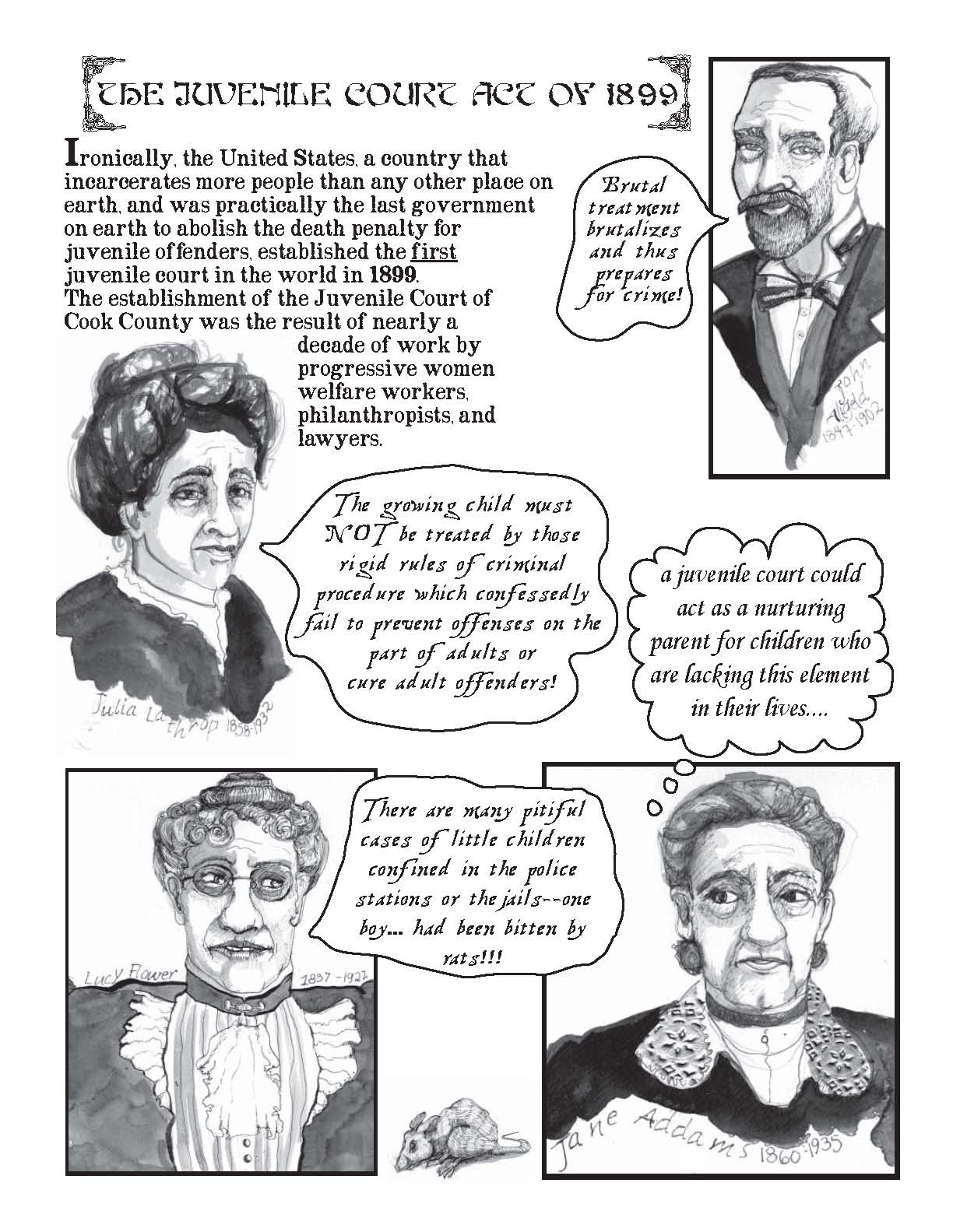
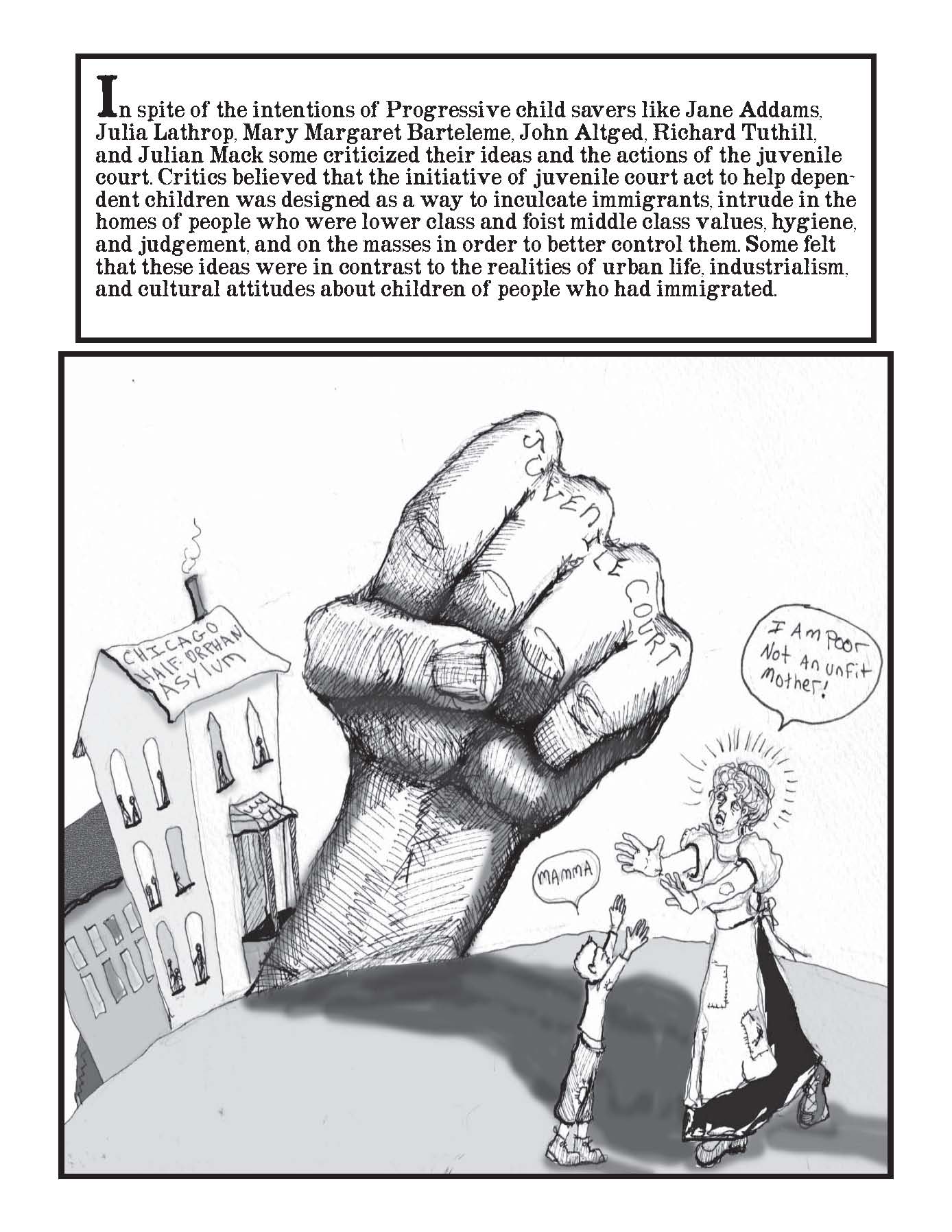
History of Juvenile Court in Images…

Based on the popularity of my recent post that featured a preview of some of the images that will be included in a juvenile justice zine project that I am involved with, I thought that folks might want to see a couple of other images. These images are from teaching artist Rachel Williams in collaboration with several young people who participated in a comic zine workshop co-sponsored by my organization.

By Rachel Williams

Jan 21 2011

The Police Are Just NOT Helping…

I am in a terrible mood today. I had what turned out to be a very short meeting at my local precinct this afternoon. I asked for the meeting to look for ways to forge a more cooperative relationship with local law enforcement. I want to stipulate up front that I have had and continue to have some cordial encounters with local police. On an individual basis, some officers have been helpful in NOT arresting youth that we work with. Those individual police officers have grasped the idea that ANY contact with the criminal legal system is a bad thing for young people. The police are the gateway to prison for many young people of color. Today’s meeting at the precinct did not go well and I won’t go into the details because I am still trying to process my anger.

As part of the reading that I have been doing for a curriculum on police violence that I am developing, I have come across a number of personal testimonials about the impact of police violence on young people’s lives and well-being. Instead of engaging in an all out rant today, here is an excerpt by Travis Dixon reflecting on his encounters with the police as a young man:

While growing up, even though I was a hardly imposing “geek,” I was often harassed by police officers who assumed that I was up to no good simply because of my race and my neighborhood. On one occasion I was attending a church barbecue. When it was time to head home, I borrowed my grandfather’s truck (with his permission, of course). I was soon pulled over and confronted by two white police officers with their guns drawn; although I was a good kid returning home from a church function, they thought I was a violent predator. It turns out that I was dropping off a friend who lived near a store that had been burglarized earlier that day, and so the Los Angeles police were on a manhunt, looking for a black man, any black man. One inappropriate move, including any verbal protest against my mistreatment, and I might have been beaten, arrested, or even shot. And so my childhood unfolded in South Central, where, on more than a dozen occasions, I faced profiling behavior, was handcuffed, or was pulled over for no reason other than the color of my skin. I thus learned to be careful around the police, to know when to shut up, and both to recognize and fear the inarticulate fury of those who had been trained to see the world through the lens of mass-mediated racial stereotypes. (Dixon 2010, pp.106-107 in Challenging the Prison Industrial Complex, edited by Stephen John Hartnett)

This is violence and it is traumatizing. I know that many individual police officers want to do the right thing. But the overall system of policing is corrupt and badly in need of revolutionary transformation. Katheryn K. Russell (2000) cautions us against “the dismissal of police violence as a Black thing.” But we are lacking example of the White Oscar Grant or the White Sean Bell or the White Rodney King.

Police officers need to understand that this is the context that they are operating in when they approach young people of color on urban streets. They will not be given the benefit of the doubt. It is assumed by most youth of color that officer friendly is a myth. They are not wrong. For most youth of color, officer friendly does not exist…

Here is a new video by the ACLU and Elon James White about what to do when one is arrested. They inject needed levity in a deadly serious topic. I am grateful to them for that.

Jan 21 2011

Coming Home: A Poignant Scene of A Prisoner’s Return

I have written a couple of times already about a new documentary called the Interrupters by Steve James (who directed Hoop Dreams) and Alex Kotlowitz (who wrote ‘There Are No Children Here’) that will premiere later this month at Sundance.

Ninety-five percent or more of prisoners will be released at some point in the future. So prisoners get out eventually. Here is a clip from the Interrupters that I wanted to share specifically because it illustrates in under 2 minutes the inter-generational cycle of incarceration in the black community and the deep love that exists for many prisoners from their families. That abiding love is a part of the story about imprisonment that is too often unexamined and overlooked.

This clip highlights the hidden collateral costs of incarceration.

Jan 20 2011

Dumb Policies #3: More Barriers to Jail Visitation

There is a lot of lip service paid to “successful” re-entry for former prisoners.  One of the most important findings from recent research suggests that successful prisoner re-entry depends in large part on ensuring that inmates keep connections with family members and friends while they are incarcerated.

Well in D.C. some geniuses have decided to do their best to limit outside contact with inmates by proposing a plan to fingerprint visitors and check for warrants:

All visitors to the District’s jail soon will have their fingerprints scanned and checked against law enforcement databases for outstanding warrants.

The D.C. Department of Corrections is already using the “live scan” fingerprint technology on inmates when they enter and leave the jail, corrections officials said. The digital technology allows the department to take an image of an inmate’s fingerprint and check it against D.C. police databases to confirm the inmate’s identity.

Starting in March, the fingerprint-scanning technology will be put to use for all visitors, DOC spokeswoman Sylvia Lane said.

“Through a $134,000 grant from the [federal] Office of Justice Grants, we will be [using] the technology in our visitors control area to assist [D.C. police] in the identification of individuals with outstanding warrants,” Lane said in an e-mail to The Washington Examiner. If a match is made, DOC will detain the visitor and contact the police department and the visitor will be taken into custody.

The jail currently only requires that visitors present a valid identification, and names of visitors are not checked against outstanding warrants.

This new policy will continue to expand the reach of the prison industrial complex while also placing more barriers between inmates and the public. First, we already know that many prisoners do not get family or friend visits as it stands now. Our goal should be to encourage MORE such visits rather than putting up more barriers. Next, jails are already overcrowded. Why look to add to the masses of people already locked up by checking visitors for warrants?

Additionally, the company that has created and is selling the scanning technology has a whole new market to access. This illustrates why I believe that prison “industrial” complex is still the appropriate term to be using not-withstanding the fact that the term is not unproblematic. The money-making motive is always intertwined with incarceration.

Jan 20 2011

Action Alert: Please Call Gov. Quinn & Ask Him to Sign Death Penalty Repeal

As some of you may know, the Illinois Legislature took the monumental step of repealing the death penalty in our state. Governor Pat Quinn has the repeal on his desk but is dragging his feet on signing it into law. He has until March 12th to sign the bill. Gov. Quinn needs to hear from you if you are a resident of Illinois. Please call 217-782-0244 and ask him to sign the repeal. It is the RIGHT and HUMANE thing to do.

Matt Kelley has written affectingly about this issue:

I’ve been thinking a lot about the death penalty in Illinois. My first exposure to the issue of wrongful convictions, the issue I focus on in most of my work, was as an undergraduate at Northwestern University. In Professor David Protess’ class more than a decade ago, I heard Dennis Williams speak about his years on death row for a crime he didn’t commit. I worked on possible wrongful conviction cases, and celebrated with classmates when former Gov. George Ryan cited exonerations from death row in his decision to impose a moratorium on executions.

But while Ryan’s moratorium was held up as evidence of a crumbling death penalty in the decade that followed, the state quietly refilled its death row. It’s a moratorium on executions, not on death sentences. The state has spent well over $100 million to send 15 people to the purgatory of death row under an ongoing moratorium. Let’s put aside for a moment that the death penalty is wrong; there’s no point in taxpayers bearing the enormous expense of death sentences for people who will probably never be executed. It makes sense — both pragmatically and morally — for Quinn to sign the death penalty abolition bill into law.

Kelley also has posted a short and impactful video illustrating the fact that since 1989, 31 innocent prisoners have been freed from Illinois prisons by DNA testing; 5 of these were on death row.

Please take a couple of minutes out of your day to call Gov. Quinn’s office and ask him to sign the repeal – 217-782-0244.

Jan 19 2011

A Review of TAMMS Year 10’s Participatory Action Station at Hull House Museum

My friend Lisa pointed me to the following blog post by Nina Simon reviewing a postcard action station that is part of the Unfinished Business exhibit at the Jane Addams Hull House Museum.  I have previously written about my involvement in helping to organize this community-curated exhibit.

From Nina Simon’s post:

The best participatory projects are useful. Rather than just doing an activity, visitors should be able to contribute in a way that provides a valuable outcome for the institution and the wider museum audience. Finding legitimate ways for visitors to be of use is easier said than done. This week, I saw a great example at the Jane Addams Hull-House Museum that blew me away with its power and simplicity.

The Jane Addams Hull-House Museum is a small historic house dedicated to the story of Chicago’s progressive activists in the early 1900s. The participatory activity in question is part of the new Unfinished Business gallery, a room in which the museum engages with a contemporary issue related to the passion and work of Jane Addams and the historic Hull-House activist residents.

The current Unfinished Business exhibition focuses on the prison industrial complex. It has three main parts: graphic novel-style wall graphics about the history of Hull-House activism related to incarceration and youth imprisonment, an activity station focused on juvenile justice reform, and a second activity station focused on prisoners in solitary confinement at Tamms Supermax Prison. It is this station that grabbed my attention.

The station is a collaboration between the Museum and Tamms Year Ten, an advocacy group that supports prisoners and seeks to expose the injustice with which many are held in solitary confinement. A simple label explains that when Tamms opened in 1998, prisoners were only supposed to be held in solitary confinement there for one year. Ten years later, one-third of the prisoners were still there. Tamms Year Ten runs a number of projects that invite people to write to prisoners, send photographs of the outside world, and advocate for them. The Museum activity label begins:

The Tamms Poetry Committee came together after asking prisoners what people on the outside can do to alleviate the stress of prolonged solitary confinement.

“Send poems!” was one of the answers.

Museum visitors are invited to write poems on postcards and send them to Tamms prisoners. There is a set of books of poetry that visitors can copy from (recommended by the Museum’s poet-in-residence), or they can write their own. Tamms Year Ten provides lists of prisoner names and addresses, and the Museum prints up address stickers that visitors can affix to their postcards. The Museum screens and mails the postcards to the prisoners. Unfinished Business curator Teresa Silva told me that only a handful of postcards have had to be removed for negative or off-topic comments. The majority are beautiful, thoughtfully-rendered postcards. I choked up just looking through a stack. The messages were lovely, but the real power came in the simple address stickers that connected the cards to real prisoners in solitary confinement.

Yes, this activity is political. But it is political in a way that fits right in with the Museum’s mission and history. The Hull-House activists were concerned with creating a compassionate criminal justice system, and that work is by no means “finished” business in this country. Just as visitors to the Monterey Bay Aquarium clamor to take real action to protect the oceans, visitors to the Jane Addams Hull-House respond positively to this opportunity to engage in a bit of progressive, compassionate activism.

From a design perspective, this activity is scaffolded for success. The political nature of the activity is overt, so participating visitors know what they’re getting into. The postcards say right on them “I am sending this poem in solidarity with you.” Furthermore, selecting and copying out a poem from a book is something that most anyone can do. People can decorate their poems as much or as little as they like, and those who choose to take a more creative route and write their own poems or letters are invited to do so. Like the best participatory projects, this postcard activity is constrained but not limiting. The Museum gives people the tools to engage confidently without prescribing the output.

And most powerfully, that output is something useful, something that matters not just to the museum or to other visitors, but to the world. Kudos to the Jane Addams Hull-House Museum for such an inspiring call to action.

Note: for more photos and explanation of this activity, please consult this blog post by curatorial assistant Teresa Silva.
Jan 19 2011

Quote of the Week: 50th Anniversary of Military Industrial Complex Speech