Feb 04 2011

Looking for a ‘Good’ Brother: Mass Incarceration & Black Women

Months ago, the Economist published an article titled Sex and the single black woman: How the mass incarceration of black men hurts black women.  I read the piece and I quickly moved on.

I wanted to avoid the topic. Frankly I am afraid to broach the subject today.  You will wonder why I am so skittish.  You will think that this is irrational.  You might say: “Hey, you write about everything else even tangentially connected to prisons, why not this too?”

Some time ago, I wrote of feeling queasy about hip hop culture’s not-so-subtle admonition that young women of color stand by their incarcerated partners no matter what.  I received some of the most passionate e-mails based on that post that I have ever gotten.  I had hit a real nerve.  I also wrote briefly about that.

The gist of the Economist article is this; the marriage market for single black women is abysmal and:

[J]ail is a big part of the problem, argue Kerwin Kofi Charles, now at the University of Chicago, and Ming Ching Luoh of National Taiwan University. They divided America up into geographical and racial “marriage markets”, to take account of the fact that most people marry someone of the same race who lives relatively close to them. Then, after crunching the census numbers, they found that a one percentage point increase in the male incarceration rate was associated with a 2.4-point reduction in the proportion of women who ever marry. Could it be, however, that mass incarceration is a symptom of increasing social dysfunction, and that it was this social dysfunction that caused marriage to wither? Probably not. For similar crimes, America imposes much harsher penalties than other rich countries. Mr Charles and Mr Luoh controlled for crime rates, as a proxy for social dysfunction, and found that it made no difference to their results. They concluded that “higher male imprisonment has lowered the likelihood that women marry…and caused a shift in the gains from marriage away from women and towards men.”

If you are a black woman reading this, you know what our conversations are when no one is listening.  We talk about the lack of “good” brothers.  Each of us has our own definition of the term “good.”  We lament the state of affairs that sometimes pushes us to have children on our own rather than waiting for Mr. Right.  Something else is palpable in our conversations though; it’s the sadness.  I imagine that outsiders might think that black women would be angrily discussing these issues amongst  ourselves.  Yet, in my experience, that has never been the case.  My disappointment, in fact,  is that we too often keep the conversation at the level of individual solidarity rather than moving towards social justice.  Because after all, the mass incarceration of black men has more than personal implications for our lives, it is also a social justice issue for our communities. But I digress…

I am reminded of a poem by one of my favorite writers Carolyn M. Rodgers.  It is called “Poem for Some Black Women.”  The poem includes these verses:

we live with fear.

we are lonely.

we are talented, dedicated, well read

BLACK , COMMITTED.

we are lonely.

we understand the world problems

Black women’s problems with Black men

but all

we really understand is

lonely.

These words no doubt resonate strongly with other black women.  They speak to what so many of us experience.  The words evoke the symbolic violence that mass incarceration has wrought in our communities, in our lives.  I am apprehensive about writing these words.   I feel that they should be whispered.  I have no idea why this is the case.  It is so much easier for me to write about things from an analytical perspective.  I live in my head.  It feels safer.

I know that the question of the impact of mass incarceration on black women cannot be reduced to a conversation about dating and marriage.  Increasingly more and more black women find themselves locked up too.  But today, I am concerned with the collateral costs for black women of  having hundreds of thousands of black men caged in jails and prisons across the U.S.

My black girlfriends with sons live with the daily fear that they will be harassed by the cops; that our sons will end up, even if we do our very best by them, locked up too.  We keep those fears quiet.  We dare not speak the words.  With one out of three black boys born in 2001 likely to spend some of their lives in prison, we know that the bogeyman is not a fantasy but rather that he is close by, too close for comfort.  My black girlfriends with heterosexual daughters wonder if they will ever find love and companionship or if they will be consigned to living single for life (not by choice).  The worries are there.  Always.  It feels like I shouldn’t be writing this down.  Perhaps these words are best whispered.

Most of the time this blog is about the macro issues that relate to the prison industrial complex.  I focus on the micro when sharing individual experiences of the incarcerated.  Today, I feel like I am writing for a confessional.   I worry about the reception because I know about the reach of racism in America.  Black lives are so cheap in this culture.  Being vulnerable does not serve us well.  Yet we need to talk about the emotional, mental and spiritual costs of mass incarceration.  We need to acknowledge how the prison industrial complex touches our individual lives.  We need to move from abstraction to the concrete to the real.  It is about lived experiences after all.   Isn’t it? I don’t know…

Then I remember being in a room with a group of teenage girls of color five years ago.  We were reading some essays by Pearl Cleage as preparation for a documentary film that they were producing.  As we were discussing one of the essays, a young woman sighed out loud: “I am just looking for a good brother; Is that too much to ask?”  That young black woman was 14 years old.   Her wish led to the writing of a collective poem called “Looking for a Good Brother” that I will share here.  The poem wasn’t specifically about the mass incarceration of black men and yet that young woman’s wish seems somehow connected to the topic. I wanted to tell this young woman that many, many ‘good brothers’ are locked up.  That the system has conspired to deprive her of her wish.  And I wanted to tell her that it isn’t too much to ask for a healthy and abiding love.  I wanted to tell her…

I hope that you will find the young women’s words as poignant and moving as I did.

Looking for a Good Brother – Inspired by Pearl Cleage (collective poem by the Rogers Park YWAT)

It’s time!

Brothers, it’s time to step up

We are waiting

Let’s be clear

We are looking for some good brothers

We are looking for the real deal

A brother who can listen

A brother who can change

A brother who is not afraid of women

We are looking for a real brother

One who loves his people

A brother who doesn’t hit, slap, yell, punch, rape, kill women and children

A brother who doesn’t call us bitch or ho

We are looking for a brother who says I’ll be with you till we get there

Till we get to the place where violence ends

We are looking for a brother who says

“That’s not cool” when his friends down women

We are looking for a REAL brother

A brother who uses his hands to build, not to break

A brother who understands the word “solidarity”

We are looking for a brother

One who gets it

A brother who doesn’t pass the buck

A brother who takes responsibility for male violence

A brother who speaks truth to power

Will you stand with us?

Brother, will you stand strong with us?

Will you be a soldier in an army of peace with us?

It’s time

It’s time to step up

Brothers, we need you

We are waiting.

Feb 03 2011

Free Screening of Me Facing Life: Cyntoia’s Story – Feb 19th

I wanted to get the word out about an important event that I am privileged to be organizing… If you are in Chicago on Feb 19th, please consider joining us for this event.

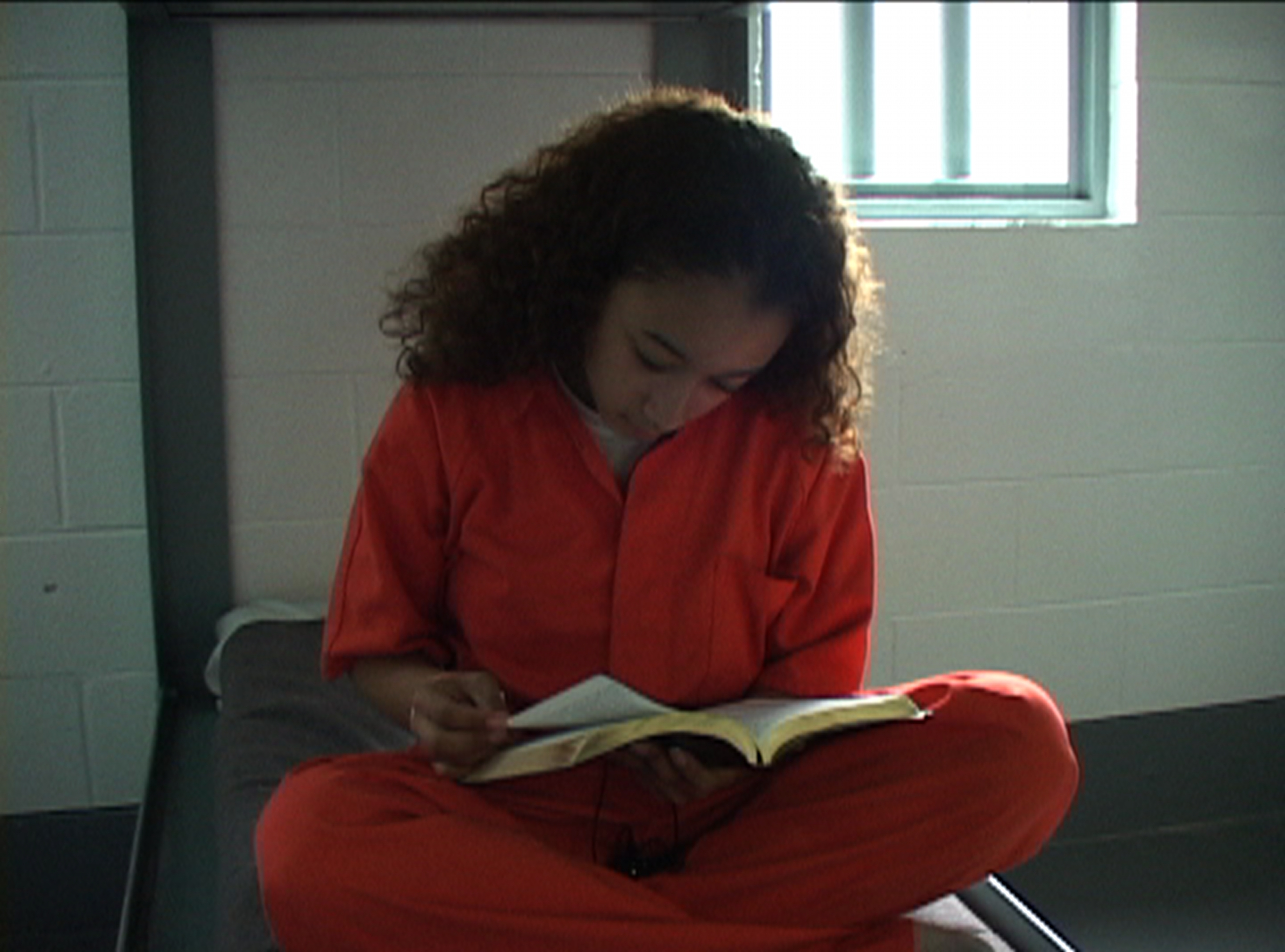
2004: Cyntoia within three weeks following her arrest for murder

Me Facing Life: Cyntoia’s Story takes a hard look at some of the complex social issues concerning a 16-year-old girl who is serving a life sentence for murder. Cyntoia Brown found herself in a series of bad situations that led to her killing a man who picked her up for sex. The filmmaker spent nearly six years exploring her life and familial relationships in order to answer a very basic question… why? This documentary pushes aside assumptions about what we think about violence and takes a glance into a startling social mirror that reveals a strong connection between violence in her maternal line and a predestined childhood filled with bad decisions.

Following the film, there will be a reading of a poem written in prison by Jacqueline Montanez, who was given a life sentence in Illinois at the age of 15. Then Mariame Kaba from Project NIA will lead a discussion about the high rate of youth incarceration in the U.S. and the inherent flaws of our juvenile justice system.

WHO:
Shobha Mahadev, Project Director, Illinois Coalition for the Fair Sentencing of Children
Sharmili Majmudar, Executive Director, Rape Victim Advocates
Vikki Rompala, LCSW, Chicago Child Trauma Center at La Rabida Children’s Hospital
Twyanda Major, Visible Voices (CLAIM)
Dominique McKinney, Young Women’s Empowerment Project (YWEP)
Moderator: Mariame Kaba, Founder, Project NIA

WHEN:
Saturday, February 19, 2011, 2:00 PM – 4:30 PM

WHERE:
Chicago Cultural Center
78 E. Washington St., Chicago
In the Claudia Cassidy Theatre

This event is free and open to the public. No RSVP needed.

We are asking attendees to please bring a new young adult book to the screening to donate to incarcerated youth at the Cook County Juvenile Temporary Detention Center and IYC- Warrenville

To see the trailer, click here.

Presented by Project NIA, The Chicago Department of Cultural Affairs, ITVS and WTTW Channel 11 in collaboration with the exhibition, Off the Beaten Path: Violence, Women and Art.

** Me Facing Life: Cyntoia’s Story will have its premiere on the Peabody and Emmy® Award-winning PBS series Independent Lens, hosted by America Ferrera, on Tuesday, March 1, 2011 at 10 PM (check local listings).

Feb 03 2011

Punishing Children: Houses of Refuge & Juvenile Justice

This past Saturday marked the launch of a 30-hour juvenile justice advocacy training program (JJATP) that my organization is sponsoring in partnership with the Jane Addams Hull House Museum. Twenty people came together to discuss the history and to better understand the current manifestations of juvenile justice in Illinois. Our goal with the JJATP is to increase community members’ knowledge about the key issues facing youth in conflict with the law. Ultimately we expect that this increased knowledge and awareness will serve as a catalyst for social change.

It is worth taking a few minutes to think about the current challenges that we face with respect to juvenile justice. Just a couple of days ago, I read a profoundly troubling account of how guards at the juvenile wing of Rikers jail in N.Y. are allegedly encouraging violence among the inmates. It seems important at these moments to recall the roots of juvenile justice (in this instance particularly those in New York).

It is impossible to understand the State’s regulation of children and youth in the U.S. without considering immigration and population growth in the early 19th century. From the mid-18th to the mid-19th centuries, the overall population of the U.S. exploded from 1.5 million to 23 million.

Nowhere were the newcomers to the colonies more visible than in states like New York, Massachusetts and Pennsylvania. These mostly Irish and German immigrants were poor and their children moved to cities like New York seeking work. Many of these young people’s parents were seen as unfit because their children were unsupervised and some were committing petty crimes to ensure their own and their families’ survival.

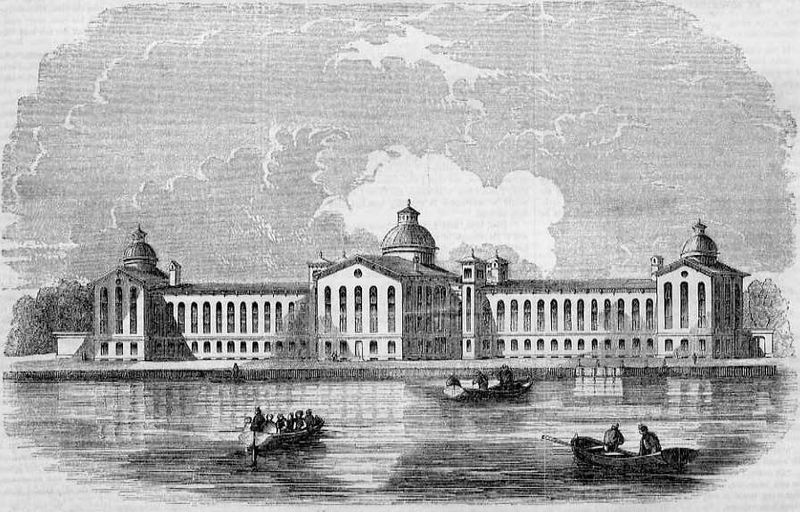
House of Refuge, Randall's Island (1855)

In this backdrop emerged several philanthropic organizations on the east coast dedicated to addressing the problem of “juvenile delinquency.” One of the most prominent of these groups was the Society for the Reformation of Juvenile Delinquents (SRJD), founded in the 1820s. This group of wealthy businessmen and professionals lobbied the New York State Legislature to pass a bill in 1824 to establish the New York House of Refuge, which was the first correctional institution for youth in the U.S.

Here is how the SRJD described the goals of the house of refuge and defined what it meant by “delinquents”:

“The design of the proposed institution is, to furnish, in the first place, an asylum, in which boys under a certain age, who become subject to the notice of our police, either as vagrants, or homeless, or charged with petty crimes, may be received, judiciously classed according to their degree of depravity or innocence, put to work at such employments as will tend to encourage industry and ingenuity, taught reading, writing, and arithmetic, and most carefully instructed in the nature of their moral and religious obligations while at the same time, they are subjected to a course of treatment, that will afford a prompt and energetic corrective of their vicious propensities, and hold out every possible inducement to reformation and good conduct.”

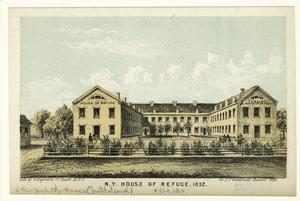
N.Y. House of Refuge, 1832. Digital ID: 805114. New York Public Library

The following is a description of the early days of the New York House of Refuge:

The reformatory opened January 1, 1825, with six boys and three girls. Within a decade 1,678 inmates were admitted. Two features distinguished the New York institution from its British antecedents. First, children were committed for vagrancy in addition to petty crimes. Second, children were sentenced or committed indefinitely; the House of Refuge exercised authority over inmates throughout their minority years. During the nineteenth century most inmates were committed for vagrancy or petty theft. Originally, the institution accepted inmates from across the state, but after the establishment of the Western House of Refuge in 1849, inmates came only from the first, second and third judicial districts (Ch. 24, Laws of 1850).

A large part of an inmate’s daily schedule was devoted to supervised labor, which was regarded as beneficial to education and discipline. Inmate labor also supported operating expenses for the reformatory. Typically, male inmates produced brushes, cane chairs, brass nails, and shoes. The female inmates made uniforms, worked in the laundry, and performed other domestic work. A badge system was used to segregate inmates according to their behavior. Students were instructed in basic literacy skills. There was also great emphasis on evangelical religious instruction, although non-Protestant clergy were excluded. The reformatory had the authority to bind out inmates through indenture agreements by which employers agreed to supervise them during their employment. Although initially several inmates were sent to sea, most male and female inmates were sent to work as farm and domestic laborers, respectively.

The young people who most often found themselves targeted by early juvenile justice statutes were Irish immigrants. Between 1825 and 1855, 63% of the youth committed to the House of Refuge were of Irish descent. Refuge youth were subjected to corporal punishment including hanging children from their thumbs and severe beatings.

Other states began to open their own Houses of Refuge for youth in the mid-19th century. However over time, these institutions began to suffer from overcrowding and the conditions of the spaces deteriorated quickly. Common practices in many houses of refuge included solitary confinement, the use of the “ducking stool” for girls, handcuffs, and the “silent system.”

Reformers such as those from Hull House began to vociferously criticize the conditions of various Houses of Refuge across the U.S. and a series of court challenges emerged to the refuge movement. The early history of juvenile justice in the U.S. is characterized by intentions falling far short of actions. The notion of humane treatment for “wayward” children gave way to harsh punishment, exploitation, overcrowding, and various other abuses. By the time of the settlement house movement in Illinois and New York, reformers (mostly women) were pushing for changes in the juvenile justice system. One of the greatest advances would be the establishment of the first juvenile court in the U.S. in Chicago in 1899. I will address the establishment of this court next week. In the meantime, I want to end with the words of Judge Julian Mack today.

Judge Mack, who sat on the Juvenile Court bench from 1905-1907, was one of the early reformers who indicted society for creating and then ignoring conditions that produced youth crime. He argued:

The fundamental duty of society is to prevent that child from going wrong: the fundamental duty of society is to recognize the causes that lead to the wrongdoing. The fundamental duty of society is to see what the economic basis is that brings the child into the court and correct that economic wrong. Tear down your hovels and your slums. Give your working man the leisure by enforced limitation of hours of work to give thought to the raising of his own family before you step in and say that he is not competent to deal with his own children.

One can scarcely imagine such a trenchant critique coming from a contemporary juvenile court judge but it would serve all of us well if they would just look back at their own history to reclaim that legacy of social criticism and activism.

Note: For some historical images of the New York House of Refuge, click here.

Feb 02 2011

Prison Food During the Civil War…

On the heels of the revelation that California prisoners have been subjected to drinking arsenic-laden water for years, I wanted to look back at the history of prison food in the U.S. and UK.

In the coming days, I will feature some excerpts from the first prison cookbook – the Manual of Cooking & Baking for the Use of Prison Officers – published in 1902 in England.

Today though, I want to focus on a particularly terrible time with respect to prison food – the Civil War. Years ago, I picked up a small pamphlet at a used book sale. It was called “Yanks, Rebels, Rats, and Rations: Scratching for Food in Civil War Prison Camps” by Patricia Mitchell. I never imagined that I would have occasion to write about some of what I learned from this work. But alas… one never knows where life’s long and winding roads will lead.

In her pamphlet, Mitchell (2003) describes “Civil War prison life, with an emphasis on food.” The first chapter opens with the following quote from a Confederate prisoner’s diary:

“Sept. 13th (1884). Rats are found to be very good for food, and every night many are captured and slain. So pressing is the want of food that nearly all who can have gone into the rat business, either selling these horrid animals or killing them and eating them.”

Mitchell (2003) writes: “Such was life in a Civil War prison. Men coped with their incarceration to the best of their ability, eating what was available, trying to turn gut-wrenching circumstances into some semblance of normalcy by making a pest plague part of their diet.”

During the Civil War more than 400,000 soldiers were imprisoned for periods ranging from days to years. A soldier who was a prisoner at Johnson’s Island described the food there as follows:

“Bread made of inferior flour, which was occasionally sour, was issued. The meat was rusty bacon or beef-neck. Twice in one year we had good cuts of beef, but it was so far decayed as to be offensive. Occasionally we had a few worm-eaten peas, and twice I saw some small potatoes…Rats were caught in and about the sinks, and sold freely. The slop-barrels were raked, and bread-crusts were fished out, to be dried in the sun and eaten.”

A Virginia Rebel, Luther Hopkins, described the diet at Point Lookout, Maryland:

“The food, while good, was very scant. Breakfast consisted of coffee and a loaf of bread, the latter under ordinary circumstances, with vegetables and other food, would probably suffice for two meals. The loaf was given us at breakfast, and if we ate it all then we went without bread for dinner. If there was any left over we took it to our tents…and saved it for the next meal.

The dinners consisted of a tin cup of soup (generally bean or other vegetable), a small piece of meat…on which a little vinegar was poured to prevent scurvy. My recollection is we had no other meal…[W]e were always hungry, and the chief topic of conversation was the sumptuous meals we had sat down to in other days…”

A Northern soldier in Danville, Virginia, found “rat dung in the rice, pea bugs in the peas and worms in the cabbage soup.” Michigan soldier John Ransom reported on food at Pemberton prison in Richmond, Virginia, “The ham given us to-day was rotten, with those nameless white things crawling around through it.”

To understand what would lead men to eat some of the “food” discussed above, one only needs to read the words of Randolph Abbott Shotwell, a Confederate prisoner of war at Fort Delaware:

“For three weeks I have not been comfortably warm during the day; nor able to sleep over two hours any night; have not tasted warm food; have not been free from the pangs of actual hunger any moment…How strange a thing it is to be hungry! [A]ctually craving something to eat, and constantly thinking about it from morning till night, from day to day, for weeks and months!”

This is the context within which prisoners can happily eat rats, cats, dogs, and rotten food.

Feb 01 2011

What Should We Make Of Prison Tourism?

Eastern State Penitentiary

Defunct prisons all over the world operate as tourist attractions, museums and even hostels, offering everything from haunted tours to the chance to stay overnight in a cell. Even more surprisingly, some old prisons are being used as wedding sites.

Alcatraz was opened to tourists by the National Park Service in 1971. Today over a million people visit the island prison each year. What meanings do people who visit Alcatraz and other prisons like Eastern State Penitentiary in Philadelphia as tourists bring to and take away from their visits?

Some tourists undoubtedly visit old prisons because of an interest in architecture. Many of these defunct facilities were built at a certain period of time in American history and are formidable and imposing structures. Other tourists surely visit because they are fascinated with the stories of crime and “criminals” that they can hear about. These stories play the same role as the scary camp fire tales that some people remember from their youth. Still others might visit because they have an interest in the history of the United States and therefore would want to learn more about our history of punishment and social control. Michelle Brown (2009) explains that “[v]isitors arrive at the gates of closed prisons for many reasons — to retrace history, to search for ghosts, and to view otherwise prohibited places (p.90).” She adds: “Still, most have trouble articulating why they are visiting at all (p.90).” This point is an interesting one to ponder because it challenges us to interrogate our human fascination with disaster and pain.

So far, I have exclusively addressed tourism in defunct/closed prisons. There are also tourists who visit working prisons. In these cases, the prisons and the prisoners act as “living museums (Brown 2009, p.90). I am unsure if it is the same population that visits both of these types of sites: the defunct and the working prison. One would imagine that at least some of the people who are visiting working prisons today as tourists are doing so for research and informational purposes. Though Brown (2009) contends that this is “the minority of most tourists at these sites (p.91).” I will not be concerned with tours of working prisons in this post. I hope to come back to that topic in the future.

Prison tourism is not a new thing. When U.S. prisons were first opened in the 19th century, they were often the largest and most imposing structures in cities and towns. People would visit just to marvel at the impressive structures and no doubt to satisfy their curiosity about the prisoners who inhabited these places as well. Famous writers and intellectuals like Alexis de Tocqueville and Charles Dickens also made such visits to American prisons during that time.

Michelle Brown (2009) writes:

These early ambassadors and diplomats spent days and sometimes weeks in the study of the prisons they visited, talking openly with administrators, staff, and inmates, observing daily operations, and writing about the experience in correspondance, notes, and eventually key works, citing the American prison project as a crucial democratic experiment in governance and the production of civic life (p.94).”

What I am concerned with here though is the modern phenomenon of prison tourism. Today, we lack public intellectuals of the stature of De Tocqueville and Dickens who are regularly visiting and writing about prisons. Most of the modern prison tourists are there in the role of spectators and consumers of pain and punishment. As such, I want to highlight some information about the complexities of modern prison tourism.

Michelle Brown (2009) describes a series of prison tours that she took in her book “The Culture of Punishment: Prison, Society, and Spectacle.” I was struck by this particular passage in the book that captures the inherent commercialism of these tours:

“At the gates of the prison, sally ports and administrative offices are converted into ticket desks and souvenir shops. This staging area is carefully arranged with both historical materials – signs, brochures, pamphlets, photos, posters, books, and plaques describing and commemorating the history and function of the institution as well as consumer spectacle – magnets, key chains, coffee mugs, shot glasses, T-shirts, playing cards, postcards, Hollywood souvenirs, disposable cameras, and ghost hunting equipment (flashlights, dowsing rods, etc.). At the Ohio State Reformatory and the former West Virginia Penitentiary, these discourses intersect as friends and families take photos of one another standing beside the electric chair or weapons display cases of homemade prisoner shanks and shivs. At West Virginia Penitentiary, some pose for the camera in areas designed to simulate mug shots. The entrance to prison tours consequently sets the stage for how to treat the event, emphasizing the tour as both museum and theme park – an experience to be carefully documented through the accumulation of a visual record (photos/postcards) and the purchase of souvenirs. (p.100)”

The excerpt quoted above really underscores how prison tours try to engage participants in both history and commerce at once. In some of these tours, there is also an emphasis in recounting the gruesomeness of certain crimes and in sensationalizing criminal exploits. Here again, I quote from Brown:

“Stops are made along the way at various points where stabbings, assaults, rapes, and murders occurred. These are some of the most descriptive and prolonged moments of the guided tours where escorts engage in complex narrative constructions, much like a good ghost story, emphasizing at the conclusion that all of this took place ‘right where we are standing.’ These flashpoints are also highlighted in publicity materials. At West Virginia Penitentiary, tourists are encouraged to ‘visit North Hall, where the most violent criminals spent 22 out of 24 hours,’ to ‘witness, Old Sparky which was built by an inmate to execute inmates,’ and to ‘see Charlie Manson’s letter requesting transfer to Moundsville.’ (p.106)”

Brown (2009) explains that “[t]his format lends legitimacy and authenticity to the experience, acting not only as a basic primer in institutional functions, in how inmates were housed and processed on a daily basis, but also engaging in and reproducing popular constructions and stereotypes of criminality, deviance, and danger. (p.106)”

So you might ask what’s the point in considering prison tourism?
What, if anything, is wrong with people touring defunct/closed prisons? I started thinking seriously about this issue a couple of years ago when I considered taking a trip to visit Alcatraz. When I do visit prisons, they are always working ones and I am almost always there to visit a particular person. I haven’t visited closed prisons as a tourist. I have found myself over the years uncomfortable with the idea of prison tourism and I never could put my finger on the reasons until a few months ago when I read Michelle Brown’s book.

Brown (2009) writes: “In most prison touring contexts, all human life with any direct connection to the practice of punishment is omitted.” Here is where my discomfort with this practice becomes acute. How can we think about prison without thinking about the incarcerated bodies that make up its core? The answer, I think, is that we cannot and should not lest we offer a fantastical view of prisons and how they work. This leads me to believe that prison tourism actually harms the possibility of organizing for the ultimate abolition of all prisons. These tours, rather than serving as a way to convert people into budding prison reformers, are actually more likely to distance the public from the actual realities of prison life by sensationalizing the carceral experience and by othering the prisoner. The tourist acts mostly as a detached spectator who might as well be watching an episode of Lockup, USA on regular television. Prison tourism then turns people into voyeurs of the incarceration experience rather than potential allies for transforming the current system.

For those readers who have visited defunct/closed prisons, what led you to do so? What did you learn? Am I wrong in my assessment?

Update: Thanks to Mary for sending along this youtube video of a tour at the West Virginia Penitentiary which partly illustrates what I wrote about here.

Feb 01 2011

‘Broken On All Sides’ A Documentary about the Effects of Mass Incarceration

I saw a link to an upcoming documentary about the effects of mass incarceration on prisoners and communities titled ‘Broken On All Sides.’ I checked out the excerpt that was provided on YouTube and in just under 7 minutes, the filmmakers address many of the key issues of mass/hyper incarceration. It is well worth your time to watch this clip.

Here is how the project is described:

The project began as a way to explore, educate about, and advocate change around the overcrowding of the Philadelphia county jail system. The documentary has come to focus on mass incarceration across the nation and the intersection of race, poverty, and the criminal justice and penal systems. The feature-length documentary will be available for free– for activists and educators to use in order to raise consciousness and organize for change. The director, Matthew Pillischer, hopes to tour the documentary, setting up conferences in cities across the country, where a screening of the movie can kick off discussions by formerly incarcerated people and allies on how we can dismantle the system of mass incarceration.

The project centers around the theory put forward by many, and most recently by Michelle Alexander, that mass incarceration has become The New Jim Crow. That is, since the rise of the drug war and the explosion of the prison population, and because discretion within the system allows for arrest and prosecution of people of color at alarmingly higher rates than whites, prisons and criminal penalties have become a new version of Jim Crow. Much of the discrimination that was legal in the Jim Crow era of segregation is today illegal when applied to black people but perfectly legal when applied to “criminals.” The problem is that through conscious and unconscious choices, black people have been targeted at significantly higher rates for arrest and prosecution. So, where does this leave criminal justice?

Through interviews with a formerly incarcerated person, a prison guard, a prison policy advocate, a judge, a journalist, prison activists, a former city mayor, and lawyers representing prisoners, this documentary will aim to answer questions and provoke questions on an issue walled-off from the public’s scrutiny.

Jan 31 2011

In Britain, Young Prisoners Resort to Bartering for Fresh Fruit…

When I wrote about prison food in December, I had no idea that a lot of other people were also interested in the topic. Given that this is the case, I will continue to write about the history and current incarnation of prison food.

Today, Fox News reports that the food in British youth prisons is so terrible that young prisoners are resorting to bartering for fresh fruit.

Fresh fruit is in such high demand in Britain’s youth detention facilities that teenage inmates treat it like a currency, a charity claimed Monday.

The food served in the UK’s Young Offenders Institutes is of such poor quality that bags of fruit sold in prison shops are in such high demand that inmates are being bullied into buying them and handing them over to older criminals, said The Howard League for Penal Reform.

“Hungry children in prisons told us they bully each other for an apple — yet we know that food is a foundation for success, with studies repeatedly revealing a significant link between diet, behavior and academic performance,” said Frances Crook, director of the charity.

This is an indictment of these institutions and a violation of basic human rights. The prison authorities in the UK should be challenged on this.

Here’s more from the report:

It conducted interviews with over 50 young offenders aged between 15 and 18 across three institutions and consulted a youth offending team. Weekly menus from nine facilities were also examined, and it was concluded that the prisons were not spending enough on food for inmates.

“We’re feeding our most troublesome children with high-calorie, low-nutrient food that we know will make their behavior worse and put their health at risk,” Crook added.

A Ministry of Justice spokesperson told NewsCore, “We ensure that the food provided to young people is balanced and meets nutritional guidelines,” adding that the establishments were inspected regularly by education and prison watchdogs and that neither body raised any concerns over the quality of food.

This statement from the Ministry of Justice spokesperson has a “Bagdad Bob” feel to it for me. It doesn’t pass the smell test. Others need to follow up with more investigations of this matter.

Jan 31 2011

Announcing Suspension Stories: A New Resource to Dismantle the School-to-Prison Pipeline

Poster by Caitlin Ostrow-Seidler

I am privileged to regularly work with some of the most inspiring and dedicated youth leaders on the planet. Over the past few months, I have had the distinct pleasure to collaborate once again with the young women of the Rogers Park Young Women's Action Team as they conducted participatory action research about harsh school disciplinary policies and their connection to pushing students into the prison pipeline. I have had the incredible good fortune to be an ally to these amazing young people for 8 years now.

The result of their hard work can be found in this most incredible new website called Suspension Stories. The site includes survey research, art, audio, video as well as other relevant resources and tools. I know that the young women dearly hope that others who are organizing against school pushout and the school to prison pipeline will find value in the results of YWAT’s hard work.

There are many people besides the young women of YWAT who contributed to making this initiative happen. That list is incredibly long and we send a big thank you to everyone.

Finally as a point of personal privilege, I would like to especially recognize Lillian Matanmi for her leadership on this project. I met Lillian when she was just a freshman in high school. Over the years, she has grown into a confident and competent leader. She was the driver of this project and without her it would simply not have happened. I know that all of the members of YWAT agree with me on this. Thank you Lillian for your passion and commitment to social justice. I am in awe of you.

Please take a minute to visit the Suspension Stories site. Be sure to leave some feedback for the girls to let them know how the site might be useful to your organizing and work.

Jan 31 2011

Urgent Call to Action: Justice For Tiawanda Moore

Last weekend, I wrote about Charles Drew who is facing 15 years in prison for recording his arrest. I linked to a New York Times article that included the story of 20 year old Tiawanda Moore who is also facing 15 years in prison for recording a police encounter. The Times reports that “Ms. Moore, whose trial is tentatively scheduled for Feb. 7 in Cook County Criminal Court, is accused of using her Blackberry to record two Internal Affairs investigators who spoke to her inside Police Headquarters while she filed a sexual harassment complaint last August against another police officer.”

I will quote extensively from the Times story to provide more specific details and context about Ms. Moore’s case:

Ms. Moore’s case is more complicated and “disturbing,” said her lawyer, Robert W. Johnson, who is representing her pro bono.

Ms. Moore lived with her boyfriend at the time of the incident and theirs was a stormy relationship, filled with fights and visits by the police, Mr. Johnson said. Last July, the boyfriend called the police and said he wanted Ms. Moore out of his house. But by the time the police arrived, Mr. Johnson said, the couple had calmed down. Still, one of the officers talked to Ms. Moore upstairs while his partner interviewed the boyfriend.

On Aug. 18, Ms. Moore and her boyfriend went to Police Headquarters to file a complaint with Internal Affairs about the officer who had talked to her alone. Ms. Moore said the officer had fondled her and left his personal telephone number, which she handed over to the investigators.

Ms. Moore said the investigators tried to talk her out of filing a complaint, saying the officer had a good record and that they could “guarantee” that he would not bother her again.

“They keep giving her the run-around, basically trying to discourage her from making a report,” Mr. Johnson said. “Finally, she decides to record them on her cellphone to show how they’re not helping her.”

The investigators discovered that she was recording them and she was arrested and charged with two counts of eavesdropping, Mr. Johnson said. But he added that the law contains a crucial exception. If citizens have “reasonable suspicion” that a crime is about to be committed against them, they may obtain evidence by recording it.

“I contend that the Internal Affairs investigators were committing the crime of official misconduct in preventing her from filing a complaint,” Mr. Johnson said. “She’s young. She had no idea what she was getting into when she went in there to make a simple complaint. It’s just a shame when the people watching the cops aren’t up to it.”

Days later, accompanied by Mr. Johnson, Ms. Moore returned to Internal Affairs and was able to file a full complaint. There is a continuing investigation of Ms. Moore’s charges against the officer, a Police Department spokesman said.

Meanwhile, Ms. Moore is in Cook County Jail after another domestic dispute with her boyfriend, Mr. Johnson said.

In a tearful telephone interview from jail, Ms. Moore said that when she went to Internal Affairs she was only trying to make sure no other women suffered at the hands of the officer.

“I’m scared,” she said. “I don’t know what’s going to happen now. I don’t want to be in jail. I want to make my parents happy and proud of me.”

I’ve spent the past few days reaching out to colleagues to gather more information about Ms. Moore’s case in the hopes of organizing a show of support for her trial now tentatively scheduled on February 7th. I have also been in contact with Ms. Moore’s attorney. I am pleased to join with my friend and co-founder of the Chicago Taskforce on Violence against Girls and Young Women, Melissa Spatz to launch the following call to action:

1. You can read the entire New York Times article here to familiarize yourself with some of the issues at play.

2. Complete this petition.

3. E-mail [email protected] if you are interested in potentially attending Tiawanda’s trial. We will let you know once the trail date is confirmed. The State’s Attorney has asked for another continuance of the case as of June 8th. Ms. Moore is asking that the state provide her with a TIMELY trial if it is in fact going to prosecute her. The State keeps postponing the start of the trial.

Jan 30 2011

On Solitary Confinement and Charles Dickens…

Artwork by Billy Dee

In 1842, Charles Dickens toured the United States. He subsequently cataloged his experiences in American Notes for General Circulation.

During his trip, he visited Eastern State Penitentiary which was located in Philadelphia. He wrote about his day-long visit and one of his most famous passages focused on the effects of solitary confinement at the prison:

The system here, is rigid, strict, and hopeless solitary confinement. I believe it, in its effects, to be cruel and wrong. In its intention, I am well convinced that it is kind, humane, and meant for reformation; but I am persuaded that those who devised this system of Prison Discipline, and those benevolent gentlemen who carry it into execution, do not know what it is that they are doing. I believe that very few men are capable of estimating the immense amount of torture and agony which this dreadful punishment, prolonged for years, inflicts upon the sufferers; and in guessing at it myself, and in reasoning from what I have seen written upon their faces, and what to my certain knowledge they feel within, I am only the more convinced that there is a depth of terrible endurance in it which none but the sufferers themselves can fathom, and which no man has a right to inflict upon his fellow-creature. I hold this slow and daily tampering with the mysteries of the brain, to be immeasurably worse than any torture of the body: and because its ghastly signs and tokens are not so palpable to the eye and sense of touch as scars upon the flesh; because its wounds are not upon the surface, and it extorts few cries that human ears can hear; therefore I the more denounce it, as a secret punishment which slumbering humanity is not roused up to stay.

In just a few words, Dickens sums up what I cannot imagine anyone being able to convey any better. Let these words roll off your tongue: “a secret punishment which slumbering humanity is not roused up to stay.” Imprint the image in your brain. Sear the concept in your heart. I wanted to share this passage because it is instructive to the current debates that we are having about whether solitary confinement is a form of torture. Dickens’s eloquent words provide support for the view that there is no question that it is.