Feb 17 2011

Black Youth in Chicago 1920 & 2011: Still Struggling to Survive

I live in Chicago and am fascinated by the history of this city. I have been immersed over the past few years in reading and learning about juvenile justice in Chicago.

In 1920, African American youth accounted for 12.2 percent of the total arrests for juvenile delinquency in Chicago; this increased to 21.2 percent in 1930. Irene McCoy Gaines, a prominent Colored Women’s Club member, made the case in the 1920s that the unwillingness of white employers to hire black people was significantly contributing to the increase in juvenile delinquency in Chicago:

On account of scarcity of work, thousands are forced into increased idleness…the colored youth is tried at the bar and judged guilty of idleness, worthlessness, crime, and vice, and is condemned by the very jurors who forced upon him the idleness that caused his ruin…failure to educate and protect the youth is to intensify the problems of ignorance, crime, and poverty which handicap the advancement of all society.

In 1920, Chicago was steeped in a severe recession. Unemployment throughout the city, hit blacks particularly hard. Employment conditions were related to juvenile delinquency in a few ways. Young blacks in Chicago had a difficult time finding jobs. They were then likely to spend their time hanging out on the streets and thus more prone to find trouble. Judge Edgar Jones, in a speech in front of the Wabash Ave Y.M.C.A. offered that of the 1,500 black males who appeared in the juvenile court during the first ten months of 1925, almost all had said that they had “no place for recreation except for pool rooms and the streets.” For those living in Chicago today, ask yourself how different the situation is for young black people. I would submit, not much.

Youth who could find no work were also likely to get involved in criminal activities in order to financially survive and contribute to their families. In the 21st century, the economic plight of Chicago’s youth is still precarious. Last year, the Chicago Reporter published an article about the severe and chronic unemployment among youth on the West Side of Chicago in particular:

In 2008, 18,600 of the 35,700 people between ages 16 and 30 in a census region that includes East Garfield Park, Humboldt Park, North Lawndale and West Garfield Park had not worked during the previous five years or longer, according to a Chicago Reporter analysis of census data.

The figure of 52 percent was the nation’s highest. A region of Mississippi that includes Tallahatchie County, where the body of Chicago-area native Emmett Till was found in 1955, came second, with 50 percent.

The second highest rate of long-term unemployment in Chicago was recorded in a South Side region that includes Auburn Gresham, Englewood, Washington Heights and West Englewood. In 2008, 14,700 of 36,000 residents there between ages 16 and 30—or 41 percent—had not worked during the previous five years or longer.

This situation is urgent and the crisis is grave. I don’t understand how we can expect young people who are literally locked out of the opportunity structure to survive without employment prospects. We should not then be surprised when some turn toward illicit means to ensure their survival.

Feb 16 2011

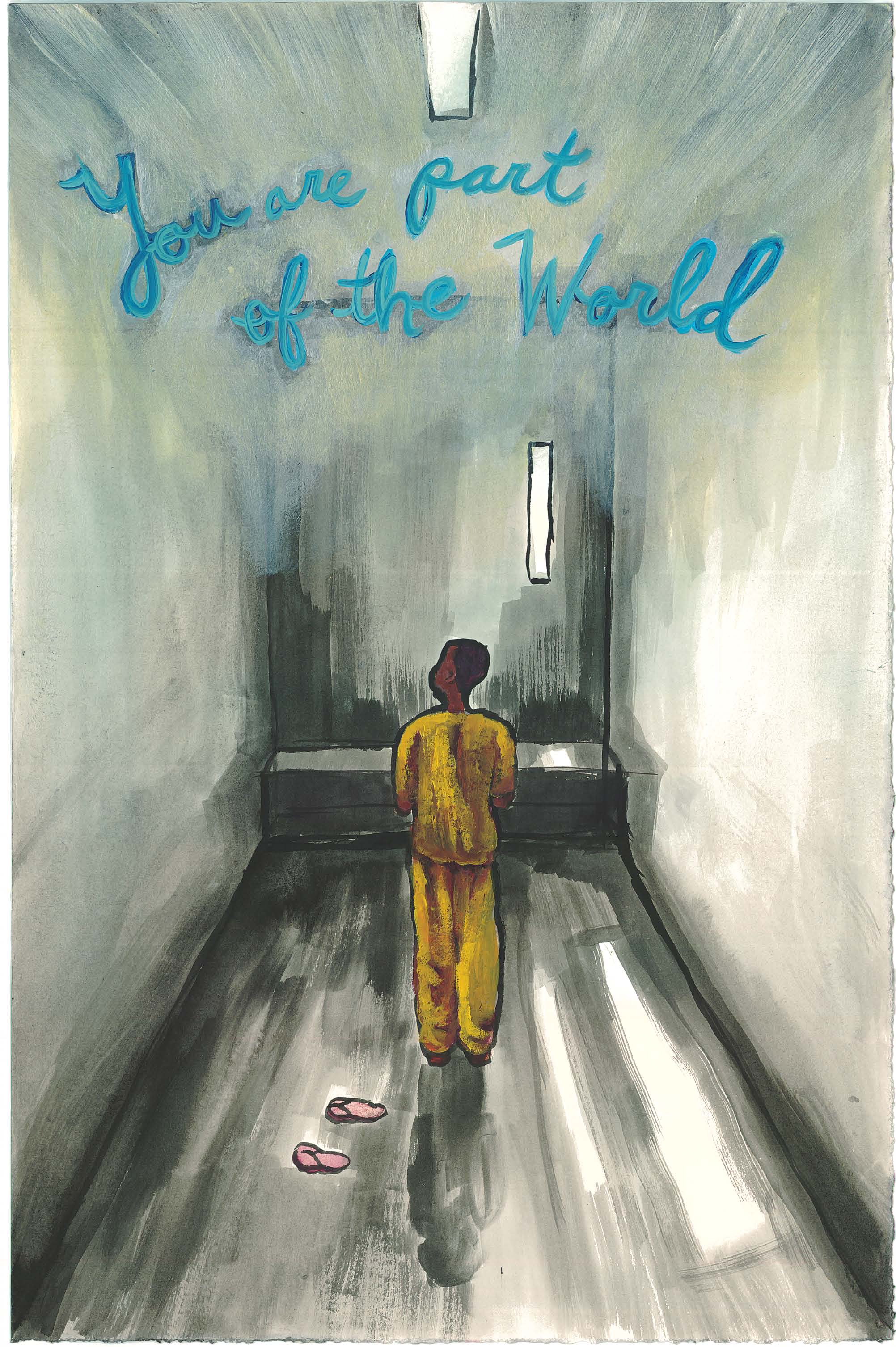
Preparing for Prison: Grief & Helplessness

by Billy Dee

A friend called this morning. She’s been working with a family whose son is preparing to go to prison. The lawyers have agreed to a plea bargain. He will serve three years. All that is left is for the deal to be certified. In the meantime, he just waits.

The young man is 19. He committed his offense at 17. It’s been 2 years in the system. The closer he gets to being locked up the more depressed he becomes. He wants to kill himself.

Those of us who work in some proximity to the criminal legal system often focus on the arrest, the court proceeding, the actual incarceration and sometimes re-entry. Yet it occurred to me this morning that I personally pay very little attention to that moment right before a person is about the walk into prison for the first time.

Today I was reminded of yet another terrible aspect of incarceration: the time right before the prison gates close the first time. What must this be like?

My friend spoke of the fear that this young man is currently experiencing; debilitating apprehension. His family is equally beside itself. My friend asked me for resources that might help this young man. I was distressed to tell her that I know of none.

I offered some ideas. They seemed woefully inadequate. I suggested that I would reach out to some formerly incarcerated young men so that they could share their experiences with him. Perhaps they could tell him what their first night in prison was like. Maybe they could share how they survived. I know, I know that this is cold comfort. Someone else’s experience can’t replace your own. You have to smell the smells, you have to taste the food, you have to experience the loneliness…. No one else can do your time. But…

Still I want to offer something to this teenager. I want to tell him that his life is not over; no matter how he is feeling today. I want to tell his family that the best thing they can do for him is not to forget him on the inside; to keep contact (letters, visits if they can afford them). One of the tragedies of incarceration is the sense among prisoners that they have been foresaken.

So I made some phone calls and two friends who are former prisoners have agreed to take part in a peace circle with this young man and his family. I am hopeful that the circle will provide him with a sense that he is cared for, will show him that he will not be forgotten, and will arm him with more information about the general experience of being locked up from the perspective of people who have done their time. I know, I know that this falls so short.

Ultimately, I feel helpless today. I really feel helpless today.

Feb 16 2011

Ceilings of Oppressions: A Photo Project about the Cradle to Prison Pipeline by Halley Miglietta

I am often asked to contribute to a variety of projects. I was particularly honored to be asked by Halley Miglietta who is an artist, activist and photographer to contribute some words to her project which she ended up calling “Ceilings of Oppressions.”

I am a big believer in the importance for organizers to rely on art as well as other mediums to convey our messages. Art and social justice are inextricably linked. Imagine using these photographs in your high school class to engender conversation about the cradle to prison pipeline. I am certain that young people would have so much to say about their own experiences while also reflecting on the ways that they can help to dismantle the pipeline.

Here are some words from Halley about her work:

The focus of this project was to capture the oppressive relationship between humans and institutions, as each photograph is inextricably linked in portraying the interconnected, wicked pipeline of injustice. The function of the text on top of each image is to provide clarity and knowledge – coming from scholars, journalists, and hip-hop artists alike.

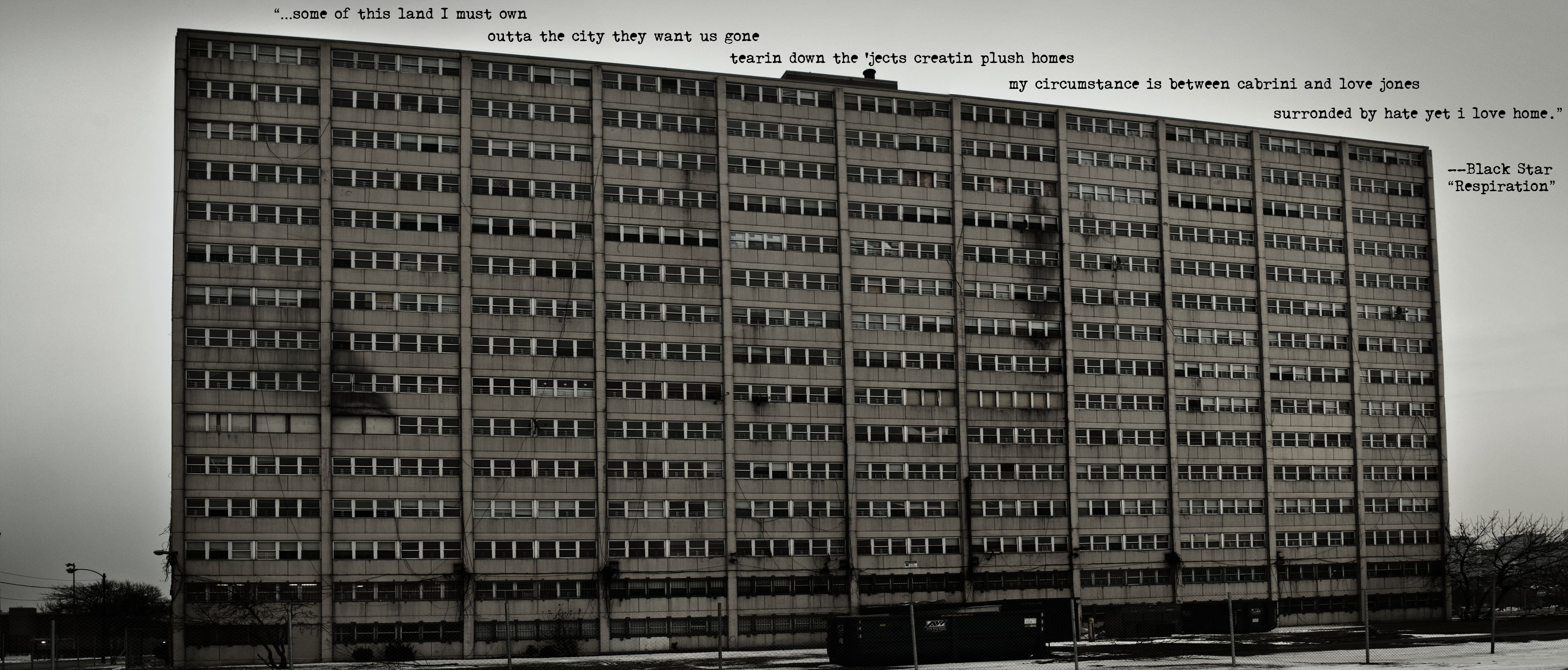
The project begins with an image of the old Cook County Stroger Hospital – a representation of life’s beginning. What follows is an image of the last standing, recently vacated Cabrini Green housing project. Housing projects were originally constructed to board the massive migration of families and individuals coming to Chicago for jobs in the height of industrial booms. These became the people of Chicago’s working class in whose children were bred in public schools to stay within the confines of their social/economic class and skin color as a means of sustaining the status quo. Thus the image of the school, which highlights the role our educational system has played in a system of organized miseducation and class tracking. The next image, the factory, depicts a mighty employer of immigrant populations and blacks who migrated from the south for machine-based jobs. When the economy globalized, industry shut down, as did jobs for the working class. What happens when the jobs are gone but the people still exist? Our country has used criminalization as a solution. Which brings us to the next image, the Cook County Jail, the landing spot for many victims of systematized marginalization. The final image of the cemetery is an acknowledgement of life’s end, and a gateway to the second part of the series entitled Acts of Resistance (coming soon).

This project is in collaboration with the Chicago Grassroots Curriculum Taskforce

Click on each photograph to see a larger image…

Ceilings of Oppressions - Halley Miglietta - Cook County Hospital

Birth symbolizes the possibility of everything.
In the United States, a black boy born in 2001 has a 1 in 3 chance of going to prison in his lifetime.
So for me, a visit to the maternity ward at Cook County Hospital carries with it a decided feeling that possibility is constrained by a ceiling of oppression.” — Mariame Kaba

Ceilings of Oppressions -- by Halley Miglietta - Cabrini Green

“…some of this land I must own
outta the city they want us gone
tearing down the ‘jects creatin plush homes
my circumstance is between Cabrini and Love Jones
surrounded by hate yet I love home.” — Black Star “Respiration”

Ceilings of Oppressions - by Haley Miglietta - School

As Carter G. Woodson declared, when you can control a person’s thinking you can control that person. Colonial education in America was designed to control, pacify, and socialize subject people. The education of Black Americans has always been inextricably connected to state politics and the labor market.—William H. Watkins

Ceilings of Oppressions - by Halley Miglietta - Factory

There has been a process of manufacturing and other businesses leaving the city of Chicago. As a result there has been no concern to meet the question of hardcore unemployment in the inner city. Federal funds designated for that use have been put to work reorganizing the city for its new white, middle-class look. –Keep Strong Magazine, Chicago 1980

Ceilings of Oppressions - by Halley Miglietta - Cook County Jail

“…the only crime you’re guilty of is the color of your skin
police put you in a cell
then throw away the key
and it don’t matter who you are — it could be you, it could be me
because the system is a business
the inmates are stocks, the wardens are the CEOs callin all the shots
for private investors, corporate oppressors, who pay the police to harass and arrest us.
We caught up in a justice system with no justice.” – Sticman “On the Hunt”

Ceilings of Oppressions - by Halley Miglietta - Cemetary

“The struggle for justice is always in the balance of life and death.
Through critical analysis and action,
our task is to create spaces that support the work we have committed to do.
At times, the duties & responsibilities in this process are difficult.
In the end, we do this work because our lives depend on it.
Death can be untimely, rapid, and finite.
The task at hand is to ensure that our struggle will continue
to live in the hearts and minds of those who will replace us.” — David Stovall

Feb 15 2011

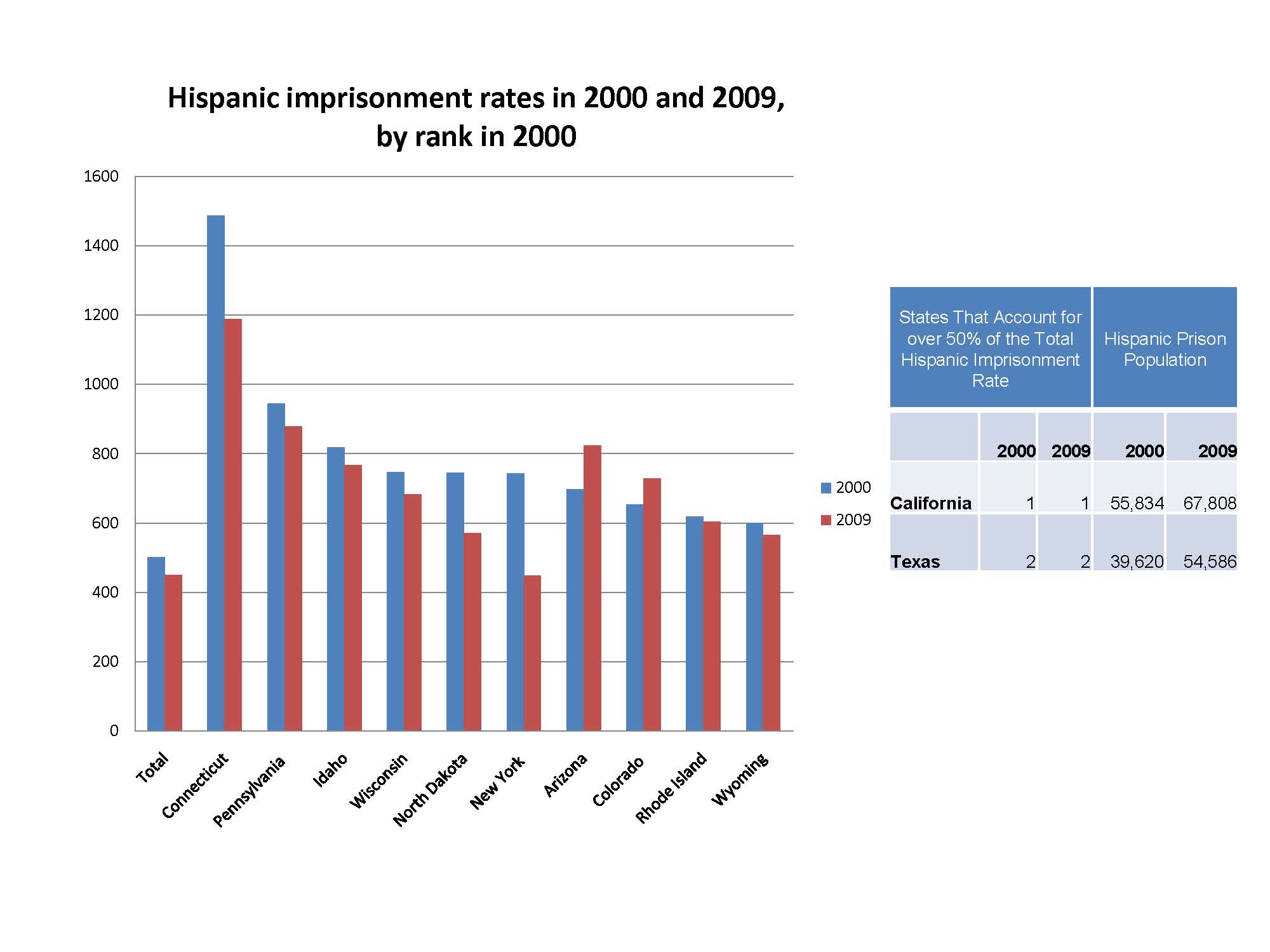
Crazy PIC Fact of the Day: Top Hispanic/Latino Incarceration Rates

I have received a few e-mails over the past few weeks asking me to post a chart about Hispanic/Latino imprisonment rates. I had offered a similar chart depicting top Black imprisonment rates. I have the sneaking suspicion that that I am unofficially working as a research assistant for some industrious high school and college students who are supposed to be doing their OWN research about the criminal legal system. I will start charging for fulfilling such requests starting next week :).

So here is a chart of states with the top Hispanic imprisonment rates (click on the chart to see a larger image):

You can download a copy of the chart here.

Feb 15 2011

Punishing Toddlers With Jail: Colbert Report Edition

Starting with a serious question: How young is too young? The Colbert report highlights the absurdity of the U.S.’s treatment of children in the criminal legal system.

The Colbert Report Mon – Thurs 11:30pm / 10:30c
The Enemy Within – Toddler Edition
www.colbertnation.com
Colbert Report Full Episodes Political Humor & Satire Blog Video Archive
Feb 14 2011

Any Contact with the Criminal Legal System Increases Suicide Risk…

(h/t to my friend Gary for this information)

Interaction with the criminal justice system, even if there is no guilty verdict, may be an independent risk factor for suicide, researchers report. A study that included more than 27,000 suicides found that odds of suicide were greater after contact with the criminal justice system for both men and women. The association was true even when the cases resulted in not guilty verdicts or sentences without jail time, the researchers report in the Archives of General Psychiatry.

Suicide was particularly likely for individuals with recent or frequent contact with the justice system, or for violent offenders. (Medpage Today, 2/07/11)

Feb 14 2011

Proof that the U.S. Remains Medieval: West Virginia Proposes Bringing Back Paddling in Schools

So apparently, West Virginia outlawed paddling and other forms of corporal punishment in their schools in 1994. But wait for it… Because the youth of today are deemed to be so damn disrespectful, one of the state’s lawmakers has proposed legislation to bring back paddling to classrooms. What I find even more distressing is that this legislator also moonlights as a substitute teacher.

The Charleston Daily Mail offered an astonishing editorial about the paddling proposal:

West Virginia has a part-time legislature made up of people who have jobs back home. They are supposed to bring their life experiences to the Capitol with them.

Delegate Brian Savilla, R-Putnam, did just that when he proposed bringing corporal punishment back to West Virginia. He is a substitute teacher.

The state banned the paddling of students in 1994.

“I firmly believe it’s led to a lack of respect,” Savilla said.

“Back when we had paddling, you did have instances, but they were on a smaller scale. When there was paddling, there was more discipline in school, and the system itself was more structured.”

There is no question that today’s youths are less respectful of authority and schools than students a generation ago.

The reasons are many – the breakdown of the family is a huge reason – but the brunt of dealing with the consequences is borne by teachers.

In removing corporal punishment from the toolbox the teacher has to maintain discipline in the classroom, the Legislature failed to replace that tool. Savilla said detention, suspension and even expulsion have failed to work.

It is like trying to feed a child who is not hungry and keeps throwing bowl after bowl of food on the floor.

Part of the problem is state courts, which maintain that education is a “right,” and have forced state officials to provide an education to a student no matter how bad his behavior may be.

Students expelled for disrupting school are now “entitled” to education, at taxpayers’ expense, in an alternative setting.

Taxpayers can’t afford that.

Schools aren’t broken. Society is.

Somehow, society must communicate, through real consequences, the fact that with “rights” come corresponding responsibilities – in this case, to respectful behavior in school.

Otherwise, the “right” to education, which kids undervalue, is forfeited.

Parents who knew their children could lose the right to attend public schools would do a better job of working with school officials.

Savilla’s proposal may go nowhere, but he has brought attention to a serious problem. Serious minds in the House and the Senate should take it up.

Orderly schools would make things easier for teachers, bring up test scores, and set more children on a productive path.

The entitlement philosophy is not accomplishing that.

Let me get this straight, the newspaper is suggesting that a student’s “bad behavior” should disqualify him/her from attaining an education through public schooling. Presumably, the editorial board is suggesting that students who “act up” should be shipped to private schools. Yet we know that the students who are disproportionately targeted by school disciplinary policies are poor, male and of color. Taken to its logical conclusion, these students once banned from attending public schools would have to find private schools to accommodate them. Can we guess about the likelihood that they would continue their education? This would lead to an increased number of school dropouts who had essentially been barred from accessing an affordable education. How early would we begin to kick children out of public schoTax payers in West Virginia would eventually be left holding the bag for a much more expensive option – they would be left paying thousands of dollars more to incarcerate these students in the future. Because closing off the path to education insures that you are opening the door to future incarceration.

Feb 13 2011

Voice from the Inside: Malcolm Braly Describes the Predictability of Prison Life

Interior of San Quentin Prison (1950s)

Malcolm Braly spent almost 17 years in several prisons including San Quentin and Folsom State for various burglary convictions. He wrote three novels while incarcerated. After he was released from prison in 1965, he wrote On the Yard, False Starts: A Memoir of San Quentin and Other Prisons. The following is an excerpt from False Starts which describes his incarceration experience:

The hardest part of serving time is the predictability. Each day moves like every other. You know nothing different can happen. You focus on tiny events, a movie scheduled weeks ahead, your reclass [reclassification by the prison staff], your parole hearing, things far in the future, and slowly, smooth day by day, draw them to you. There will be no glad surprise, no spontaneous holiday, and a month from now, six months, a year, you will be just where you are, doing just what you’re doing, except you’ll be older.

This airless calm is produced by rigid routine. Custody doesn’t encourage spontaneity. Walk slow, the Cynic says, and don’t make any fast moves. Each morning you know where evening will find you. There is no way to avoid your cell. When everyone marched into the block you would be left alone in the empty yard. Each Monday describes every Friday. Holidays in prison are only another mark of passing time and for many they are the most difficult days. Most of the outrages that provide such lurid passages in the folklore of our prisons are inspired by boredom. Some grow so weary of this grinding sameness they will drink wood alcohol even though they are aware this potent toxin may blind or kill them. Others fight with knives to the death and the survivor will remark, “It was just something to do.”

Feb 12 2011

Dispatches from the Prison Industrial Complex: Mock Prison Riots…

I have been planning to write about the Mock Prison Riot phenomenon ever since I learned about it last summer while attending my first and only American Correctional Association conference. Below is a commercial about the Mock Prison Riot experience which is described as follows:

The Mock Prison Riot is a FREE four-day, comprehensive law enforcement and corrections tactical and technology experience, including 44,000 square feet of exhibit space, training scenarios, technology demonstrations, technology assessments and evaluations, certification workshops, a Skills Competition, and unlimited opportunities for feedback, networking, and camaraderie on a global scale. The Mock Prison Riot is the only venue of its kind where law enforcement and corrections practitioners can touch, see, and actually deploy technologies from the showcase under real-world conditions, utilizing the grounds of the decommissioned West Virginia Penitentiary to maximum advantage. All of our services are offered free of charge to attendees. Visit us at www.mockprisonriot.org.

Basically, this “experience” is one big trade show to sell products to stakeholders within the prison industrial complex. Examples like this are why I cannot think of a better term than “prison industrial complex” to describe what we are seeing in terms mass/hyper incarceration in the U.S. One of the arguments against using the term is that the 100 billion dollars devoted to corrections at the federal, state and local levels are dwarfed by the over 700 billion dollars spent on the U.S. military. To me, the fact that the PIC gobbles up less resources than the military is immaterial. The point is that the profit motive does come into the prison system and the Mock Prison riot phenomenon underscores this fact.

The paramilitary aspect of the mock prison riots is also worth underscoring. I have written in the past about my aversion to boot camp for many reasons but chiefly because of the inherent militarism that permeates the experience. The same is true about the mock prison riots.

Promoters of the Mock Prison Riots have developed the following 3D application that allows individuals to take a virtual tour of the defunct West Virginia Penitentiary:

I recently wrote about the phenomenon of touring old prisons. Well it looks like we’ve found still another use for these structures…

Feb 10 2011

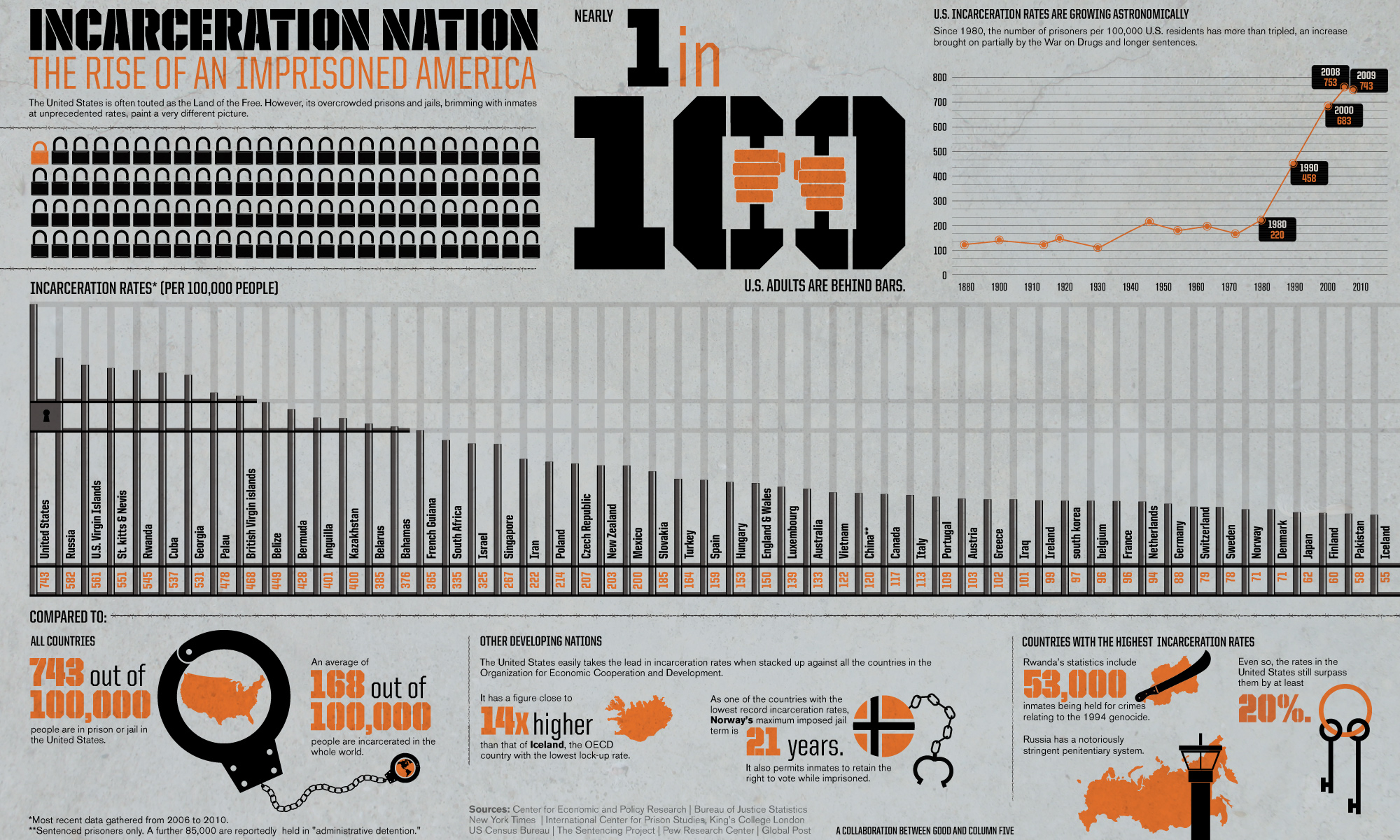
Infographic: Incarceration Nation

From Good Magazine:

Click here for the full sized infographic.