Jul 19 2011

Guest Post: Solidarity through Prison Radio (Thousand Kites) – A Report-Back from the Allied Media Conference

This is a the first of what I hope to be many guest posts to Prison Culture. This post is written by my friend Lewis Wallace. Lewis is a long-term anti-prison activist, writer, performer, artist and all around Renaissance man. He is based out of Chicago. I am grateful to have an opportunity to regularly collaborate with Lewis in dismantling the PIC and creating a more just world.

I recently had the opportunity to go to Detroit for the Allied Media Conference, held in Detroit annually every year. One of the conference tracks was called “Resisting the Incarceration Nation.” The track was led by organizers from around the country who are working to reform and/or dismantle the prison system, using creative media tools in the process.

I was particularly inspired by an organization based in rural Kentucky and Virginia called Thousand Kites. Thousand Kites does solidarity work with prisoners through performance, video, and radio. “Kite” is prison slang for a message; throwing a kite means passing along a message. This workshop was focused on their weekly radio program, “Calls from Home,” a broadcast that transmits messages from families, friends and supporters of incarcerated people through prison walls via a local radio station. “Calls from Home” has a very interesting story behind it, which the workshop facilitators shared; I am going to try to recount that story based on notes and memory, with major apologies to the organizers for any inaccuracies. I was deeply moved by their story and approach.

Thousand Kites began with a community radio station called Appalshop based in Whitesburg, Kentucky, in the Appalachians (WWMT 88.7 FM). When Appalshop started, the local people there had been the targets of a lot of media attention because of the War on Poverty, but felt like they weren’t being represented accurately in the media. They were represented as isolated, ignorant victims, not as people with their own culture and resourcefulness. They created a radio station to focus on local Appalachian culture; “The underlying philosophy has always been that Appalachian people must tell their own stories and solve their own problems,” their website said.

The vast majority of people living outside prison walls in rural Kentucky and Virginia are white. Not so for the people living inside of prison walls. For some time, Appalshop had one hip-hop show, once a week, for one hour. Well, it turns out that area in Eastern Kentucky and Western Virginia has nine different prisons located out there in the mountains. Two are supermax prisons, which means the people who live there are kept in solitary confinement almost all the time. Some of the prisons in the area are private, and have contracts with states all over the place to keep people there, thousands of miles from home in the middle of the mountains. Even from within Virginia or Kentucky, most of the people in captivity in that area are from urban places and many are African-American men. This one hip-hop show, called “Holla to the Hood,” was a source of comfort to people who loved hip-hop and were isolated from their home communities. The show’s creators began to receive letters from many of the men in the private prisons, documenting the extreme abuse and isolation. Eventually, in response to this letter-writing, a campaign grew to draw attention to the abusive practices at the supermax facilities, and to advocate for people being detained far from home to be returned to their home communities.

One of these campaigns, focused on a group of people who were transported all the way from the Virgin Islands to be kept in facilities in the Appalachians, partnered with a radio station in the Virgin Islands and with an organization called the Virgin Islands Prison Project. The campaign was successful! The men were moved to facilities in the Virgin Islands—still incarcerated (which I disagree with on my own abolitionist principles), but able to be visited by family and friends more easily. The Appalshop folks also partnered with organizations in Richmond, VA, in Pittsburgh, and in Connecticut to campaign against the prisons’ abuses.

Through this process, they realized that radio was an amazing way to stay in communication with people inside area prisons. Not all people in captivity have consistent radio access (especially in supermax facilities where many so-called privileges are restricted), but many do. They also learned from the prisoners’ letters that it was extremely difficult for them to keep in touch with their families; the prisons are located in unbelievably inaccessible places, even if you are coming from within Virginia (imagine a supermax facility on top of a mountain, for example). Visits are expensive, often prohibitively so, and phone calls are also a huge rip-off—controlled and overcharged by corporations who have exclusive deals with prison systems or private prison corporations. Radio waves, however, can’t be controlled by prison officials. So, Appalshop/Thousand Kites started “Calls from Home,” a show that allows the families, friends, or anybody who has a message for people incarcerated in this region to call in and leave a message. The messages are strung together each week into a radio broadcast, heard by all who are able to tune in, inside and outside prison walls.

The radio show has had many positive effects on the surrounding community, within and outside of the prisons. One is that families and friends can call a toll-free number with messages of comfort, love, support, holiday messages, and so on; these are broadcast to everyone which can help build community and personal connections between incarcerated people. It has also helped raise awareness in the majority-white region about the lives of the people who are being held inside prisons there; a lot of times prison guards, who were white, had only ever encountered an African-American person in the context of imprisoning them. According to the workshop presenters, some locals campaigned against the show initially; others, including prison guards, have expressed that they found the show illuminating because it connected them to the simple fact that incarcerated people have families, friends, and love in their lives, all rendered invisible by the physical isolation and control inherent to imprisonment.

One of the things that made this workshop so effective was that after explaining this whole history, the presenters went on to explain exactly how it is that they go about making “Calls from Home” work. It’s actually very simple. They have a toll-free number, 877-410-4863. Anyone can call from anywhere. Callers leave messages throughout the week. Every Sunday evening, they collect the messages through a Skype account and replay them into a basic audio recording/editing program. They then string the messages together into a radio show (yes, they occasionally have to edit out inappropriate messages, like sexual stuff or stuff that would put the program or people inside at risk). All the technology used to create the show is very simple and free to download (Skype, Audio Hijack and Audacity); Appalshop puts it on the air every week and voila!

Thousand Kites is in the process of creating a toolkit to help others start prison radio shows. I was so inspired by this and began to think about the possibilities for staying in touch and supporting family and community connections with incarcerated people in Illinois. It seems a little limited because we are based in Chicago, where the airwaves are very crowded; plus many of the people who are incarcerated here are far, far downstate. My friend and penpal who is in Tamms Supermax does not even have radio “privileges.” So, it’s not an option for everyone. Still, Thousand kites is doing a really amazing form of solidarity that also has concrete connections to and uses in organizing campaigns. Check out their website http://www.thousandkites.org/ or http://www.callsfromhome.org. You can listen to the show, and you can call the number anytime and leave a message yourself: 877-410-4863. We did that ourselves during the workshop and the listeners down in Kentucky and Virginia got our message of support and solidarity that very next week. Extra credit if you come up with brilliant ideas for how to use radio to reach incarcerated people in Illinois and email us ([email protected]).

Jul 18 2011

Prisoners Pay More: The Commissary Boondoggle

I thought that some readers would find it interesting to know just how much stuff costs at Illinois prison commissaries.


Prisoners who do not have a job currently receive up to $10.00 “state pay” each month. This amount has not been increased in many years. Additionally, Illinois Department of Corrections (IDOC) usually deducts 3-4% from the $10.00 to cover housing costs. And sometimes the “state pay” is not in fact paid. The “state pay” is used to cover other costs the prisoner has that are not covered by the IDOC. For example:

* Deodorant-$2-4.00 on commissary. None supplied.
* Toothpaste-$2-4.00 on commissary. Not supplied on a consistent basis or at all.
* Toothbrushes-$0.50 on commissary. Very rarely supplied by IDOC.
* Soap- small (1″ by 2″) bars-nondeoderant, provided to each inmate each week. $0.40 per bar at commissary.
* Shampoo. $1-3.00 at commissary. None provided
* Laundry detergent-$4-5.00 at commissary. None provided.
* Lotions-$2-4.00 on commissary. None provided
* Shaving Equipment-one single edge razor provided at most once per week. Usually, 2-3 times per month.
* Shaving equipment-electric razor or trimmer combs purchased from $10-50.00 from commissary.
* Fans-cell houses have no air conditioning. General population cells have no windows. Fan costs $25.00 from commissary.
* Legal services-copies of legal decisions and other similar materials at $0.05 per Pages.
* Food-IDOC provides three meals a day (quality questionable). Additional food, coffee, condiments, etc., must be purchased from commissary.
* Clothing-currently, inmates are fortunate if they receive two pairs of boxers, socks, twoT-shirts, one blue shirt, one pair of pants from IDOC. Due to budget cuts, this happens only once per year. Formerly, an inmate would receive these items four times per year. Inmates do not receive boots, even during winter months, other than slipper-type shoes. Regular shoes must be purchased from commissary. Costs range from $12-66.00.
* A towel and washcloth may be given 1-2 times per year.
* All electronics must be purchased from commissary. Extension cords, cable cords, headphones, TV’s, radios, splitters, lights, light bulbs, batteries, razors, etc.
* Cold/allergy/pain relievers are purchased from commissary. The nurses/med techs formerly provided the at the cost of the $2.00 co-pay, but don’t have them anymore.
* Envelopes/paper/pens to write to family, friends are not provided and must be purchased from commissary. An envelope with stamp currently costs $0.53.

(H/T to the Illinois Institute for Community Law and Affairs for this information)

Note: No sooner had I posted this was I reminded that the vast majority of the items listed above are not full sized but travel sized items. Thanks Dan for the reminder.

Jul 18 2011

A Prisoner’s Words Describing the “Hole”

We throw around the words solitary confinement in a very cavalier way in the U.S. Thanks to efforts like Solitary Watch public awareness is being raised about the brutality and torture of solitary confinement. This is a good thing. Today there is an excellent Op-Ed by Colin Dayan in the New York Times about the plight of prisoners at Pelican Bay and also about their resistance through hunger strikes. Yet I find something missing in our consideration of isolation in prison. We need to hear more of the voices of those who have experienced this torture.

A prisoner named Ahmad Al Aswadu wrote an essay titled “A Black View of Prison” in the April-May 1971 issue of the Black Scholar. In his essay, he describes the experience of living in the “hole” while incarcerated. Here is some of what he wrote:

The “Hole” (called such because its locality is usually under the prison’s first floor) is solitary confinement. One could stay in the hole for a week or a lifetime depending upon his color and attitude. It is here in the hole that men are made and broken at the same time. It is here that the previous threat of getting “hurt” can realize itself all too quickly. And it is here that the seeds of Black Consciousness have been cultivated in the minds of many black men.

It is very difficult for a layman such as I to describe the atmosphere of the hole but I shall try. I believe that the very first thing that the brother notices about the hole is the desolateness and the feeling of utter aloneness. The first time that I was sent to the hole I felt as if my soul had deserted me. I don’t believe that I had ever experienced such a feeling of intense emptiness in my life before then. I had been sent to the hole to have my attitude changed, because, as they stated, it was not conducive to “good order.” A brother had just been murdered by the guards who worked in the hole, and rather than go through that type of thing, I pretended to be institutionalized. Fortunately, my stay only lasted fourteen days and I was returned to the general inmate population.

Life in the hole is epitomized by one big question mark. Uncertainty is the order of the day. Your visitors are turned around at the gate when they come to see you. The food quantity and quality is drastically reduced to the level of subsistence. You might get a shower and you might not — depending upon whether or not the guard’s wife was good to him the night before. I believe that it is the hole that is the most memorable aspect of the prison experience. They are all the same, and yet they are totally different from one another.

Today, Critical Resistance is hosting a national conference call about the Pelican Bay Hunger Strike. All of the relevant details are below:

Monday, July 18th
6pm EST/ 5pm CST/ 4pm MST/ 3pm PST
toll-free call in number: 1(800)868-1837 (new number)
participant code: 62435226

Jul 17 2011

Poem of the Day: Letters Come to Prison by Jimmy Santiago Baca

"Words Break Down Walls" by Molly Fair (Justseeds)


Letters Come to Prison
by Jimmy Santiago Baca

From the cold hands of guards
Flocks of white doves
Handed to us through the bars,
Our hands like nests hold them
As we unfold the wings
They crash upward through
Layers of ice around our hearts,
Cracking crisply
As we leave our shells
And fly over the waves of fresh words,
Gliding softly on top of the world
Flapping our wings for the lost horizon.

1976, Arizona State Prison-Florence, Florence, Arizona.

Jul 16 2011

Prison as Black Men’s Natural Habitat?

A new study suggesting that black men survive longer in prison is making the rounds on the internet and in the mainstream media. According to Reuters:

Black men are half as likely to die at any given time if they’re in prison than if they aren’t, suggests a new study of North Carolina inmates.

The black prisoners seemed to be especially protected against alcohol- and drug-related deaths, as well as lethal accidents and certain chronic diseases.

But that pattern didn’t hold for white men, who on the whole were slightly more likely to die in prison than outside, according to findings published in Annals of Epidemiology.

The study observed about 100,000 men between ages 20 and 79 who were held in North Carolina prisons between 1995 and 2005. Sixty percent of those men were African American.The full study and its findings can be found in the Annals of Epidemiology.

The study author David Rosen is quoted in the article saying: “For some populations, being in prison likely provides benefits in regards to access to health care and life expectancy.” Perhaps sensing that his findings might be misinterpreted or misused, Rosen sent an e-mail to Reuters adding:

“It’s important to remember that there are many possible negative consequences of imprisonment — for example, broken relationships, loss of employment opportunities and greater entrenchment in criminal activity — that are not reflected in our study findings but nevertheless have an important influence on prisoners’ lives and their overall health.”

Ah, the tyranny of social science… The question remains: “how ought we to interpret these study findings?” At Outside the Beltway, Doug Mataconis takes his shot at interpreting the findings of the study:

This isn’t surprising at all. First of all, when someone is in prison the opportunities for drug and alcohol abuse, which contribute significantly to bad health, are significantly reduced. Additionally, prison diets are much more regulated and, quite honestly, probably healthier than what someone in a lower-income group is likely to eat on the outside. Moreover, there isn’t much else to do when you’re behind bars other than exercise, which itself has health benefits. Finally, while prison health care doesn’t provide for regular checkups necessarily, it’s likely to be better than what the inmate could get on the outside. Meanwhile, on the outside, African-American men are more likely than the population as a whole to have drug and alcohol problems, the diet of someone who lives in a lower income group is likely to be high in fat and salt, and less access to health care.

It’s worth examining some of the claims made by Mataconis to see whether they are in fact credible. First, are African-American men more likely than the population as a whole to have drug and alcohol problems? A review of the literature about substance abuse by John Hopkins University reveals the following:

African Americans, Hispanics, Native Americans, and Alaskan Natives have higher death rates for cirrhosis of the liver relative to the total population.

Alcohol mortality rates are highest for African-American men, even though alcohol use tends to be more moderate for African Americans than for whites or Hispanics.

African Americans are more likely to report using illegal drugs on a weekly basis than any other ethnic group.

Hispanics are most likely to engage in heavy alcohol use, followed by whites and African Americans.

It appears that even if African-Americans use less alcohol and drugs, their mortality rate from the abuse of these substances tends to be higher than the general public.

Another claim made by Mataconis is that prison food may in fact be healthier than the food that lower income groups consume on the outside. Is there a way to assess whether this is true? Anecdotally, over the past few years, school lunches which many young people who are below the poverty line are subjected to have been found to be less nutritious than prison food. Good Magazine even created an infographic unfavorably comparing school lunches to prison food. The point being made is that BOTH types of food suck rather than prison food actually being good.

What should we make of all of this? Does this mean that more black men should be encouraged to spend time in prison to ensure longevity? Some people may in fact make the case that these findings are proof that prison is not as bad as it is made out to be. They will revive claims that prisons are in fact “country-clubs.” I want to make a few points about these potential claims. First, conditions in prison are brutal and awful. Only a disingenuous person would suggest that prisons are a good place to be. Second, the real “crime” is that the conditions in so many low-income communities are the equivalent and sometimes perhaps worse than prisons. Earlier this week, I wrote about the metaphor popularized in the 1970s of “America as the prison.” This seems particularly relevant as we consider the implications of the study.

Mataconis concludes his post with these words:

The policy implications here seem rather clear, the question is how to implement them. Long-term poverty in minority communities has been a problem in the United States for awhile, and nothing the government has done has seemed help at all.

I want to suggest that the only real attempt that was made to address long-term poverty in this country was during the Great Society era. However, it is clear from that experiment that “programs” are not what are needed to address poverty. People need and want employment. Yet the capitalist system is set up to ensure a perpetual underclass. It’s the law of supply and demand. There must always be an imbalance in order for capitalism to survive and thrive. In the past, I have had my students read a book titled “the Stakeholder Society” by Bruce Ackerman and Anne Allstot. The authors make a provocative proposal which is to provide each high school graduate with a one time cash payment of $80,000 once he or she reaches the age of 21. This would be offered with no strings attached. I like to use this book with students because it provokes debate and also surfaces a lot of the entrenched prejudices that we all hold.

I usually ask students whether the way for us to address poverty would be to give poor people money to live. “What if we gave each American $125,000 when they are born?” I ask them. This usually gets my students talking about concepts like the free rider issue or they make culture of poverty arguments (not usually recognizing them as such). I bring this up only to make the point that our country is rich enough and has it within its power to ensure that all of its citizens could work and earn a living wage. The greatest anti-poverty program is a LIVING WAGE JOB. Simple. The easy way to ensure longevity for black men in this country is NOT to lock them up in prison but to provide them with solid educational options and real employment opportunities. Simple.

Jul 15 2011

Poem of the Day: Easy to Kill by Jackie Ruzas

The door,
I can see its molding if I scrunch in the
left corner of my cell
and peer through the bars to my right.
Each morning I awake
one day closer to death.

The prison priest, a sometime visitor,
his manner warm, asks
“How are you today? Anything I can do for you, son?”
“Is it just that I’m so easy to kill, Father?”
His face a blank, he walks away.

Play my life back on this death cell wall,
I wish to see my first wrong step.
To those who want to take my life,
show me where I first started to lose it.

1975, Madison County Jail, Wampsville, New York

Source: Doing Time: 25 Years of Prison Writing. Edited by Belle Gale Chevigny.

Of Irish and Lithuanian stock, Jackie Ruzas (1943) grew up in Queens. At parochial school, “I received both an education and bruises from the Grey Nuns.” Turning 16 at Aviation Trades High School, he was invited to quit or be expelled. He joined the ranks of construction workers. “When the sixties brought protest, alienation, and drugs, I joined those ranks as well. It all led to a final curtain on a sunny autumn say in October 1974, when a confrontation between a state trooper and myself resulted in his tragic death.”

Though charged with a capital crime, a jury spared him a death sentence; he is serving “an exile of twenty-five years to life.” He earned a G.E.D., but says he is mostly self-taught, “with a twenty-four year addiction to the New York Times.”

“I realized many years ago that writing provided me with a sense of flight to anywhere I chose to travel. I could leave my cell without sirens in my ears and dogs on my heels. Over the years I have tutored in classrooms in every maximum security prison in this state, and nothing gives me greater satisfaction than being part of an inmate’s journey from illiterate to literate.” He is organizing to restore college programming to Shawangunk Correctional Facility.

His poems have appeared in Candles Burn in Memory Town and Prison Writing in 20th Century America.

Jul 13 2011

Malcolm X and the Making of Prison Revolutionaries…

Don’t be shocked when I say that I was in prison. You’re still in prison. That’s what America means: prison.” – Malcolm X

Two books had a profound impact on my political consciousness. One of those books was “the Autobiography of Malcolm X.” It was sitting on my dad’s shelf when I picked it up for the first time at 11 or 12 years old. I was never the same. I just finished Manning Marable’s new book about Malcolm titled “Malcolm X: A Life of Reinvention.” I read the book with the eyes of a grown woman instead of the eyes of a pre-teen. I am even more admiring of Malcolm now because I am more comfortable with complexity and nuance. I know that my touchstones are not perfect; that they are human and therefore fallible.

I was particularly interested in the chapter of Marable’s brilliant biography that focuses on Malcolm’s incarceration experience. One of my writing projects is focused on how prison has been perceived in the black American imagination. As part of that, I am immersed in prisoner writing of the 60s and 70s. I want to encourage anyone who is interested in our current mass incarceration epidemic to go back and read the work of American prisoners of that period. You will be in for a major education.

Many incarcerated people of that era were connected to the Black Arts Movement. Malcolm X was an inspiration for many of the artists and prisoners of that era. They made the case in their writing as Malcolm had that prisons and the police were tools to oppress and dominate poor people and people of color. Malcolm’s radical critique of the criminal legal system was itself inspired by Marx and Gramsci. Later other participants in the Black Arts Movement would also be inspired by Althusser’s essay “Ideology and Ideological State Apparatuses”.

Writing in 1970, Zayd Shakur, the deputy minister of information for the New York State chapter of the Black Panther Party, echoes Malcolm’s contention that “America means: prison” as he makes the case that life in prison is an extension of life in our communities:

Prisons are really an extension of our communities. We have people who are forced at gunpoint to live behind concrete and steel. Others of us, in what we ordinarily think of as the community, live at gunpoint again in almost the same conditions. The penitentiaries, as they call them, and the communities are plagued with the same thing: dope, disease, police brutality, murder, and rats running over the places that you dwell in. We recognize that most of the militant-dissatisfied youth are off in the penitentiaries. Eighty percent of the prison population is black, brown, and yellow people. You look around and say, “what happened to my man. I haven’t seen him for a long time,” then you get busted, go to jail, and there he is. Prisons are an extension of the repression. In these penitentiaries are the Malcolms, Cleavers, Huey P. Newtons, Bobby Seales and all other political prisoners. Now the inmates are moving forth to harness their own destinies. They’re not relying on lying, demagogic politicians to redress their grievances. Of course, the courts didn’t redress their grievances in the first place, so there’s no sense in relying on them either. There’s very little difference between the penitentiaries in California and those in New York, New Orleans, Alabama, or Chicago. It’s the same system — America is the prison. All of America is a prison where the people are being held captive by the real arch criminals.”

I came across an interesting interview by the Liberated Guardian (L.G.) of two prisoners who had recently been released from Attica in March 1972. There were many interesting and important insights that the former Attica prisoners shared but I wanted to highlight one particular section of the interview. A former prisoner identified as Joe responds to the following question posed by the L.G.: “Do you think it’s true what George Jackson says, that the best of our kind are in the San Quentins and the Folsoms?”

The conditions produce revolutions. They don’t just happen. You can take Rap Brown. You can take him out of the ghetto, he can talk all the revolutionary bullshit he wants to, but nobody’s going to riot cause the people got their basic needs met. But he says that same thing in the ghetto and the people will react cause he is serving their needs now: showing them who’s the enemy and how they can go about meeting their basic needs. So it’s the conditions that produce the men that are leaders of the society or push the society to a higher stage of development. The George Jacksons, the Malcolm Xs, the Stokely Carmichaels, even myself. We are all products of society that we live in. And once you become aware of certain things, we say now wow, now you dig society, you got to go forth and change your conditions. Once you become hip to what’s going on, you’re going to want to change it.

Anyone who has read any part of Karl Marx will recognize the underpinnings of Marxist theory in this response. What I find particularly interesting about both of these passages is that both suggest that there is no real difference between political and nonpolitical prisoners. They also illustrate quite clearly the type of intellectual work that was happening in the late 60s and early 70s inside and outside of prisons. They suggest what we miss when we isolate prisoners from the broader society.

At the same time that conservatives were shifting the criminal legal system towards a “law and order” focus, the culture of American prisons was becoming more radical. This is a seemingly contradictory phenomenon of the 60s and 70s. One has to ask whether the increasing political and cultural engagement of American prisoners of the 1970s can be reinvigorated in the 21st century. It seems that we need a revival of prison revolutionaries in order to turn the current tide of hyper-incarceration. We should probably heed Louis Farrakhan’s words once again echoing Malcolm’s: “All of us are in prison. Those locked up are merely in solitary confinement.” Put another way, the liberation of those of us on the “outside” is distinctly linked to the liberation of those behind bars.

For more background on the nexus of arts and politics in prison, read Lee Bernstein’s book “America Is the Prison” which I wrote about several months ago.

Jul 12 2011

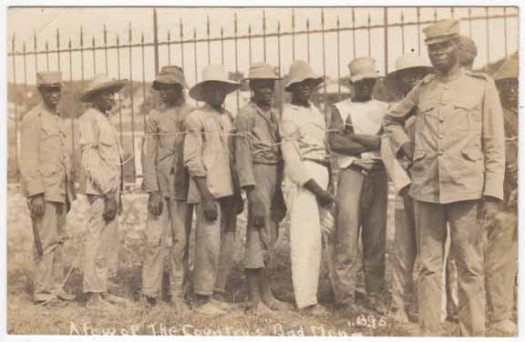
Photo of the Day: Southern Chain Gang

This is a vintage postcard from my collection of a Southern Chain Gang of Black Prisoners. The postcard is from around 1910 and says on the bottom: “A Few of the Country’s ‘Bad Men’.”

Jul 10 2011

On A Writing Retreat…

It’s summer and it is as good a time as any for me to take a step away from my daily grind. If you are a regular reader, you know that I have my hands in many different pots all at once. I can truly say that I am lucky to have all of the opportunities that I do to contribute to social change and justice.

Several years ago, I heard someone say that he didn’t know what he thought about anything until he had written it down. I subscribe to the same view. I have an overdue book project as well as a couple of other writing projects that I have to complete this summer. As such, I will be taking a writing retreat until mid-August.

What does this mean for Prison Culture? I will continue to post here sporadically. I am also reaching out to friends and colleagues to ask them to send along their posts so that I can share their insights about the prison industrial complex with you too.

When I am back to full steam again in late August, I hope to have tons to share with all of you. In the meantime, please have a good summer and keep up the struggle!

Jul 09 2011

Poem for the Day:13th and Genocide by Isaiah Hawkins

The clouds were low
when the sun rose that day.
For the white folks were coming
to lay some black brothers away.

From eight surrounding counties,
the white folks came,
with 12 hundred locks
and some brand new chains.

The word was kill niggers,
kill all you can.
For they don’t have the right
to live like men.

Then up in the sky
appeared a big green bird.
And from inside came
these few words.

“Put your hands on your heads
and you won’t get hurt,
lie on your bellies,
put your face in the dirt.”

Then from a distance
came a black brother’s cry.
“I’m a man, white folks,
and like a man I’ll die.”

This poem was written by Isaiah Hawkins who was a prisoner at Attica. He was a member of the prison liaison committee who worked for the betterment of all inmates’ conditions. He wrote the poem as a member of a poetry workshop that was intended as a rehabilitative measure for Attica. A series of 8 week poetry workshops began on May 24, 1972 and was run by Celes Tisdale who was a member of the Buffalo Black Drama workshop. Mr. Tisdale selected some of the poems from the workshops and published a pamphlet titled “Betcha Ain’t: Poems from Attica.” This is where I found Mr. Hawkins’s affecting poem. He was released soon after the workshop began.