Oct 08 2011

Black Youth, Police Violence, and Daily ‘Urban Hassles’

by Art Hazelwood

I’ve mentioned before that I am working on a lot of police related projects at this time. In fact, my organization is basically focusing on issues of police violence through 2012 and likely beyond. One of the main reasons for this is because the young people who we interact with want to talk about the police. This is a ubiquitous topic of conversation. Yet I am not feeling particularly well-equipped to offer anything transformational to the youth. It is not enough to address the “problem” without also providing some historical context for it as well as thinking through a way out of the police state.

So we are embarking on several projects that we hope will provide us with a better way to engage with young people around conversations about the police. We have launched a new participatory action research project called “Chain reaction: alternatives to calling the police.” We are working on a wiki project about Chicago police brutality and I am working on developing a curriculum about the history of police violence.

I was at a restorative justice conference in Madison, Wisconsin for most of the past week. I learned about a new measure called the “urban hassles scale” which is a tool to assess the daily hassles experienced by urban minority youth. An article that presents the scale offers some definitions of urban hassles:

“Lazarus (1984) defined daily hassles as “experiences and conditions of daily living that have been appraised as salient and harmful or threatening to the endorser’s well-being” (p. 376). Hassles have also been defined in the literature as irritating, frustrating everyday experiences arising from the transactions between the individual and the environment (Kanner, Coyne, Schaefer, & Lazarus, 1981).”

You can imagine how excited I was at discovering this scale. Evaluation is a major part of the work that we do at my organization. It is always easier and better for us if we can find validated measures that we can use in our evaluation tools. So as soon as I returned from Madison last night, I went in search of the “urban hassles scale.” Here are the components of the scale:

1. Take different routes home to keep safe
2. Pressured by friends to join a gang
3. Made fun of because of grades
4. Worried that someone will try to take your clothes, shoes, or money
5. Pressured to carry weapon for protection
6. Must work to help pay bills at home
7. Nervous about gunshots/sirens at night
8. Keeping your fear about safety secret from your friends
9. Offered sex by drug addicts for money

What is GLARINGLY missing from this list of measures? THE POLICE, of course… It is absolutely inconceivable to me that researchers could ignore one of the single most detrimental stressors in the lives of urban youth of color. This is another indictment of academia in my opinion. It underscores the huge gap between theory and practice. I say this as someone who has one foot in academia herself. Just listen to these young people of color describing their experiences of being “stopped and frisked” by the police.

This is the epitome of an “urban hassle.” Someone really needs to revise the scale in order for it to be credible. In the meantime, we will use it while making sure to add something about young people’s relationship to the police (in order to make sure that it reflects their lived realities).

Note: By the way, since I have worked with girls for so many years, I would also add a measure about street harassment and heterosexist public harassment to the scale.

Oct 04 2011

Prison Education Reduces Recidivism…

According to a press release that I received yesterday:


“Jake Cronin, a policy analyst with the Institute of Public Policy in the Truman School of Public Affairs at the University of Missouri, studied Missouri Department of Corrections data and found that inmates who earned their GED in Missouri prisons were significantly more likely to find a job after prison and less likely to recidivate than inmates who did not. Cronin found the biggest jump in reduced recidivism rates, more than 33 percent, when he looked at inmates who earned a GED and acquired a full-time job after their release.

“Employment proves to be the strongest predictor of not returning to prison that we found,” Cronin said. “Those who have a full-time job are much less likely to return to prison than similar inmates who are unemployed. Recidivism rates were nearly cut in half for former inmates with a full-time job compared to similar inmates who are unemployed. Inmates who take advantage of the educational opportunities available to them in prison are more likely to find a job than those who do not.”

Cronin says these reduced recidivism rates can save the state a substantial amount of money in reduced incarceration costs. He points to a similar study which found that educational programs that reduced recidivism rates saved the state of Maryland $24 million a year, which is twice the amount of money spent on the program. Cronin believes this shows that correctional facility educational programs are a good investment for the state of Missouri.

“If similar results occur in Missouri, which I would expect given the findings of this study, that would mean the state is currently saving more than $20 million a year in reduced incarceration costs as a result of correctional education programs,” Cronin said. “In this political environment, states across the country are looking for ways to save money. This is one program that, in the long run, saves the state money. It is a good investment; an investment that has a high rate of return.”


This is directly relevant to current prisoners. My pen pal Randy Miller who is incarcerated at Indiana State Prison is an advocate for prisoner education. Here is a letter to the editor that he wrote a couple of months ago about this topic:

Recent legislation passed by Indiana law makers eliminated the bachelor’s degree program from all Indiana State Prison beginning in the fall semester of 2011. The reason given by Governor Mitch Daniels and the state legislators for this action, is that it is unfair for tax payers to be burdened with the cost of covering educational expenses for convicted felons. This may be a valid argument, except that financially it is an outright lie.

The cost of college expenses in the 2010 school year for all Department of Correction inmates was $9.06 million, covered by the Obama grant program. Under new legislation, only $2 million will be allocated to the Department of Corrections to cover educational expenses for college. On the surface this appears to be a financially sound move and looks to save tax payers $7 million a year, but let’s look at what it really costs.

The state of Indiana pays the Department of Corrections just under $58 per day, per inmate, or $21,170.00 per year. There are approximately 361 inmates eligible to receive a bachelor’s degree each year within the Department of Corrections. Obtaining a bachelor’s degree cuts two years off an inmates sentence, saving tax payers $42,340.00 per inmate. By eliminating this opportunity for an average of 361 inmates state wide per year, Governor Mitch Daniels and your state legislators have saved you the tax payer $7 million a year in educational expenses to inmates, and burdened you with $15,284,740.00 per year to house inmates who now cannot receive this time cut. These costs do not include the rising rate of recidivism bound to follow these cuts in education.

Governor Mitch Daniels wants to move to technical schooling to teach inmates a trade rather than a general education, even though these trades have been shown and proven to have little to no effect on lowering recidivism rates. As it stands today, the average recidivism rate in Indiana is at 63 percent. A bachelor’s degree cuts that rate to less than 8 percent! Under Governor Mitch Daniels, Indiana has led the nation in prison population growth, with a prison population increase of more than 6 percent per year. Even California, a state who’s prison population dwarfs Indiana’s in comparison, cut it’s prison population by almost 3 percent.

It is time to change the way we think about the Department of Corrections. It is unfeasible to think you can warehouse inmates and ignore the problem, especially when more that 95 percent of those inmates will be re-entering society someday. The single most beneficial tool we have to lower crime rates, reduce recidivism and ensure the success of inmates re-entering society is education. There is absolutely no benefit for anyone in cutting educational funding to prisoners and eliminating the bachelor’s degree opportunity to inmates.

By
Randy Miller #154124
Indiana State Prison
August 6, 2011

Oct 02 2011

Sunday Musical Interlude: Long John

I’ve written about chain gangs before. One of the legacies of chain gangs are prison work songs. These songs were often the precursors of what we have come to know as the “blues.” One of the most famous of these prison work songs is “Long John.” This song and many others were recorded by ethnomusicologists John and Alan Lomax. You can see the lyrics and some background for Long John here.

Oct 01 2011

The New Scarlet Letter: the Final Chapter?

Today kicks off National Youth Justice Awareness Month so it is fitting that I am writing about a young woman who I call Mariah and her recent discovery of a juvenile criminal record. There have been three previous blog posts following her trials and tribulations already. Today, I offer what I hope is the final chapter in her journey.

We arrived at Juvenile Court around 8:50 am yesterday. Mariah’s expungement hearing was scheduled for 9:00 a.m. At around 9:30 am, an assistant state’s attorney came out to the waiting area to inform Mariah that she would have no objection to her expungement petition. She asked Mariah to mark some parts of her petition N/A. She also told her that if the judge approved her petition, it would take 60 to 90 days for the State Police to expunge the record.

About five minutes later she came back out to invite Mariah into the courtroom to see the judge. We were lucky to be assigned Judge Heaston who approved the fee waiver application and the petition itself without delay. All in all it took 3 minutes for him to do this. He directed us back to the Clerk’s office to get a certified copy of the expungement order. He told Mariah that it would take about 45 minutes and that she should keep the order in a “safe place” because the Clerk’s office would make her “jump through hoops” if she lost her copy and needed to get another one in the future.

We went to Dunkin Donuts to get some breakfast while we were waiting to get the certified copy of the expungement order from the Clerk. Once we picked that up, we left and Mariah took a deep breath and exhaled.

You will no doubt be happy to know that Mariah received a letter on Thursday saying that her license had been approved. This process was no doubt expedited by the calls that the office of financial and professional regulations received from two journalists from WBEZ and the Tribune about the matter.

Ceilings of Oppression - by Haley Miglietta - School

I will let Mariah’s own words be the final ones in this saga:

I really feel lucky. I thought this whole process would take much longer. There was poster right next to courtroom 9 that stated today’s choices are tomorrow’s consequences. It had a yellow school bus on it and it reminded me of the stupid choice I made to fight in 8th grade. I’m really seeing the consequences of my choice. It sucks that I had to go through this but I’m glad it’s over and I have my license. Hopefully I can put this all behind me and never have to deal with that incident of the past again. In 90 days this basically “never happened.” I think I can finally move forward.

Sep 30 2011

Sagging Pants, Hypercriminalization and School Pushout…

I came across this “ad” on a friend’s Facebook wall today.

Some people’s first reaction to this “ad” might be to chuckle at its utter ridiculousness. Surely the purveyors of this ad are not advocating that young people who wear sagging pants go to jail for this?!!!?? Unfortunately though, the reality is that some legislators are in fact advocating fines and community service for young people who don’t “pull up their pants.” Here’s an example from New Orleans:

Here’s an ad from a state senator in New York that attempts to couch the “war on sagging” within a historical context of racism.

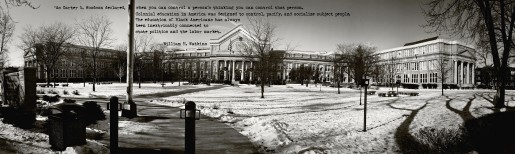
The key sentence in the video for me is: “If we raise our pants, we raise our image.” The concept of being a “credit to one’s race” is deeply embedded in African American history. The state senator seems to be embracing the legacy of Booker T. Washington through his video. The sad thing is that for many African American youth pulling up their pants will NOT shift the deeply embedded image that the culture has of them as being “criminal” or “disposable.” It’s not about the clothes. Instead it is about what Amos Wilson has written:

In the eyes of White America an exaggeratedly large segment of Black America is criminally suspect. This is especially true relative to the Black male. In the fevered mind of White America, he is cosmically guilty. His guilt is existential. For him to be alive is to suspected, to be stereotypically accused, convicted and condemned for criminal conspiracy and intent. On the streets, in the subways, elevators, in the “wrong” neighborhood (p.37).”

In the past, I have written about attempts to criminalize youth of color by outlawing sagging pants and have connected this to the way that prison clothing is used as a marker of criminality.

A few weeks ago I wrote briefly about Victor Rios’ new book “Punished: Policing the Lives of Black and Latino Boys.” In the book, Rios coins the term “youth control complex” which is defined as “a system in which schools, police, probation officers, families, community centers, the media, businesses, and other institutions systemically treat young people’s everyday behaviors as criminal activity.” The “war on sagging pants” is a perfect illustration of this “youth control complex” in action.

Rios writes about the impact of the “youth control complex” on the lives of young people of color:

Young people, who become pinballs within this youth control complex, experience what I refer to as hypercriminalization, the process by which an individual’s everyday behaviors and styles become ubiquitously treated as deviant, risky, threatening or criminal, across social contexts.

This hypercriminalization, in turn, has a profound impact on young people’s perceptions, worldviews, and life outcomes. The youth control complex creates an overarching system of regulating the lives of marginalized young people, what I refer to as punitive social control.

Hypercriminalization involves constant punishment. Punishment, in this study, is understood as the process by which individuals come to feel stigmatized, outcast, shamed, defeated, or hopeless as a result of negative interactions and sanctions imposed by individuals who represent institutions of social control.

These days, ground zero of the “youth control complex” can be found in our nation’s schools. Dr. Aaron Kupchik who studies school discipline issues has found that schools with large minority populations are more likely to have metal detectors. None of you will be surprised by this finding. However I want to make the point that the crackdown on sagging pants is integrally related to the types of zero tolerance policies enacted in most urban schools. In fact, some schools have begun to punish students who wear sagging pants on school property. It comes full circle.

Kupchick and his colleague Goeff Ward are particularly concerned about the use of metal detectors in schools.

Unlike the other four measures, Kupchik identifies metal detectors as invasive (“kids are patted down like they’re going through airport security”) and disruptive to learning environments.

Further, he adds, metal detectors are more heavily aligned with the criminal justice system, and unlike locked gates, which restrict outside elements from coming into the schools, detectors presume students guilty of bringing items inside.

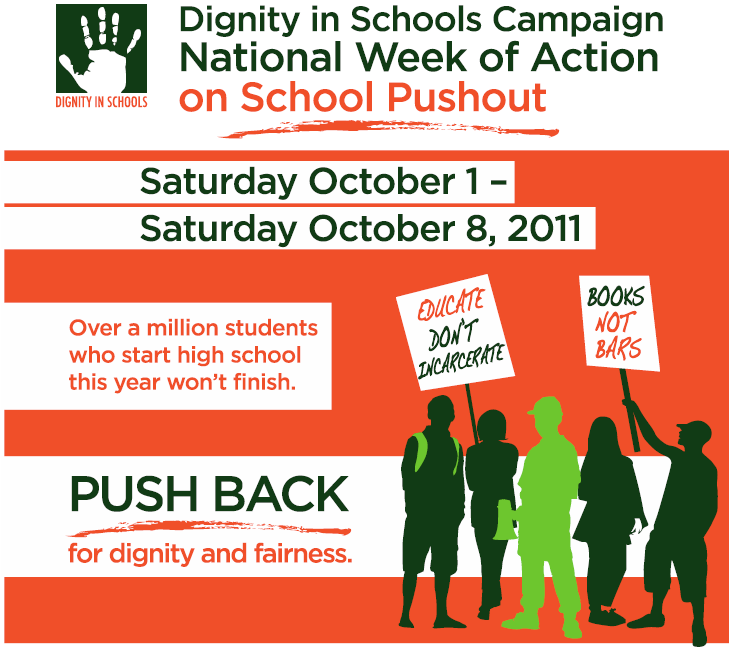
Scholars, educators, and young people from across the country are sounding the alarm about the intersection between schooling and youth hypercriminalization. From October 1 to 8, the Dignity in Schools Campaign (DSC), a coalition of educators and organizers, is spearheading the National Week of Action on School Pushout. The Dignity in Schools Campaign’s National Week of Action brings together organizations and individuals from 13 states to call for an end to zero tolerance policies, for the implementation of positive approaches to discipline, like restorative justice practices and positive behavior supports instead of relying solely on suspensions and expulsions, and for the passage of federal legislation that promotes positive school climates.

I suggest that everyone read the Week of Action Platform (PDF) to learn about what’s at stake in the education of young people across the U.S. You can also find fact sheets about how these issues on playing out in your state on their website. Below is an example of one of their fact sheets:

Sep 29 2011

‘Things Fall Apart:’ Youth Resist Institutional Violence…

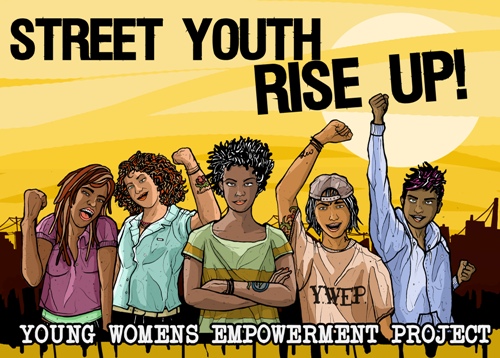
Years ago, I served on the board of an organization that I still love called the Young Women's Empowerment Project (YWEP). YWEP is not to be confused with the Rogers Park Young Women's Action Team (YWAT), a youth-led group that I co-founded and have written about before.

Regular readers of this blog know that I am a prison abolitionist. I have written often about my ideas and thoughts about abolition here. I am often asked about what would happen to all of the “bad” people if there were no prisons. There are tons of people who others would consider “bad” who aren’t locked in cages. So those questions do not concern me. I do however worry about one thing: the fact that many of the institutions that we would need to rely on in order for abolition to be fully realized are so oppressive and fundamentally broken.

Case in point, yesterday the Chicago Tribune reported that Hartgrove pyschiatric hospital on the Westside of Chicago is basically a hell-hole for young people. Citing a new report from the University of Illinois at Chicago, the Tribune writes:

Among the chilling details in the UIC report on Hartgrove were descriptions of some hospital employees who appeared to be indifferent or too poorly trained to treat seriously mentally ill youth.

One case involved a 16-year-old girl with severe sickle cell anemia who was forced to cope with intense pain for long periods of time. When she became overwhelmed and had emotional outbursts as a result, staff blamed her for not being able to control herself.

A psychiatrist at the facility labeled her behavior as “med-seeking,” according to records.

In another case, employees in May reportedly fractured the arm of a 16-year-old boy, who was not a state ward, apparently because they were not properly trained in restraint techniques.

The Tribune also reports that “[a]bout 100 violent incidents were documented between December 2010 and mid-June 2011, which included physical attacks, uncontrolled threatening behavior and sexual assaults.” I feel sick to my stomach in reading this because I have referred several young people to Hartgrove over the years. I never heard that they were mistreated at the hospital but I have to admit to having followed up with less than half of the youth who I referred there. Once released, they would usually be referred to services closer to where they live. The sickening part of this for me is that I assumed that they would get the help that they needed from the hospital. I know better but I just want to believe that the institutions that are supposed to serve vulnerable youth will not actually harm them. How can I be both so jaded and so trusting at the same time?

I do know better. The young women of YWEP have created a bad encounter line that I have written about previously here. YWEP explains the history and purpose of the bad encounter line:

In 2009, YWEP completed a youth led research study on ways girls and transgender girls in the sex trade & street economy are resistant and resilient to violence. In this research we looked at two categories of violence, individual and institutional. Although both categories had surprising results, we were most surprised at the amount of girls and transgender girls facing violence from institutions- like police, hospitals, social services and even Department Children and Family Service.

We wanted to tackle this problem from a community organizing approach from this idea the Bad Encounter Line (BEL) was born. The BEL is a way to report bad experiences you have had with institutions and tracks the neighborhood, gender and time of day so YWEP can learn more about how we are being harmed.

The Bad Encounter Line is an excellent example of how marginalized young people of color resist institutional violence. It also illustrates the young people’s resilience. I am angry that it has to come to this. However I feel so proud that the youth are mobilizing to bring this violence to light. This is a form of violence in the lives of youth that does not garner media attention or award winning documentaries. Yet it is real and can often be debilitating for young people. YWEP also started a task force called “Street Youth in Motion” which is organizing a community march tomorrow. If you are in Chicago tomorrow, you are invited to support the young people at their demonstration.

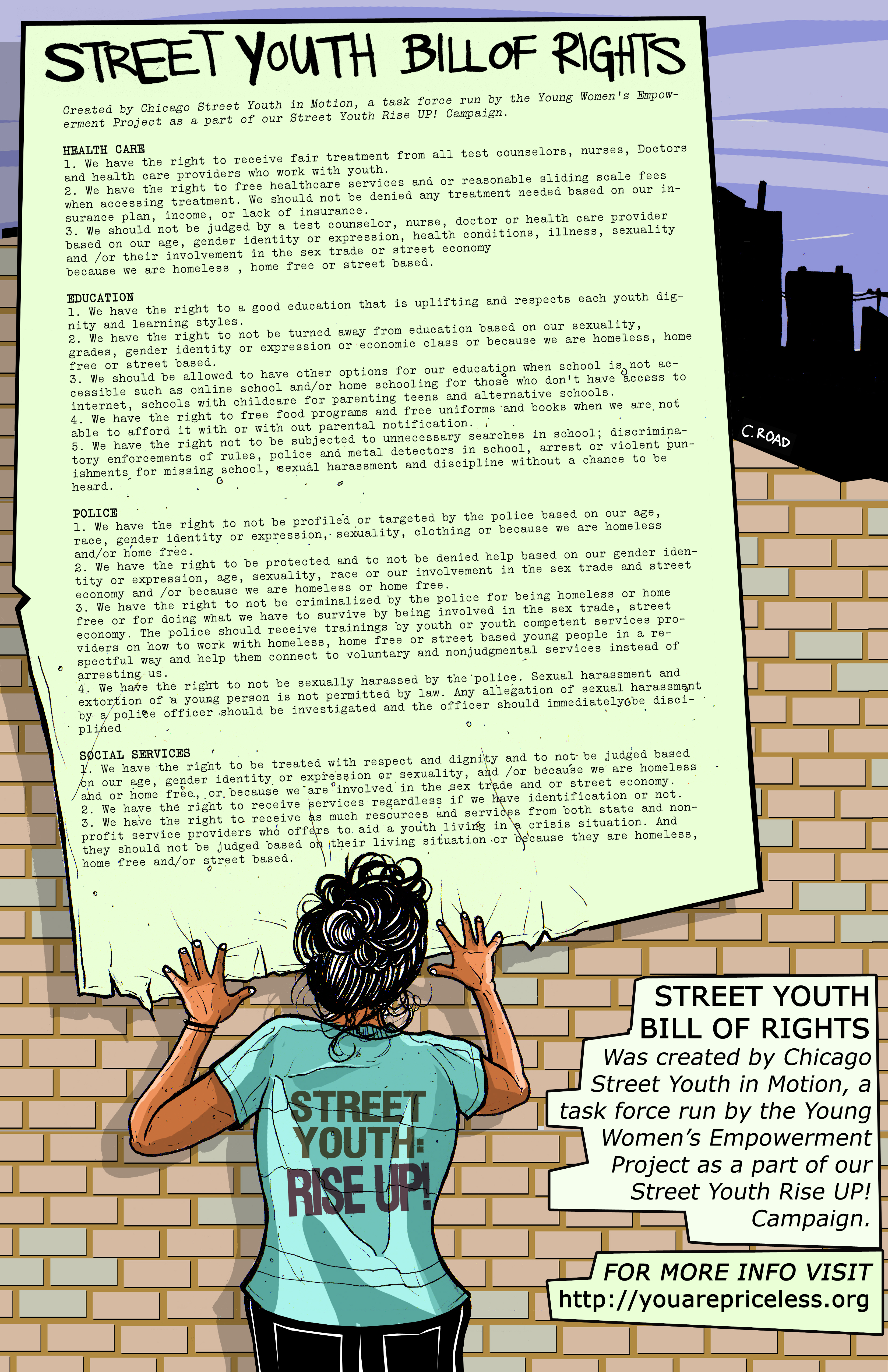
The Taskforce wrote a Street Youth Bill of Rights (PDF) that they want all non-profits to sign “to [in their words] make them accountable to us and can’t get away with denying us help!”

Ultimately, I guess that this is what should give me hope. Young people are organizing and demanding accountability from the institutions that should be there to help them. This is another example of transformative justice. So perhaps I don’t have to worry about the promise of abolition after all…

Sep 29 2011

Books about Incarceration for Teens…

By Peter Yahnke

Last week, I received a moving e-mail from a young mother who has a 15 year old son. She wrote to me about some of her struggles with her son. She made a specific request: Could I provide her with a list of books that her son would find entertaining while also addressing the experience of incarceration? Thankfully, I am an avid reader of young adult fiction (YA) and I have indeed come across some books with incarceration themes that I could recommend. I sent her a list earlier this week and thought that other readers of this blog might also be interested in some of these titles.

My hands-down best YA title about incarceration that I read this year was Lockdown (2010) by Walter Dean Meyers. I just love Meyers because he is a master at writing in the voice of young Black boys. The book is best for high school age youth. Here is a short review from Booklist:

Myers takes readers inside the walls of a juvenile corrections facility in this gritty novel. Fourteen-year-old Reese is in the second year of his sentence for stealing prescription pads and selling them to a neighborhood dealer. He fears that his life is headed in a direction that will inevitably lead him “upstate,” to the kind of prison you don’t leave. His determination to claw his way out of the downward spiral is tested when he stands up to defend a weaker boy, and the resulting recriminations only seem to reinforce the impossibility of escaping a hopeless future. Reese’s first-person narration rings with authenticity as he confronts the limits of his ability to describe his feelings, struggling to maintain faith in himself; Myers’ storytelling skills ensure that the messages he offers are never heavy-handed. The question of how to escape the cycle of violence and crime plaguing inner-city youth is treated with a resolution that suggests hope, but doesn’t guarantee it. A thoughtful book that could resonate with teens on a dangerous path.— Ian Chipman

The next book that I recommended is titled “Holes (1998)” by Louis Sachar. This is a book about a young man who is sentenced to boot camp. I will include the Booklist review below. However I really disagree with the reviewer about the final part of this book. It is the realism of the ending that really saved the book for me. My godson absolutely loved this book. He read it when he was in the 7th grade and I think that it was completely age appropriate for him. He has since recommended it to other friends.

Middle-schooler Stanley Yelnats is only the latest in a long line of Yelnats to encounter bad luck, but Stanley’s serving of the family curse is a doozie. Wrongfully convicted of stealing a baseball star’s sneakers, Stanley is sentenced to six months in a juvenile-detention center, Camp Green Lake. “There is no lake at Camp Green Lake,” where Stanley and his fellow campers (imagine the cast from your favorite prison movie, kid version) must dig one five-by-five hole in the dry lake bed every day, ostensibly building character but actually aiding the sicko warden in her search for buried treasure. Sachar’s novel mixes comedy, hard-hitting realistic drama, and outrageous fable in a combination that is, at best, unsettling. The comic elements, especially the banter between the boys (part scared teens, part Cool Hand Luke wanna-bes) work well, and the adventure story surrounding Stanley’s rescue of his black friend Zero, who attempts to escape, provides both high drama and moving human emotion. But the ending, in which realism gives way to fable, while undeniably clever, seems to belong in another book entirely, dulling the impact of all that has gone before. These mismatched parts don’t add up to a coherent whole, but they do deliver a fair share of entertaining and sometimes compelling moments. -— Bill Ott
by Erik Ruin

Another recommendation from the canon of Walter Dean Meyers is Monster (1999). Here is a review from Booklist:

Myers combines an innovative format, complex moral issues, and an intriguingly sympathetic but flawed protagonist in this cautionary tale of a 16-year-old on trial for felony murder. Steve Harmon is accused of acting as lookout for a robbery that left a victim dead; if convicted, Steve could serve 25 years to life. Although it is clear that Steve did participate in the robbery, his level of involvement is questionable, leaving protagonist and reader to grapple with the question of his guilt. An amateur filmmaker, Steve tells his story in a combination of film script and journal. The “handwritten” font of the journal entries effectively uses boldface and different sizes of type to emphasize particular passages. The film script contains minimal jargon, explaining camera angles (CU, POV, etc.) when each term first appears. Myers’ son Christopher provides the black-and-white photos, often cropped and digitally altered, that complement the text. Script and journal together create a fascinating portrait of a terrified young man wrestling with his conscience. The tense drama of the courtroom scenes will enthrall readers, but it is the thorny moral questions raised in Steve’s journal that will endure in readers’ memories. Although descriptions of the robbery and prison life are realistic and not overly graphic, the subject matter is more appropriate for high-school-age than younger readers.— Debbie Carton

I read Paul Volponis’ Rickers High (2010) this summer and I found it gripping and engaging. It has stayed with me all of these weeks later. I highly recommend it for young men of high school age. Here’s the booklist review:

Recasting his specialty-press debut novel, Rikers (2002), for a younger audience, Volponi tracks a juvenile offender’s final 17 days in the New York correctional facility. Though arrested just for telling an undercover cop where to buy weed, Martin has spent five months at Rikers waiting for his case to come up. The experience has made him a canny observer of the prison ecosystem, good at keeping his head down and steering clear of gangs, extortion schemes, brutal correction officers, and other hazards . . . mostly. The author draws authentic situations and characters from his six years of teaching at Rikers, and though his scary cautionary tale is less harrowing than Adam Rapp’s Buffalo Tree (1997) or Walter Dean Myers’ Monster (1999), it is nevertheless an absorbing portrait of life in stir. In the end, Martin walks out on plea-bargained probation, bearing both inner and outer scars. Rare is the reader who won’t find his narrative sobering. — John Peters

The reviewer mentions the book “The Buffalo Tree (1997)” by Adam Rapp. I read that book about 10 years ago. While I personally loved it, the young mother who wrote to me said that her son has some literacy challenges. Because of this, I refrained from recommending books that might prove challenging in terms of language. If you are a grown person or if you are a teenager who likes to be challenged by language, then I highly recommend that you read “The Buffalo Tree.” It is a searing portrayal of life inside a juvenile detention center.

I read “Boot Camp (2007)” by Todd Strasser last year. It was excellent and felt very realistic. I liked this book more than I did “Holes.” I imagine that young people from 10th grade up would also very much enjoy “Boot Camp.”

Louis Sachar’s Holes (1998) described a juvenile detention camp with tall-tale trappings. For a somewhat older audience, this documentary-style novel tackles similar “boot camps” without the fablelike buffer, delivering a troubling glimpse of what might go on in such camps (and backing it up with an author’s note and sources). Garrett, 15, is trapped in the “secret prison system for teenagers” when his controlling parents, enraged by his affair with a teacher, are lured by the promise of a boot-camp brochure: “The child who returns from the Lake Harmony experience is the child you always knew you had.” Once at the camp, Garrett endures a battery of brainwashing techniques, including physical abuse, and eventually meets two other desperate teens who want to escape. Some plot elements don’t add up; it’s hard to believe, for instance, that the one supportive adult Garrett encounters—a warden—would let the camp continue without blowing the whistle. But as in Strasser’s Give a Boy a Gun (2000), the real-world issues will hit a nerve.— Jennifer Mattson

My final suggestion was a book titled “A Question of Freedom: A Memoir of Learning, Survival, and Coming of Age in Prison (2010)” by R. Dwayne Betts. I usually avoid recommending non-fiction books to high school students especially those who struggle with literacy issues. Fiction takes licenses which can make it even more entertaining and accessible to readers who struggle with literacy. The middle school and high school age young people who I work with usually respond best to my fiction recommendations. However, I really enjoyed Dwayne Betts’ book. It is a story of redemption and does not come across as preachy or after-school special like. Here’s a short description:

At the age of sixteen, R. Dwayne Betts-a good student from a lower- middle-class family-carjacked a man with a friend. He had never held a gun before, but within a matter of minutes he had committed six felonies. In Virginia, carjacking is a “certifiable” offense, meaning that Betts would be treated as an adult under state law. A bright young kid, he served his nine-year sentence as part of the adult population in some of the worst prisons in the state.

A Question of Freedom chronicles Betts’s years in prison, reflecting back on his crime and looking ahead to how his experiences and the books he discovered while incarcerated would define him. Utterly alone, Betts confronts profound questions about violence, freedom, crime, race, and the justice system. Confined by cinder-block walls and barbed wire, he discovers the power of language through books, poetry, and his own pen. Above all, A Question of Freedom is about a quest for identity-one that guarantees Betts’s survival in a hostile environment and that incorporates an understanding of how his own past led to the moment of his crime.

I could have gone on but I felt that this list was a good beginning. All of the books that I mentioned above have male protagonists because I thought that the young man who I was recommending the books for would find these characters appealing and perhaps relatable.

Because I have spent over 15 years specifically working with young women in gender-specific programs, I am going to suggest a book titled “Upstate (2005)” by Kalisha Buckhanon. I ran a book group for young women of color in their teens a couple of years ago where we read “Upstate.” The young women LOVED this book. Here is review from Booklist:

With e-mail being used for everything from business memos and meeting reminders to tender love notes, the epistolary novel– with a history stretching from the days of Samuel Richardson and Choderlos de Laclos’ Liaisons Dangereuses to, more recently, Helene Hanff’s 84 Charing Cross Road and Alice Walker’s Color Purple– seems to be burgeoning again. Buckhanon’s foray in the format presents a decade of correspondence between Antonio, initially a teen arrested for murder, and his sweetheart, Natasha. Both from tiny, dark apartments in Harlem, they are passionately in love and lust but destined to walk very different roads. Eschewing Walker’s more dialectal language, Buckhanon opts for writing that is best called “lite,” suggesting New York City black speech but not so authentically as to compromise mainstream audience potential. Those aware of how unlikely success is for young women in Harlem and felons in and out of lockup might take issue with Buckhanon’s somewhat sanitized depiction. Others may eagerly anticipate a TV adaptation of it. — Whitney Scott

If you are an educator or youth worker, I have a terrific curriculum to teach “Upstate” to young women for those who might be interested. Please feel free to e-mail me and I can share it with you.

By the way, I would love to hear others’ suggestions of good YA books about incarceration. So feel free to let me know your ideas.

Happy reading!
Sep 25 2011

Poem for the Day: America Eats Its Young by Jemeni

America Eats Its Young

America’s still eating its young,
But I think she need to get slim.
Fast!
Somebody tell that heifer to exorcise her demons,
Stop chewin on black children
& reduce her jail cell ulite.

Ain’t nobody want her breast-milk
So she’s backed up, chest swollen.
See justice for black folk
is notoriously lactose
intolerant.

Maybe she should get a tummy-tuck,
Cuz her underbelly’s showin.
And we see a disproportionate percentage of black boys
Locked up in the belly o’ dat beast,
She likes darkies,
Developed a taste for dark meat,
I mean she’s been suckin the blood from our marrow
since
Slavery

Too bad most innocent cons
Don’t have the Canadi-ons
To clear up the lie —
Po’ suction causes a clog in the system
And a lot of black boys get lost in the system.
Inmates studying law to find a clause in the system/
I mean,
they know dey gon’ die,
But at least they could try to put some sorta
– Pause – in the system.

4 copes get acquitted.
And Giuliani got the nerve to give
Applause.
For the system.

America’s still eating its young
And she’s got a mansize hunger
So she eats a snickers
Cuz snickers satisfies you!
Cuz eating these snickers satisfies you!
Eating these snickers satisfies you!

Eating these — niggers
satisfies you.

And she’ll do anything to sadist-fy her mansize
hunger.
Sodomize some mother’s child,
then pick his broken manhood from
between her teeth
with
toilet
plungers.

Maybe we should staple her mouth shut
41 times
Or sorry, just shoot the staple gun at her
41 times
And maybe 19 will sting.

It…it…it was self-defence!
See, we thought lady liberty was holding a torch.
Who knew till after it was just a home-fried chicken wing.
But you understand our dilemma,
I mean the whole world knows

America eats its young.

Sep 22 2011

A Little Break from Blogging…

Regular readers of this blog know that I have several “day” jobs. Over the past few days, I have been going at 110 miles an hour working at those “jobs,” supporting efforts to save Troy Davis’s life, and also trying to handle family issues. At this point, I need a break from blogging for a few days while I handle my business. I’ll be back railing against the injustice of the prison industrial complex here next week.

I leave you with one of my all-time favorite songs “Ella’s Song” by Sweet Honey in the Rock. Every time I start to feel weary, I listen to this song on a loop and it never fails to revive my spirits:

Sep 22 2011

Eulogy for Troy…

Words fail me… But I decided to try. May Troy Davis Rest in Peace.

EULOGY FOR TROY

Please try to remember that what they believe, as well as what they do and cause you to endure does not testify to your inferiority but to their inhumanity” – James Baldwin

I pulled up your picture last night.
I put my hand over your face.
I wanted to feel close to you.
I have called you Troy for years now.
We are not familiar.
I have written you letters.
I never expected a response.

I pulled up your picture last night.
I looked into your eyes.
I recognized you.
You have eyes like my brother.
And I am afraid.
I live with low-grade anxiety for the black boys in my life.
Nephews, Godsons, Someone’s Son…
America is hungry and insatiable.
It feeds on black blood.

I pulled up your picture last night.
Printed it out and put it under my pillow.
I wanted to make sure that I remembered.
I need to provide testimony.
I am called to confront injustice.

I had a dream…
My younger brother was falsely accused.
He was just a boy.
He survived their attempt to lock up another brother.
He was lucky? It was only an attempted soul-murder by the system.
I woke up and it was true.

I pulled out your photograph from under my pillow.
I tried to kiss it.
I wanted to breathe life back into your body.
I could not.
I decided to tell you a story instead.
One that is worthy of your legacy.
We were all so outraged by the injustice of your killing
That we joined hands and gave a mighty roar.
It was heard across the world.
And…
We abolished the death penalty.