Dec 08 2011

I really wanted to avoid commenting on Blagojevich…

Earlier this year, our former Governor Rod Blagojevich was convicted on 18 different counts. Yesterday, he was sentenced to serve 14 years in prison. Federal rules stipulate that he must serve 12 out of the 14 year sentence.

I had decided that I wasn’t going to comment on Blagojevich or his case on this blog. I won’t bore you with all of my reasons for this. But, I’ve been pushed off my original decision for two reasons. The first is this headline in the Onion: “Least Corrupt Politician in Illinois History Sentenced to 14 Years in Prison” which was accompanied by this photo of the former Governor.

The headline basically captures my sentiment about this case. Is Blagojevich corrupt? Yes. Is he guilty of committing politics in Illinois? Again, yes he is. Does he deserve to be locked up for 14 years? Absolutely NOT.

It is no secret that I don’t believe in prisons. I don’t understand how locking this man up for 14 years accomplishes anything positive. Why are we, as a society, unable to come up with ways to ensure accountability for harm caused without relying on locking people in cages? What the hell is wrong with us?

One of the arguments Blagojevich made in his appeal for leniency from the judge was that his incarceration would adversely impact his family. The judge had these words in response:

Referring to comments from Blagojevich’s lawyers in asking for a sentence of no more than 3½ years, Zagel said: “I don’t doubt his devotion to children, but this is not … exceptional, in my own experience. I see case after case where good fathers are bad citizens. There is no question that the innocent children of felons suffer. This is tragic, but, as he admits, the fault of this lies with the defendant alone. Now, it is too late.

“If it is any consolation to his children, he does not stand convicted of being a bad father.”

But Zagel noted the damage caused by Blagojevich “is not measured in the value of money and property. The harm is the erosion of the public trust in government; [people’s] confidence in and trust in government.”

I am sorry but this is preposterous. By the logic of this judge, most of the corporate interests in our society could be sentenced to years in prison based on their roles in eroding the public trust in government. Those interests game the system and use money to curry favor with politicians. It is a legal form of bribery.

My second reason for writing about Blagojevich involves an article titled “Blagojevich Likely to Face Menial Work in Prison.” It begins with these words:

An eight-digit number affixed to his prison clothes. A job scrubbing toilets or mopping floors at 12 cents an hour. [emphasis mine] His incessant jogging confined to a prison yard. Most painful of all, restricted visits from his wife and two daughters.

After sentencing for his conviction on federal corruption charges, that is likely to be the new life for impeached Illinois Gov. Rod Blagojevich, who is more accustomed to fancy suits, a doting staff and a comfortable home in a leafy Chicago neighborhood.

The rest of the article basically continues along these same lines. The reporter contrasts Blagojevich’s current life circumstances with the experience of being a prisoner. He outlines the limits that the former Governor will have on his freedom. For example, he won’t be able to jog when he wants, he will be limited in his phone calls, he will face isolation, he will miss important family milestones, he may have conflicts with guards and other prisoners…

Yet what truly stuck out to me in the article was the reference to the fact that Blagojevich is likely to earn just “12 cents an hour” for the work that he does in prison. Think of that for a minute. 12 cents an hour as payment for labor. It’s exploitation, pure and simple.

Blagojevich has made himself into something of a national punchline by his various TV and radio appearances. As such, not many people outside of his family will be shedding any tears for him. I, however, would like to point out that this man is going to be locked up in a federal prison outside of the state. Family visits will be severely limited, he will be doing menial labor for basically no pay, his family will be left to fend for itself, and he will spend at least 12 years locked in a cell. This simply makes no sense. It is wrong. I will be in the minority of people who believe this. I don’t care.

Dec 07 2011

David Simon (creator of the Wire) Pissed Some People Off…

Without a doubt, the highlight of my trip to DC this week was hearing David Simon (creator of the Wire and Treme) speak at the 6th annual Models for Change conference. I don’t think that the conference organizers were prepared for what he had to say, judging from the looks on some of their faces.

by DT Kindler (12/5/11)

Simon opened his speech by warning us that it would be “depressing.” He began by excoriating those who have elevated profit at the expense of morality. He slammed his “liberal friends” who suggest that being environmentally conscious or “green” will “save us money.” No it won’t, he said. It will cost us money but that is OK in the service of a greater good.

He proclaimed himself “not a marxist” and said that we need to acknowledge that there will be costs rather than profit in re-integrating the poor and the marginalized into society. We should be willing to bear these costs because it is the right thing to do, he contended.

In his opinion, the system needs to “choke on itself” if we are to have any hope for justice and real transformation in the future. The game, he said, is “rigged.” He declared that he had decided to “refuse to play” by the current rules of the destructive drug war. He called the drug war “a triumph of brutality” and a “war on the underclass.”

He advocated jury nullification. He told the audience that once the state could no longer empanel 12 jurors to hear a non-violent drug case, those prosecutions would end.

He suggested that young men of color are making a rational choice to go to the “corner” because that’s the last “factory” operating in communities like Baltimore.

The assembled group watched transfixed, some with wide eyes, others with slack jaws, others with unabashed glee. I fell into the latter category. There is nothing more hilarious than watching a rich white man castigate a mostly white crowd of liberals. It was genius and many of the folks in the audience were incensed. How dare this man who has enriched himself by telling the stories of young black and brown people suggest that the only hope for any of them is for the system to “choke on itself?” Simon was at times rude, at times patronizing, but always filled with righteous indignation bordering on rage. And you know what? I LOVED IT! I live with this righteous rage on a daily basis. If I had delivered Simon’s speech, it would have been dismissed as a rant by an angry black woman. I think that the audience was forced to listen to Simon and to hear him differently.

For my part, I am tired of polite conversation at polite conferences about juvenile justice. As Simon said, “these kids are dying.” I was waiting for him to end his speech with a primal scream saying: “WAKE UP! SHIT IS F-ED UP!” He didn’t do this of course but a girl can still dream…

P.S. If the conference organizers post video of the speech, I will share the link here. However, I feel pretty certain that the video might be mysteriously “misplaced.” [Just kidding!] In the meantime, you can get a taste of Simon in this interview on Bill Moyers' show.

Dec 05 2011

Reversing Nihilism: Using Hip Hop to Empower Youth

A couple of weeks ago, I facilitated a workshop at the Teachers for Social Justice curriculum fair with my friend and colleague Erica Meiners. The goal of our session was to share resources about how educators and organizers can talk with young people about the prison industrial complex.

I received an e-mail last week from one of the participants of the workshop. She teaches high school here in Chicago and with her permission I wanted to share a question that she asked: “How do I convince my black male students that prison is not a rite of passage for them?” I had to take a deep breath after I read this.

Over 40 years ago, George Jackson wrote:

Black men born in the U.S. and fortunate to live past the age of eighteen are conditioned to accept the inevitability of prison. For most of us, it looms as the next phase in a sequence of humiliations.” – (Blood in My Eye, 1972).

Jackson’s words are frankly more relevant today when there are over 850,000 black men in prison and jail than they were in the late 60s. This weekend, I heard a panel discuss youth activism in the era of Black power. The panel was organized in conjunction with a screening of the film Black Power Mix Tape 1967-1975. One salient point made during the discussion was that in spite of the hardships that Black people faced in the 1960s, there was a sense of hopefulness that permeated the culture. The Black Freedom Movement helped to engender that hope; this has dissipated in our current historical moment. Hope has been trumped by intractable unemployment and poverty. Hope has been displaced by a sense of despair that is easily transformed into nihilism.

Yet there is resistance to this sense of despair. You have to look to find it but it is there. You can hear it in the righteous anger (and unfortunate misogyny) of Tef Poe’s anthem “Everybody’s Strapped” as he raps about the Oscar Grant case, police brutality, the prison industrial complex, the fecklessness of politics, and the abandonment of poor people by the state. “Recession in the air. Economical terror. Black President but shit is feeling like the Reagan Era…”

Needless to say that I certainly do not have THE answer to the teacher’s question except to say that we have to try everything to reach the young people in our charge. We have to provide individual support that convinces them that they are valuable.

Sometimes as a way to spark conversation with young people about the value of being Black, I like to use the following clip of Martin Luther King:

We also need to mobilize to transform society by uprooting structural oppression. This is obviously a heavy lift and will take time. However, I am a big believer in the importance of supporting young people to develop their leadership through studying social movement history and learning concrete organizing skills. I think that this is another way that we can reverse nihilism and offer hope.

Finally, I think that drawing on the portrayals of the justice system in hip hop and rap music to engage young people in discussions about their lived realities is incredibly valuable. On Friday, I organized a workshop featuring Jasiri X about how to engage young people through hip hop. In my opinion, he is an artist and educator who is doing this exceptionally well. Some of his videos about the Oscar Grant Case and the Jordan Miles Case can serve as excellent conversation starters about police brutality and about criminal injustice.

Taken together, I hope that these suggestions offer a starting point for the teacher and her students.

Dec 04 2011

A Teacher Never Knows Where Her Influence Ends…

There is a great quote by Henry Adams that I often return to: “A teacher affects eternity; he can never tell where his influence stops.” I’ve always appreciated this quote.

I have taught hundreds of young people (in high school and college) over the years. Most I cannot fully remember but even years later a few do stand out. I received an e-mail on Friday from one of my memorable former students. I taught a college senior seminar about race, gender and youth violence in 2002. She was enrolled in the course. She is an African American young woman which made her stand out at Northwestern. She was funny and very engaged in the subject matter. At the end of the quarter, she collected money from her peers to present me with a gift card from Target for the youth in an organization that I helped to found.

A couple of years later, I received a letter from my student telling me that she had been motivated by the course to seek an internship at the Department of Juvenile Justice in Florida. This led her to decide to go to law school. She eventually became a juvenile defender. Until Friday, it had been years since we’d last been in touch.

She wrote to tell me that she is receiving an award from her local bar association for her juvenile justice-related work. She said that she wanted to reach out to thank me for helping her to find her path in life. She wrote that she was planning to dedicate the award to me but that most importantly she hoped that she would one day be able to make a difference in someone else’s life like I did in hers.

So, first let me say that I have no words. I am profoundly humbled that she thinks me worthy of such an honor. This is one of the reasons that I will never fully give up teaching. It keeps me perpetually young and gives a home to my endless curiosity.

However, I am writing about this not because I think that I did so very much to “help her find her path.” She did the work herself. Instead, I wanted to underscore another point. She has now become a mentor to several young women. I want to say how incredibly thrilled that makes me. I am grateful that these young women of color can look to my former student for support, encouragement, and guidance. I am moved to tears about that.

So I thank my former student for reaching out to me and letting me know how she is. I want to congratulate her on what I know is a well-deserved honor recognizing her contributions. Finally, I want to tell her how proud I am that she is teaching other young women about how they can succeed. A teacher can never tell where her influence stops, indeed.

In the spirit of recognizing the value of mentorship, I invite all of you in Chicago to attend a free screening of the film “the Interrupters” at the Chicago Cultural Center on December 17th from 2 to 5 p.m. The film is followed by a panel discussion featuring women who mentor young women. You’ll want to come just to hear the amazing Ameena Matthews (who is featured in the film) speak about her experiences (yours truly is also on the panel but that is not the reason to attend). Below is a clip from the Interrupters which features Ameena doing what she does every day, teaching and mentoring young people:

Dec 03 2011

A Story about Restorative Justice #2: An On-Going Series

A big part of my mission on this blog is to feature examples of alternatives to incarceration. It is often difficult to find such stories reported in the news. The news prefers subscribe to the “if it bleeds, it leads” motto. Back in January of this year, I featured a story of restorative justice involving a mugging victim.

Now comes this story from the Cincinnati Enquirer:

Wearing his hard hat and a sheen of sweat, Danny Pabst stepped away from the locomotive and watched as Michael Morgan swung a sledgehammer like a baseball bat, smashing it into a metal rod held by his older brother, William Morgan.

Grunt, clang. Grunt, clang. Grunt, clang.

The Morgan brothers, Pabst and others were trying to dislodge a rusted, bent, 3-inch-thick metal pin. It was connecting a piece to the exterior of a 60-year-old locomotive being renovated in a Norwood rail yard.

After 30 minutes of sledge swinging and oath uttering, the pin finally was freed.

“I like the work that they do,” a panting Pabst said of William, 34, and Michael Morgan, 30.

He likes their work so much, he’s decided to hire them.

But Pabst wasn’t as enamored of them in April, when the brothers broke into the rail yard – where Pabst restores privately owned, historic passenger railway cars at his Cincinnati and Ohio Railway Services company – and stole $7,000 in copper cables.

The seven cables, so heavy that the brothers also stole a plastic 55-gallon garbage can to carry them in, are the electrical umbilical cords that connect rail cars.

Police were unaware of the theft when they saw the Morgan brothers at about 4 p.m. April 28 on railroad tracks burning rubber coatings off cables to get to the copper wire. But when Pabst reported the theft the next day, police immediately made the connection.

They went to a nearby scrap yard, where workers told police they had paid $454.50 for copper brought in by William Morgan, who signed the receipt and was on video scrapping the copper.

The copper cables were being hauled by William Morgan in a gray garbage can just like the one Pabst said had also been stolen, scrap yard workers told police.

Arrests weren’t new to the brothers. William Morgan, a former iron worker, had been to prison once. Michael Morgan, who did odd jobs, had been twice. All were theft-related convictions.

They stole from Pabst, William Morgan said, because their father is ill and receives hospice care.

“Our dad’s dying of cancer and we’re trying to keep the (family) house,” William Morgan said.

The brothers, who live just blocks away, know the rail yard well.

“They’ve been running us out of here since we were kids,” William Morgan said with a laugh.

When they came to court in August, Pabst asked if they had cash to repay him the $7,000.

Because they had no money, Pabst offered a suggestion.

As attorney Greg Nolan, who represented Michael Morgan in his receiving-stolen property case, put it: “The words out of Danny’s mouth were, ‘These jerks, if they just would have only come to me in the daylight hours, I would have hired them. I’m desperate for help.’

“Given the number of copper thefts and the amount here, there was a good chance both of these gentlemen were going to jail.”

Pabst, though, persuaded Hamilton County Common Pleas Judge Robert Ruehlman to place the brothers on probation so they could work off their debt to him.

“That’s amazing,” the judge said. “That’s a first. We don’t have that very often, where guys steal stuff and then actually come back and work for the victim, pay them back by working for them.”

The judge put the brothers on probation for a year so they could pay off the debt.

Read the rest of the story here.

Dec 03 2011

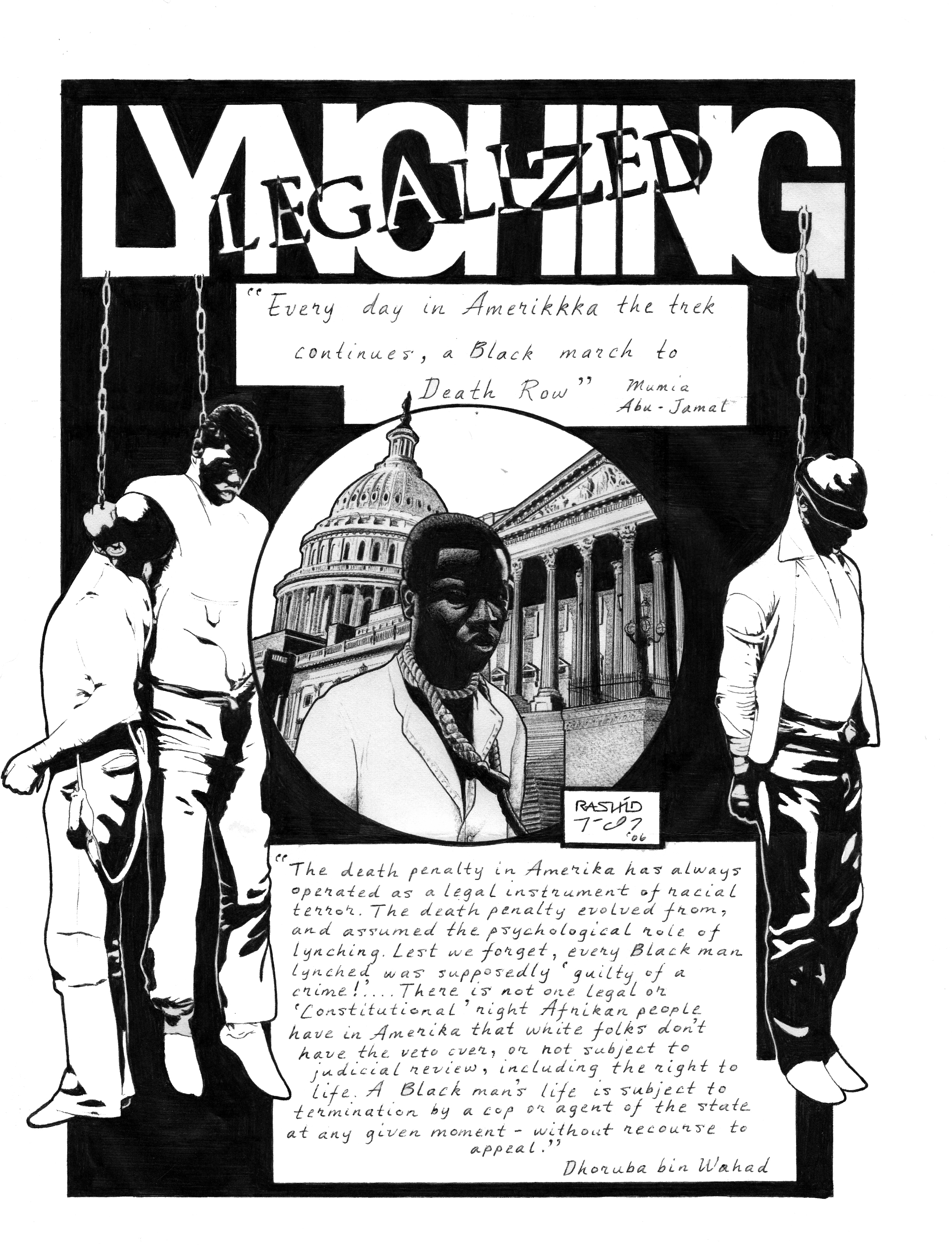
Image of the Day: Legalized Lynching

by Kevin "Rashid" Johnson

For more information about artist and prisoner, Rashid Johnson’s work click here.

Dec 02 2011

Capturing the Essence of Being Locked Up: Baldwin’s ‘Equal in Paris’

By Josh MacPhee

In 1955, James Baldwin wrote an essay titled “Equal in Paris” which was published in Commentary Magazine. I really love this piece of prose. Baldwin recounts the eight days that he spent in French prisons after he was accused of stealing bedsheets from a hotel. Ultimately, Baldwin was released. He had in fact not “stolen” the sheets; a friend of his (also an American) had. Relying on the themes of injustice, imprisonment, abuse of power, and police brutality that are so prevalent in all of his work, Baldwin offers a searing description of his time behind bars. Below I offer a couple of the excerpts that stayed with me after reading them nearly 20 years ago:

For, once locked in, divested of shoelaces, belt, watch, money, papers, nailfile, in a freezing cell in which both the window and the toilet were broken, with six other adventurers, the story I told of l’affaire du drap de lit elicited only the wildest amusement or the most suspicious disbelief. Among the people who shared my cell the first three days no one, it is true, had been arrested for anything much more serious—or, at least, not serious in my eyes. I remember that there was a boy who had stolen a knitted sweater from a monoprix, who would probably, it was agreed, receive a six-month sentence. There was an older man there who had been arrested for some kind of petty larceny. There were two North Africans, vivid, brutish, and beautiful, who alternated between gaiety and fury, not at the fact of their arrest but at the state of the cell. None poured as much emotional energy into the fact of their arrest as I did; they took it, as I would have liked to take it, as simply another unlucky happening in a very dirty world. For, though I had grown accustomed to thinking of myself as looking upon the world with a hard, penetrating eye, the truth was that they were far more realistic about the world than I, and more nearly right about it. The gap between us, which only a gesture I made could have bridged, grew steadily, during thirty-six hours, wider. I could not make any gesture simply because they frightened me. I was unable to accept my imprisonment as a fact, even as a temporary fact. I could not, even for a moment, accept my present companions as my companions. And they, of course, felt this and put it down, with perfect justice, to the fact that I was an American.

There was nothing to do all day long. It appeared that we would one day come to trial but no one knew when. We were awakened at seven-thirty by a rapping on what I believe is called the Judas, that small opening in the door of the cell which allows the guards to survey the prisoners. At this rapping we rose from the floor—we slept on straw pallets and each of us was covered with one thin blanket—and moved to the door of the cell. We peered through the opening into the center of the prison, which was, as I remember, three tiers high, all gray stone and gunmetal steel, precisely that prison I had seen in movies, except that, in the movies, I had not known that it was cold in prison. I had not known that when one’s shoelaces and belt have been removed one is, in the strangest way, demoralized. The necessity of shuffling and the necessity of holding up one’s trousers with one hand turn one into a rag doll. And the movies fail, of course, to give one any idea of what prison food is like. Along the corridor, at seven-thirty, came three men, each pushing before him a great garbage can, mounted on wheels. In the garbage can of the first was the bread—this was passed to one through the small opening in the door. In the can of the second was the coffee. In the can of the third was what was always called la soupe, a pallid paste of potatoes which had certainly been bubbling on the back of the prison stove long before that first, so momentous revolution. Naturally, it was cold by this time and, starving as I was, I could not eat it. I drank the coffee—which was not coffee—because it was hot, and spent the rest of the day, huddled in my blanket, munching on the bread. It was not the French bread one bought in bakeries. In the evening the same procession returned. At ten-thirty the lights went out. I had a recurring dream, each night, a nightmare which always involved my mother’s fried chicken. At the moment I was about to eat it came the rapping at the door. Silence is really all I remember of those first three days, silence and the color gray.”

Update: Here is a PDF copy of Equal in Paris.

Dec 01 2011

Youth Demand Quality Alternatives to Incarceration in Chicago

Yesterday afternoon, I trudged over to the Cook County Building downtown to support an action organized by the Audy Home Campaign which is led by youth from Generation Y/Center for Change and Fearless Leading by the Youth. The Campaign aims to develop the leadership of youth directly impacted by juvenile incarceration to improve conditions in the detention center, and shut it down and replace it with alternative community-based programs.

The young people’s action took place in front of the office of Cook County Board President, Toni Preckwinkle. Preckwinkle has been vocal about her belief that the War on Drugs has been a failure. Who can argue with her about that? It is certainly good to hear a public figure speaking forcefully about the need for alternatives to incarceration particularly for non-violent drug offenders (in Preckwinkle’s case).

In October, Ms. Preckwinkle unveiled her budget for the County and she proposed cutting the population of the Cook County Juvenile Temporary Detention Center (JTDC) by half over two years in an effort to save money. Here is some of what she had to say as she unveiled the budget:

“Detaining defendants in the jail while they await trial is very expensive for the county and is detrimental to our communities,” Ms. Preckwinkle told county commissioners on Tuesday. “The war on drugs has failed to eradicate drug use. Instead, it has resulted in the incarceration of millions throughout the nation — 100,000 annually right here in Cook County, at a cost of $143 per inmate per day.”

Locking up young people at the Juvenile Temporary Detention Center is even more expensive, upward of $600 a day per person, Ms. Preckwinkle said, with little benefit to the offender or society.

“So we’re spending four times what it would cost to send a child to Harvard to keep juveniles locked up,” said Ms. Preckwinkle, a former high school history teacher. “This just doesn’t make sense.”

The youth leaders who were demonstrating in front of Ms. Preckwinkle’s office yesterday were there to demand QUALITY alternatives to incarceration. They are worried that youth voices are currently absent from the debate and are also concerned about the fact that electronic monitoring might figure prominently in the County’s decarceration strategy. While the youth support the move to significantly reduce the numbers of their incarcerated peers, they also want to make sure that the resources are actually diverted back into high quality community-based programs. I shot some terrible video at the action but you can hear the youth express their concerns in their own words:

Also, here are the youth chanting when they first arrived. I always enjoy some good chanting…

Last week, I put together a fact sheet using 2010 data about the Cook County JTDC for those who might be interested.

Nov 30 2011

Pitting Prisoners Against Students in the Era of Austerity

Question: What message would you say this infographic is trying to convey?

A. We should provide more resources to support Michigan students’ education while still treating prisoners humanely.
B. We should divert resources from prisoners in Michigan because they are living in luxury while our children suffer.
C. We should decarcerate Michigan so that we can devote adequate resources to Michigan students.

[I’ll bet that the answer is neither A nor C.]

via


Nov 29 2011

Detaining Immigrants for Profit

Regular readers know that I have written about the intersection between immigrant detention and the prison industrial complex intermittently on this blog. You can find some of the posts here, here, and here.

Just recently I’ve become aware of the fact that U.S. Immigration and Customs Enforcement (ICE) is attempting to build a huge, private immigrant detention center in a small town called Crete, Illinois, just south of Cook County. A coalition of individuals and organizations are mobilizing to create an action plan to stop this center from being built. As I get more information on that campaign, I will of course share it here.

In the meantime, I have come across a few resources that I would like to share about how criminalizing immigrants is big business. First, I suggest that everyone check out the Immigrants for Sale site. They are doing great work raising public awareness about these issues. Below is one of their latest videos about how private prisons are profiting off the detention of immigrants.

Another resource that I discovered over the past six months is a series of audio stories by the Common Language Project about the history of immigration detention and also about how immigrants are being treated in detention in the state of Washington today. They are excellent and informative. I highly recommend listening.

The excellent PBS show called “NOW” did a terrific expose about the nexus between immigrant detention and private prisons in 2008. You can watch that report here.

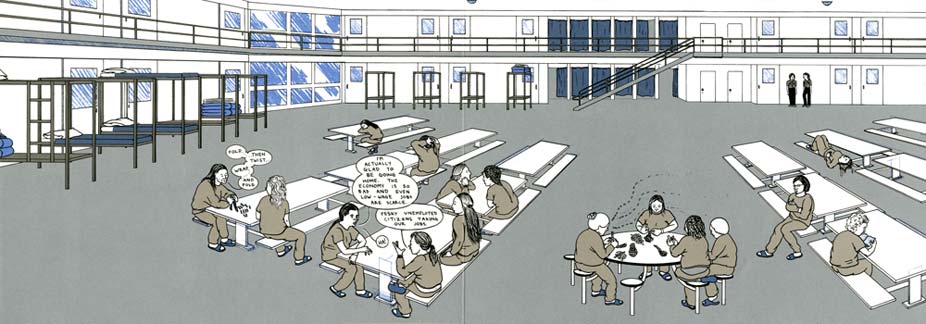
Finally, I am privileged to own two limited editions of a zine titled Detained by artist Eroyn Franklin. The zine follows the story of two immigrants as they navigate the detention process. The publication is educational and moving. I don’t know if there are still copies available but you can see various photographs of the images which were displayed as part of an exhibit earlier this year.

by Eroyn Franklin