Jul 30 2010

Adventures in Zero Tolerance Land #2

Today’s installment of “zero tolerance” policies run amok comes to us from Long Island… where a 5th grader was suspended for bringing peppermint oil to school.

Administrators at a Long Island school suspended a 10-year-old girl for bringing peppermint oil to class. A teacher’s assistant at John Mandracchia-Sawmill Intermediate School in Commack spotted fifth grader Sara Greiner offering friends a few drops of the cooking extract. “I told them it was just peppermint. You could put it in your water,” she told ABC. “No one ever told me that peppermint oil was illegal.” Greiner was sent to the principal’s office and issued a one-day suspension. The school declined to explain why she was punished, but in a letter to Greinier’s mother, Corrine Morton-Greiner, the principal wrote “[s]uch inappropriate and unacceptable behavior cannot and will not be tolerated.” Greiner’s mother is now fighting to remove the suspension from her daughter’s permanent record. “If a child offers a quarter of their peanut and jelly sandwich to another student is that student going to be suspended? Where do we draw the line?” the mother asked.

Jul 30 2010

Inmates Aren’t Slaves Or Are They?

The MetroWest Daily News wrote an editorial titled Inmates Aren't Slaves.

The tradition of prison inmates working menial jobs for meager pay dates back decades, long enough for “making license plates” to become a euphemism for going to jail.

Although prisoners are paid just pennies an hour for their work, it’s at least something, allowing them some money to purchase items from the prison canteen and helping lessen the burden on their family members who often financially support their locked-up loved ones. For some, working while incarcerated allows them to build up some small savings, giving them at least a chance to successfully re-enter society when they are released, which, after all, is part of the mission of any correctional system.

Bristol County Sheriff Thomas Hodgson would have the state remove that advantage from departing inmates and impose a greater burden on family members of remaining prisoners. Hodgson and state Rep. Elizabeth Poirier, R-North Attleboro, unveiled a bill Tuesday that would prohibit paying inmates for their work. Instead, prisoners would only receive time off their sentence – up to seven days a month – as payment for their work. Eliminating inmate pay would save the state between $2.5 million and $3 million a year, Hodgson claimed.

You know what would be better than paying inmates 2 cents an hour for their work? It would be NOT TO LOCK millions of people up in the first place!!

The editorial continues:

Indeed, the state would not be paying out that money in labor costs. But Hodgson conveniently neglects to mention what the commonwealth would lose if it stopped paying prisoners. Inmates at MCI-Cedar Junction, the state’s maximum-security prison, make every license plate affixed to every vehicle in Massachusetts. Without the cheap inmate work force, the state would have to contract with a private firm or hire new employees who would need to be paid livable wages, costing millions.

And license plates are just the beginning. Massachusetts Correctional Industries, or MassCor, is a major corporation, branching out into several industries. The Old Colony Correctional Center in Bridgewater, for example, houses a large print shop, providing discounted print jobs for state agencies, municipalities and private entities. Next door, at Massachusetts Treatment Center, inmates work in silk screen and sign shops, producing bumper stickers, business cards, street signs, city seals for police cars, etc. Inmates at MCI Framingham have been sewing American flags for more than a century. Other correctional facilities produce everything from trash barrels to beds, mattresses, eyeglasses and office furniture. MassCor even has a catalog to market its products, which generate a profit of more than $5 million a year. That doesn’t even count the savings to state agencies and municipalities, which would have to pay significantly more to purchase such products in the private sector.

While some inmates may continue to work solely to earn time off their sentence, that’s unlikely to be an incentive for many, especially those with long sentences who would barely notice the reduction. Without salaries, there would be no work force.

What is this? Under the guise of caring about prisoners’ human dignity and their professional development, this editorial board is actually making the case that it isn’t a good idea to stop paying prisoners for their work because it would adversely impact corporations and by extension the state of Massachusetts. This seems to be a more benign pro-exploitation of prisoner labor argument. The editorial board completely buys in to the prison industrial complex.

In response to this editorial, someone named Pat Ferris wrote a letter to the editor. This letter was incredibly depressing to read but I know that millions of Americans would agree with the sentiments expressed:

When early warning signs appear in young people by way of juvenile delinquency, the offender must be required to perform community service and be educated regarding the behaviors that got them into trouble in the first place. On that presumption it should be considered community service to work at some task during incarceration. Community service and working within the prison system should be a requirement if one becomes incarcerated. After all we are housing and feeding them, and if a person is not willing to work for food or shelter, they should go hungry and without a bed! [EMPHASIS MINE]

Slavery? On the contrary, more like “community service” and rehabilitation. I believe, and reason will bear this out, that this viewpoint which calls it slavery is a sign of the “viral” liberal mentality that has carried us so deeply into economic and social distress. The law was broken, a debt must be paid to society, and society must require certain criteria be fulfilled as part of an inmates rehabilitation.

We are a society of people who believe in the rule of law and that a citizen must pay a price for breaking the law. Incarceration alone does not rehabilitate, hard work and education are prerequisites that do.

God help us all…

Jul 29 2010

Why do we hate children so much in the U.S.?

I stumbled upon this article and even I (who am rarely surprised anymore) was stunned by this…

Last year, a teenager was incarcerated for refusing to visit his father. What is going on here? I have been railing about the criminalization of children and youth for years but this is really LUDICROUS.

A 14-year-old boy was thrown into the county youth home overnight and handcuffed for about four hours after refusing to follow a judge’s order to visit his father, as part of an ongoing custody case.

The boy, Jacob Mastrogiovanni of Warren, was ordered Thursday to spend three days in the youth home by family court Judge John Foster, who lifted the sentenced Friday following protests by his mother and a night of incarceration for her son.

The following sentences are perhaps the most troubling of the entire article:

Jacob said despite disliking his stay in the youth home, he vowed he will not comply with the visitation order.

“As terrible as a place as that is, I’d rather be there than” visit his father, he said.

When a 14 year old would rather be JAILED than visit his father, one would think that we would be more concerned about the father than the young man’s refusal to visit him. Unconscionable…

Jul 29 2010

Solitary Confinement in American Schools in 2010?

So apparently I missed this article several months ago but it is worth blogging about today. Following on my theme of zero tolerance policies run amok in U.S. school, we are apparently still using “seclusion rooms” for students.

The following USA Today article highlights the story of 13 year old Jonathan King:

Don King didn’t have a clue his son, Jonathan, was being put in a seclusion cell at school for hours because of bad behavior — until the 13-year-old hanged himself while in “time out.”

Now, King and his wife, Tina, are pushing state education officials to pass a policy banning the use of solitary confinement in Georgia schools, which they say led directly to their son’s death in 2004.

Apparently six years after Jonathan King’s suicide, Georgia still has no official guidelines for subjecting students to seclusion or restraint — and neither do many other states according to the article. Examples like this are the reason that I started this blog. Prison culture permeates ALL aspects of American society. Our schools are being run in many cities and states just like jails and prisons. Putting a 13 year old in a seclusion room for hours at a time while he is supposed to be getting an education is inhumane and straight up barbaric.

Jul 29 2010

Adventures in Zero Tolerance Land #1

I have been providing daily “crazy PIC facts of the day” and those have been well-received. However, I also come across daily crazy stories related to the zero tolerance policies that have been enacted in many schools. These policies have served to create a school to prison pipeline for many young people across the U.S. (particularly young people of color). I have decided to highlight some of these stories of zero tolerance run wild on a regular basis. For today’s edition of “Adventures in Zero Tolerance Land,” I would like to feature the chaos that is the New York City public school system.

In 1998, security in New York City schools was turned over to the city’s police department. In January 2010, the New York Civil Liberties Union filed a lawsuit against New York City on behalf of all of its public school students. For more information about the lawsuit, click here.

The lawsuit challenges the NYPD School Safety Division’s policy and practice of unlawful seizing and arresting schoolchildren, in violation of the Fourth Amendment and state law. NYPD personnel manifest this conduct in three ways:

* arresting students for minor violations of school rules that are not criminal activity.
* handcuffing students and locking them in seclusion rooms in school buildings, without parental or teacher consent, absent probable cause of criminal activity.
* removing schoolchildren who misbehave in school, without parental or teacher consent, and transporting them to hospitals for emergency psychiatric evaluations.

The lawsuit also challenges the NYPD School Safety Division’s policy and practice of using excessive force against students. SSOs push, shove and grab students. In many cases, this misconduct is not pursuant to making a lawful arrest. It is to compel a student to comply with an SSO’s orders or it occurs for no legitimate purpose whatsoever. These physical altercations often escalate and result in the child’s physical injury and, in some cases, hospitalization.

The complaint documents numerous incidents in which students engaged in non-criminal conduct were handcuffed, arrested and physically assaulted by police personnel at school.

The out-of-control situation in NYC public schools is described in a number of articles. Here are just a couple of interest:

The Strip Search Room

Students sue NYPD for mistreatment

Jul 29 2010

Big Cities Continue to Feed the Prison Industrial Complex

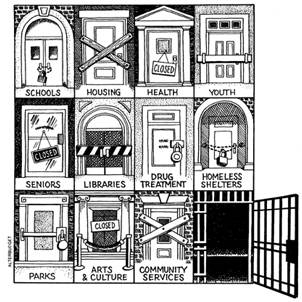
The Justice Policy Institute has a new report that starkly illustrates how our major cities (in this case Washington D.C.) are redirecting resources from support services towards the prison industrial complex.

In Washington D.C., since 2008, spending on the Metropolitan Police Department and the Office of the Attorney General increased more than 2 percent and 11 percent respectively, while funding for schools, mental health services and housing has dropped. Research shows that investing in front-end services and programs that keep people out of the justice system is more effective at improving public safety and promoting community well-being than law enforcement and incarceration.

Other key report findings include:

* Despite an increasing need for affordable and supportive housing for residents during tough economic times, the budget for the District’s Department of Housing was cut more than 30 percent in the last two years, with the Housing Production Trust Fund losing $42 million in 2008 to $18 million in 2010, a cut of more than 50 percent.

* D.C. has one of the highest rates of homelessness in the country; estimates of the homeless population range from 12,000 to 17,800 over the course of a year. Forty-seven percent of homeless people in D.C. are “chronically homeless.”

* Even though D.C. Public Schools continue to struggle with achieving its goal of providing quality education to every child, spending on education in the District has fallen 17 percent ($170 million) since 2008. Research shows that states that invest more in education have lower crime rates than states that spend less. Wards with the lowest median income and highest percentage of people of color have the lowest math and reading proficiencies and the most people without high school degrees.

* Despite a clear need for mental health services, especially for low-income populations and at-risk children and teens, the city continues to cut funding in this area. The D.C. Department of Mental Health’s budget was cut 17 percent from 2008 to 2010. Over 5,000 D.C. children in need of mental health treatment do not receive it.

* The Department of Parks and Recreation provides vital youth programming and maintains safe spaces for children to play. Yet funding for the Department of Parks and Recreation fell almost 20 percent from 2008 to 2010. These programs are especially valuable to children and teens whose families cannot afford private camps, classes, or after school programs.

This is a terrific concrete example of the warped priorities that many of our big cities and the country overall have. We need a movement to press political leaders to redirect needed resources to the social safety net rather than to the PIC.

Jul 28 2010

Musical Interlude: A Song about Redemption…

That’s it for tonight… I feel the need to share this wonderful song by Aaron Neville with you. I hope that you enjoy it.

Jul 28 2010

The Forever Racism: Structural racism and the prison industrial complex

First I would like to thank all of the organizers and activists who have been tirelessly working to eliminate the disparity between crack and cocaine in terms of sentencing over the past three decades. Today your work has begun to pay dividends. Lois Aherns of the Real Costs of Prisons explained Congress’s actions this way and characterized it as a step in the right direction:

Now the 5 year mandatory minimum sentence for crack is 5 grams. After the Bill becomes law, it is raised to 28 grams. After the Bill is signed into law 50 grams of crack is raised to 280 grams for a 10 year mandatory minimum sentence.

Now a 5 year mandatory minimum sentence for powder cocaine is 500 grams —this stays the same.
Now a 10 year mandatory minimum sentence for powder cocaine is 5
kilograms—this stays the same.

The quantity disparity between crack and powder cocaine would move from 100 to 1 to 18 to 1. The law is NOT retroactive.

I agree with Lois that this is in fact a step in the right direction. The Sentencing Project estimates that “3,000 defendants would benefit from sentencing changes each year.” This is of course a good thing.

However, I can’t help but to continue to feel exasperated with political leaders who can’t just see INJUSTICE and end it. I echo the sentiment of Adam Serwer who tweeted:

Whew, fair sentencing act, making the crack disparity only one fifth as racist as it used to be, heading to the president’s desk.

This is honestly not meant on my part to denigrate the importance of this legislative win or to minimize the very hard work of activists but rather to highlight how much farther we still have to go to uproot structural racism in this country.

Recently Bill Quigley posted a blog that has been widely circulated on the bloggosphere. He opens this way:

The biggest crime in the U.S. criminal justice system is that it is a race-based institution where African-Americans are directly targeted and punished in a much more aggressive way than white people.

Saying the US criminal system is racist may be politically controversial in some circles. But the facts are overwhelming. No real debate about that. Below I set out numerous examples of these facts.

He then goes on to offer 14 illustrations of the endemic racism within the U.S. criminal legal system. Here are the first four examples:

One. The US has seen a surge in arrests and putting people in jail over the last four decades. Most of the reason is the war on drugs. Yet whites and blacks engage in drug offenses, possession and sales, at roughly comparable rates – according to a report on race and drug enforcement published by Human Rights Watch in May 2008. While African Americans comprise 13% of the US population and 14% of monthly drug users they are 37% of the people arrested for drug offenses – according to 2009 Congressional testimony by Marc Mauer of The Sentencing Project.

Two. The police stop blacks and Latinos at rates that are much higher than whites. In New York City, where people of color make up about half of the population, 80% of the NYPD stops were of blacks and Latinos. When whites were stopped, only 8% were frisked. When blacks and Latinos are stopped 85% were frisked according to information provided by the NYPD. The same is true most other places as well. In a California study, the ACLU found blacks are three times more likely to be stopped than whites.

Three. Since 1970, drug arrests have skyrocketed rising from 320,000 to close to 1.6 million according to the Bureau of Justice Statistics of the U.S. Department of Justice.

African Americans are arrested for drug offenses at rates 2 to 11 times higher than the rate for whites – according to a May 2009 report on disparity in drug arrests by Human Rights Watch.

Four. Once arrested, blacks are more likely to remain in prison awaiting trial than whites. For example, the New York state division of criminal justice did a 1995 review of disparities in processing felony arrests and found that in some parts of New York blacks are 33% more likely to be detained awaiting felony trials than whites facing felony trials.

We just need to remember that structural racism is alive and well in the PIC even as we celebrate wins like the Fair Sentencing Act of 2010.

Jul 28 2010

Crazy Prison Industrial Complex Fact of the Day: Privatization of Prisons Still Sucks

The Federal Bureau of Prisons provides a weekly population count of federal prisoners every Thursday. As of 7/22, there were 211,094 Federal prisoners. I think that many in the general public wrongly assume that the majority of prisoners are locked up in federal facilities. Incarcerating people is a state and local issue. All the more reason for each of us to educate our neighbors and family members about the inhumanity and ineffectiveness of incarceration.

Note: The following chart is particularly relevant for those interested in the privatization of prisons.

Privately-Managed Secure Facilities
Facility State Count
ADAMS COUNTY CORR CTR CI MS 2,544
BIG SPRING CI TX 3,492
CALIFORNIA CITY CI CA 1,957
CIBOLA COUNTY CI NM 1,159
DALBY CI TX 1,839
EDEN CI TX 1,465
MCRAE CI GA 1,727
MOSHANNON VALLEY CI PA 1,486
NE OHIO CORR CTR CI OH 1,495
REEVES CI TX 1,877
REEVES DC TX 1,329
RIVERS CI NC 1,377
TAFT CI CA 1,792
TAFT-CAMP CA 552
Privately-Managed Secure Facilities Count:  24,091
Jul 28 2010

AMERICA Is the Prison: Arts and Politics in Prison in the 1970s

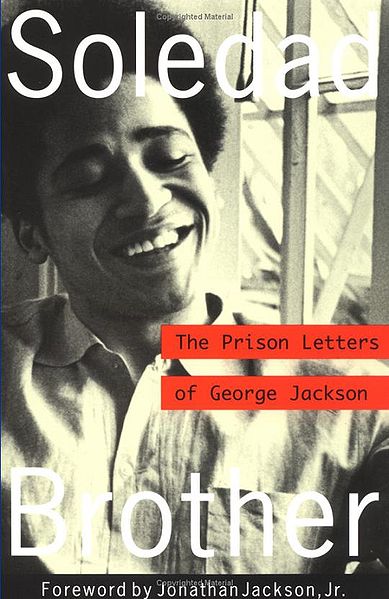
I first read George Jackson’s Soledad Brother in college. I remember being mesmerized by the anger and passion in his letters. His letters are an indictment of American racism and of the country’s treatment of black people in particular. Once I read Soledad Brother, I wanted to read other books written by prisoners so I sought out Eldrige Cleaver’s Soul on Ice among many other books. This experience fed my interest in the prison industrial complex and launched my activism around prison issues especially as they related to violence against women and girls.


Over the past couple of days, I have been reading a book called America is the Prison by Lee Bernstein. Even though I am slammed with work, I have had a difficult time putting the book down. It is well-researched and fascinating. The title of the book comes from a quote by Zayd Shakur, who was one of the New York Black Panther 21. Zayd declared that “all of America is a prison where the people are being held captive by the real arch criminals.”

Bernstein meticulously documents the prison arts renaissance of the late 60s into the 1970s. He also highlights the cultural work of prisoners who created powerful works of art (literature, visual, and performance). Bernstein provides an important historical context for understanding why so many penal institutions began to defund arts and educational programs in the 1980s. These are the programs that had ironically provided people like Jackson and Miguel Pinero with platforms for expressing themselves. When these same prisoners used the master’s tools to dismantle the master’s house, repercussions were swift and repressive.

Bernstein provides a valuable window on a time that I knew little about beyond having seen the products of that period several decades later. He has provided invaluable historical context to those works of art in this book. I highly recommend the book.