Sep 26 2010

Sunday Musical Interlude…It’s all about “Libertad”

Because it’s Sunday and we can always use conscious music. By way of Chi-town, Rebel Diaz performs their new song “Libertad.”

Sep 26 2010

Send Me To Prison…Just Get Me Out of Here…

In 2007, a young man from my neighborhood who I had become friendly with was arrested at 17 years old on felony drug charges. But that is jumping ahead.

Jamal* was 15 when we met. He had attended a youth-led speakout event that I co-sponsored in my community. He was brilliant and funny. He had a lot to say at the forum. We became friends. I would see him standing in front of the EL station on my way to work in the mornings and suggest that he should be in school. He would tell me that standing in front of the EL was much more educational than school and that by the way, he hated reading.

After two weeks of hearing this consistent line, I bought him a copy of a book called “Makes Me Wanna Holler” by Nathan McCall. It’s a book that I had assigned as part of a class I taught to college students. The cover of the book has a picture of a black man striking a “cool pose.” I think that Jamal was intrigued by the photograph. I gave him the book and said: “Give it a chance and tell me what you think. If you read it, lunch will be on me. We can discuss it together.”

As fate would have it, I needed to drive to work for the next three days. I didn’t see Jamal again for that time. When I returned to the EL, I found Jamal standing there, he was reading the book that I gave him and was 3/4 of the way through it. He saw me, smiled, and said, “You know what Ms. K, this book is on the nickel.” [That means GREAT, by the way, for those who like myself are 2005 slang challenged.]

The next Monday, he asked me for other titles that I could recommend. He said that he would look for the books at our local library. He cautioned: “Don’t try to give me any boring school books, though.”

I was so excited that I came back the next day with a list of books that I thought might interest him. I am a voracious consumer of young adult fiction and non-fiction. I find that it helps me connect to the young people that I work with. The following were some of Jamal’s favorites. I did not include the ones that he classified as “Garbage” and admonished me to never recommend to anyone else.

Buffalo Tree, by Adam Rapp. HarperTempest, c1997. While serving a six-month sentence at a juvenile detention center, thirteen-year-old Sura struggles to survive the experience with his spirit intact.

Hole in my Life, by Jack Gantos. Farrar, Strauss, Giroux, c2002. The author relates how, as a young adult, he became a drug user and smuggler, was arrested, did time in prison, and eventually got out and went to college, all the while hoping to become a writer.

A Life for a Life, by Ernest Hill. Simon & Shuster, c1998. Fifteen-year old D’Ray is growing up in rural Louisiana when someone threatens to kill his little brother if he doesn’t come up with $100 in an hour. D’Ray robs a convenience store, and when it goes awry, we watch D’Ray struggle with a life of crime, juvenile arrests and the prospect of turning it all around.

Makes Me Wanna Holler, by Nathan McCall. Vintage Books, c1994. McCall’s autobiography traces his life, from the streets of Portsmouth, Va., to prison, to the Washington Post.

Monster, by Walter Dean Myers. HarperCollins, c1999. While on trial as an accomplice to a murder, sixteen-year old Steve Harmon records his experiences in prison and in the courtroom in the form of a film script as he tries to come to terms with the course his life has taken.

Soulfire, by Lorri Hewett. Dutton Children’s Books, c1996. A rift develops in the closeness shared by Todd and Ezekiel, two African-American cousins, when Ezekiel single-handedly tries to end the problem of gang violence in his Denver neighborhood.

Getting back to Jamal’s arrest. So two years went by, with Jamal sometimes hanging out at my place on Sundays just so he could read new books that I would get for him. We would talk about those books. He is brilliant.

Then Jamal got himself into some trouble. The reasons for it were complex and I won’t break confidence to explain. Suffice it to say, that circumstances made it important for Jamal to start making a lot more money than he had been while selling dime bags.

All of a sudden, in 2007, I didn’t see or hear from Jamal for a month. That was unusual. I asked some of his friends in the neighborhood where he was and what had happened to him. There was a wall of silence. Finally one evening in October, I got a phone call from Jamal. He was at Cook County Jail and he needed my help. “What can I do,” I asked. “Do you need a private lawyer, I have friends who could help? Money for items from the commissary…” I was going on and on and he finally stopped me when he could get a word in. “Ms. K he said, please tell them to send me to prison now…just get me out of here.”

I am recounting this story because I just read an article about the fact that Cook County Jail is at critical mass. It triggered the recollection above and brings back memories of so many people who I know who have been at the jail and have characterized it as hell on earth.

From the article:

Cook County jail costs was one item discussed. An estimated $117.30 of taxpayer funds is spent per detainee per day in Cook County facilities. There are 102 counties in Illinois, and Cook County has the largest daily jail population in the state and the third largest in the U.S., trailing only L.A. and New York.

The inmate population is reaching critical mass. There are 9,548 inmates and capacity at Cook County jail is 9,838. The most common crime arrest category amongst inmates is drug related violations. National arrests in 2009 for drug abuse violations comprised 13 percent of total arrests (estimated at 1.6 milliion), according to an F.B.I. report. The most common offense was possession of marijuana.

Drug arrests have sharply increased over the last 20 years. In 1987 drug arrests only accounted for 7.4 percent. Commissioner Tony Peraica stated his concern of the high costs of prosecuting and detaining drug abusers.

Cook County Jail is overpopulated with people who do not need to be incarcerated. In addition, the jail has been investigated for its horrible treatment of its population.

In 2008 the U.S. Justice Department completed an investigation of the Cook County jail. The report found numerous violations including excessive use of force. In one instance a mentally ill inmate was restrained with handcuffs and beaten. The inmate was transported to an outside hospital for severe head trauma.

* In order to keep his identity confidential I assigned Jamal a pseudonym.

Sep 23 2010

In 2010 America, Wearing Dreads Gets You Kicked Off Homecoming Court…

Actually I have decided that I am too agitated about this latest incident of stupid and potentially racist school rules not to blog about it separately.

Here’s the story according to WLBT:

A week before Vicksburg High School’s homecoming festivities several escorts found out that they would not be participating.

Patrick Richardson said he was told by school officials that his hair is keeping him from escorting one of the homecoming maids.

The sixteen-year-old is sad that he won’t be in the next Vicksburg High School yearbook, pictured escorting his best friend Sa’shia Jones, who was chosen junior class maid.

Patrick said after paying to have a tux fitting last Thursday, the principal called him to the auditorium and told him that he could not be a homecoming escort because he wears dread-locked hair.

The junior was told he would have to cut it to be an escort.

“When I decided to grow my hair, that’s what I wanted to do,” Richardson said. “I thought it was acceptable, but from what the principal told me homecoming is of a higher standard and dreads are just not acceptable.”

Patrick has been growing the dreadlocks since last October and said the hairstyle is not prohibited or addressed in any way in the school handbook.

Full disclosure: Black hair and its social implications are a bit of an obsession of mine. When I was working on my masters thesis in New York City in the early 1990s, I wrote about the social and historical meaning of Black hair. As part of that research, I began to understand my own struggle with my hair as a metaphor of my struggle with racism in America. I have published an essay based on my thesis called “When Black Hair Tangles with White Power” in a book called Tenderheaded: A Comb-Bending Collection of Hair Stories edited by Juliette Harris and Pamela Johnson. I will not bore you with my arguments from that essay. Suffice it to say that I was certain that we had moved past the “hair wars” in America in 2010. Sadly, that is obviously not the case.

Here is what Patrick’s mother has to say about this situation and I could not have said it better:

Richardson’s mother, Tammi Mason, said she is upset because her son’s money was not refunded and that the school is not embracing his cultural expression.

“It’s actually a form of discrimination to me, because if that’s the case, then everybody who’s fat shouldn’t be able to be in it on the court,” Mason said. “They could say anything. Actually, they could say you have to be a Size 10 to be one of the maids.”

Richardson’s dreadlocks are about eight inches long and were going to be braided and pulled back for this Friday’s homecoming ceremonies.

Another Vicksburg High School parent, Lynda Jackson, told WLBT that her son De-Marcus Jackson, a freshman, also wears dreadlocks and was humiliated to find out that his hair will prevent him from escorting the sophomore maid.

Vicksburg Schools Superintendent Dr. Elizabeth Swinford said there’s no written policy, but there is a practice that bans dreadlocks on the homecoming court.

Sep 23 2010

Dear American Public Schools, Please Stop Punishing Our Youth Over Hair Issues…Signed America!

I just got off a conference call with a group of kick-ass organizers who are planning the National Week of Action against School Pushout (October 11-17) under the auspices of the Dignity in Schools Campaign.

One of the primary reasons that I care about the issue of school pushout phenomenon is because of its connection to future incarceration.

Exclusionary disciplinary policies increase a child’s likelihood of involvement with the juvenile or criminal justice system. Young people who drop out of high school, many of whom have experienced suspension or expulsion, are more than eight times as likely to be incarcerated as those who graduate. One study found that 80 percent of youth incarcerated in a state facility had been suspended and 50 percent had been expelled from school prior to incarceration.

The following are some other critical facts about the phenomenon of School Pushout:

School pushout occurs from kindergarten through high school and results from numerous factors that prevent or discourage young people from remaining on track to complete their education. Many schools over-rely on zero-tolerance practices and punitive measures such as suspensions and expulsions. Schools are suspending and expelling students at a rate more than double that of 1974. In 2006, more than 3.3 million students were suspended out-of-school at least once and 102,000 were expelled. In the four years between 2002 and 2006, out of school suspensions increased by 250,000 and expulsions by 15 percent.

The majority of suspensions are for minor misbehavior, including “disruptive behavior,” “insubordination,” or school fights, which can be interpreted in subjective and biased ways, even unintentionally. Even the most severe disciplinary sanctions such as suspension for the remainder of the school year and transfer to a disciplinary alternative school are applied to minor incidents. During the 2007-2008 school year, the most common reason for serious disciplinary actions in U.S. schools was “insubordination” (43% of all actions).

Exclusionary practices even target our youngest students. In fact, the expulsion rate for preschool students is more than three times that for K-12 students. Too many schools cede disciplinary authority to law enforcement or security personnel and over-rely on law enforcement tactics to control school discipline. More and more school districts use police officers or “school resource officers” not trained for educational environments to patrol school campuses and discipline students. Between 1999 and 2005, the number of students reporting the presence of law enforcement officers in their school rose from by 14 percent.

School-based arrests have also increased dramatically. As with other exclusionary practices, the majority of such arrests are for minor incidents such as “disturbance of the peace” or “disruptive conduct.” High school students have been arrested for food fights, writing on a desk or breaking a pencil. In the most extreme cases, five year olds have been handcuffed and arrested for throwing temper tantrums.

African-American students are 3.5 times more likely, Latino students twice as likely and American Indian students 1.5 times more likely to be expelled than white students. In addition, African-American students are nearly 3 times more likely, Latino students 1.5 times more likely and American Indian students 1.1 times more likely to be suspended than white students. Students with disabilities are suspended and expelled at a rate roughly twice that of their non-disabled peers. Students in foster care are over three times as likely as their peers to be suspended or expelled from school. Studies show that between one- and two-thirds of foster care youth drop out of high school or fail to graduate on time.

OK now back to the issue of being punished for hair issues… Death & Taxes has a short article called Hair Wars: Public Schools Take Aim at Dreadlocks, Long Hair, Individuality. Here is just a short excerpt from the article about a new story that I didn’t know about.

16-year-old Vicksburg, Mississippi teen, Patrick Richardson, was astonished last week when his principal told him he couldn’t escort one of his high school homecoming maidens’ to the dance because of his dreadlocks.

Hurt and offended, Richardson came forward, and told his local news station, WLBT, “When I decided to grow my hair that’s what I wanted to do. I thought it was acceptable, but from what the principal told me, homecoming is of a higher standard and dreads are just not acceptable.”

Vicksburg School system’s superintendent Dr. Elizabeth Swinford said that while there’s no explicit rule forbidding dreadlocks on the homecoming court, the ban is part of the school’s “practice,” WLBT reports.

Sep 23 2010

Dear Small Towns, Private Prisons Do Not Lead to Economic Recovery…

I read a distressing article in the Las Vegas Review-Journal yesterday.

Apparently the town of Pahrump is welcoming a new private prison:

Community leaders in this recession-stricken town are eagerly anticipating the arrival of about 1,000 new residents, so long as they stay where they belong behind the stun fence and razor wire.

A new medium-security detention center for federal inmates is set to open Oct. 1 in Nye County’s largest community, and some say it’s already giving the town a much-needed economic boost.

The first paragraph of the story is all kinds of wrong but let’s move on.

The privately owned and operated facility is bringing 234 new full-time jobs to town, roughly half of which have been filled by local residents.

It also will bring in as many as 1,072 inmates under a contract with the U.S. Marshals Service.

“Nevada has the highest unemployment rate in the country, and Nye County has a higher rate than the state of Nevada,” County Commission Chairman Gary Hollis said during the prison’s dedication ceremony last week . “This is a very good day for many people in our community who now have a good, high-paying job.”

Nye County Manager Rick Osborne said unemployment in the rural county stood at 16.7 percent in June. At the very least, he said, the new prison should keep that from getting any worse.

The $83.5 million facility is owned by Corrections Corporation of America, a Tennessee-based company that builds and operates prisons across the country.

I really can understand the town’s desperation for jobs with an almost 17% unemployment rate. In addition, I am always mindful that there are real people living in real places who need to have their basic needs met. I am not discounting this reality. However, a number of reports have underscored the fact that while prisons can bring some immediate economic benefits to small rural towns in the medium and long run they tend to benefit the private companies and their shareholders a lot more than the town and their residents. A terrific illustration of this truth can be seen in the film by Katie Galloway called Prison Town, USA. The film shows the impact that a massive prison has on community residents and local businesses in a small town in California called Susanville.

The Prison Town comic published by Lois Aherns at the Real Costs of Prisons Project also highlights the fact that the purported positive economic impact of prisons for local communities is overstated to say the least.

AFSCME has put together a good mythbuster document about private prisons and their supposed economic and social benefits. You can read that here. Finally, in terms of other convincing research, Good Jobs First did a good case study of the economic impact of private prisons.

The final sentence of the article is symbolic of the place that prisons have in many communities:

At the request of residents, CCA surrounded the prison with an earthen berm that almost completely hides the structure from view.

Sep 22 2010

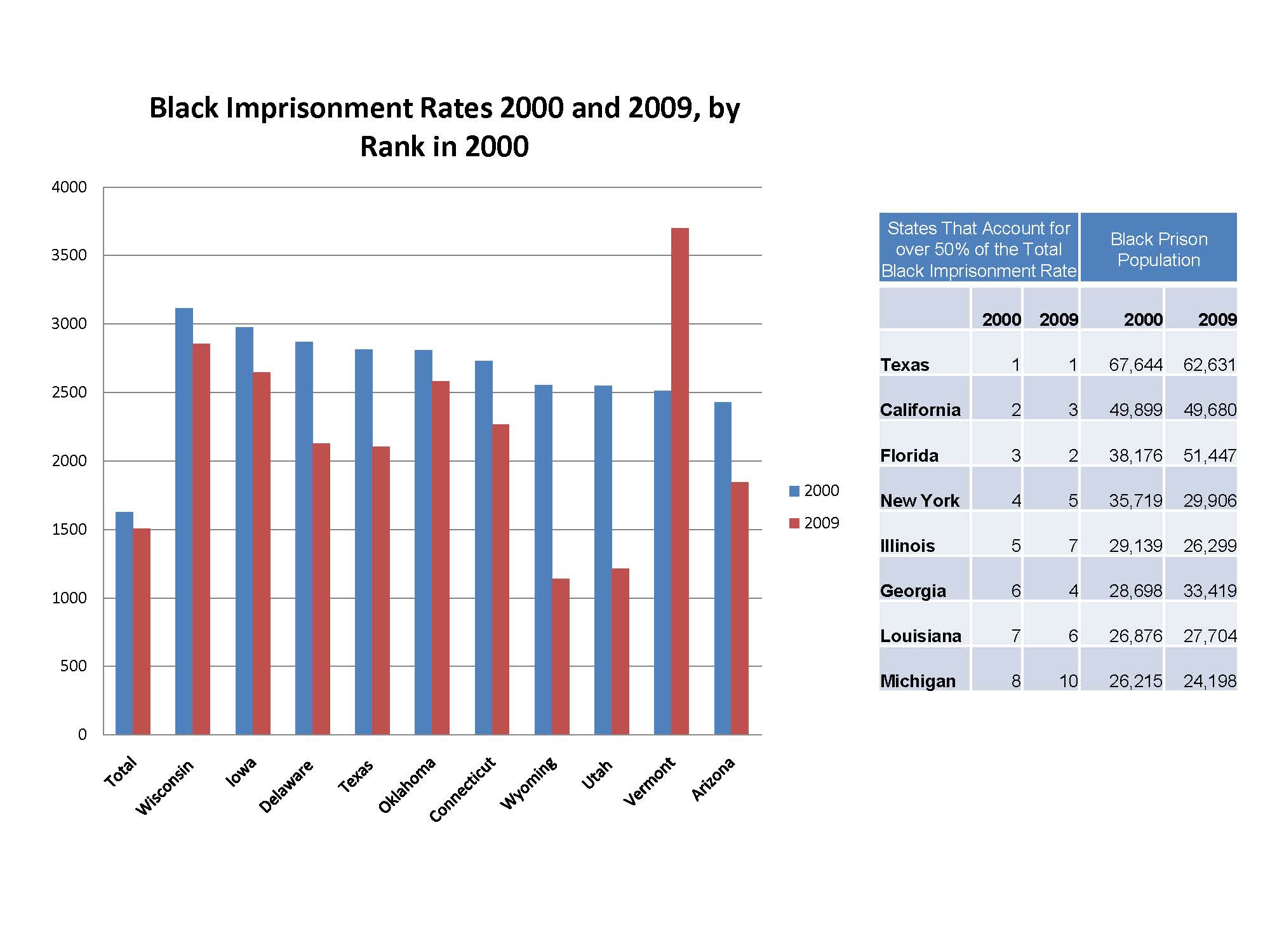
Crazy Prison Industrial Complex Fact of the Day 9-22-10: Top Black Imprisonment Rates

I decided to feature a visual representation of the black imprisonment rates in 2000 and 2009 according to the states with the highest rates in 2000. The states that are currently driving black incarceration are Texas, California, and Florida. This is in response to an e-mail request from Kevin T.

Feel free to print a PDF version of this chart here.

Sep 20 2010

Why Does It Seem That Black Men Are The Only Ones Jailed for Owning Guns?

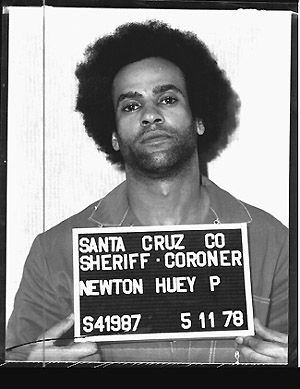
Huey P. Newton


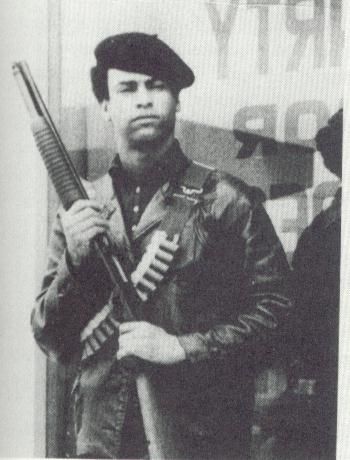
This country has been obsessed with jailing black men who own guns for centuries. The iconic images of the Black Panthers defiantly burnishing guns led to their ultimate destruction.

I found this short interview with Plaxico Burress formerly of the NY Giants (my team growing up in NYC) particularly poignant.

He articulates something very important when he maintains that he was sent to prison “for owning a gun” and that he didn’t “commit a crime he broke a law.” All of us are lawbreakers in one way or the other.

I often ask people when I am doing workshops: “Raise your hand if you have never broken a law.” Inevitably a couple of people raise their hands. I then ask them if they have ever sped or jaywalked or any number of other things that are technically against the law. They usually have. By that standard, America is a nation of 310 million lawbreakers.

I have noticed lately however that the white Tea Party adherents seem able to carry around unconcealed weapons with impunity. I don’t see their mug shots being posted on television or in other parts of the media.

Anyway, it’s worth reading the entire article about Plaxico Burress’s life behind bars.

Sep 20 2010

Exploitation = Paying Prisoners 15 Cents an Hour for their Labor & Charging $150 for a Black & White TV…

Last week, I featured the story of Paul that was documented in the Tri-County Times. The story provided a detailed account of a prisoner’s life on the inside. Part 2 of that story was published on Friday while I was on hiatus.

Below I highlight the part of the article that speaks to the prison economy:

Prisoners with jobs work during yard time. Paul was a “porter,” doing janitorial work.

Taxpayers provide the buildings, the staff, and basic room and board. Deodorant, razors, shampoo, chips, ramen noodles, a personal TV or radio has to be purchased from a prison store. That money comes from prison jobs like Paul’s, who made approximately 15 cents an hour, working 40 hours per week [emphasis mine]. Money from families also paid for extra items.

Essentially, said Paul, families give inmates the small daily pleasures the prison does not. A small, black-and-white TV, with a clear case to prevent inmates from hiding contraband inside, can be purchased for $150. “You sit that (TV) on the shelf of the bunk bed, and you use your toe for the remote control,” said Paul.

Inmates, who don’t have family support or a prison job, can’t buy deodorant or razors for shaving. They can “hustle,” by rolling cigarettes or doing other odd jobs for inmates.

What jumps out of course is the $0.15 cents an hour that Paul was paid to work as a janitor and the fact that prisoners rely so heavily on their families to help provide them with financial support while they are on the inside. Since we know that most prisoners are poor people, one can only imagine the financial strain that this places on family members who are likely to be just scrapping by themselves.

The second key part of the passage above is the fact that the prison store is marking up the cost of a small black and white TV to $150 which is obscene.

Finally, the prisoners who do not have jobs nor families to help provide them with financial support have to “hustle” to get money for basic hygiene products. This is wrong. While we are pushing for decarceration, basic hygiene products should be provided to all prisoners as a human right.

The rest of the article highlights the role that religion played in getting Paul through his incarceration, the relationships that he built with other prisoners and his life since he was paroled. It is well worth reading the entire story.

Sep 15 2010

Alas…this regularly scheduled program will be on hiatus…

I love the daily routine of blogging. It has provided me with a way to actually clear my head, to clarify what I think about any number of issues and has connected me to some awesome people over the past few weeks.

Life is going to interrupt my regular blogging routine over the next few days. Between teaching, grant writing, two major events that my organization is sponsoring this weekend, and actual life responsibilities, a blogging break is in order. I will be back at it again next Tuesday. Looking forward to it.

Sep 15 2010

Speaking for Himself: Professor Loic Wacquant Corrects My Characterization of His Critique of the Concept of the Prison Industrial Complex

Last June, I sent a memo to participants in a PIC Communiversity Course that my organization sponsored. In it, I made this argument regarding discussions about the term “prison industrial complex.”

We spent the first two sessions trying to understand the history of prisons and how the PIC operates. One area of debate that we did not broach is whether the term “Prison Industrial Complex” is a good construct to explain the expansion and encroachment of surveillance and incarceration over the past 30 years. There is a pitched battle of ideas in the academic community about whether the PIC is a useful way to describe mass incarceration. Sociologists like Loic Wacquant contend that the PIC is a misguided frame as an explanatory construct for mass incarceration. For information about Wacquant’s critique, you should read his book “Prisons of Poverty.” This is the shorter, more reader-friendly version of his book “Punishing the Poor.” Chris Parenti is another person who is a critic of the term “Prison Industrial Complex.” He contends that prison spending is much less than that of the “military-industrial-complex.” As such, he takes issue with the term. He has other criticisms that he has offered as well.

Finally, in the past couple of years, some have begun to use the term “Corrections-Industrial Complex” instead of PIC. These people contend that since the fastest growing segment of carceral supervision today in the U.S. is probation, it makes more sense to think of this phenomenon as the CIC instead. Former inmates are often still under some form of supervision once they leave the walls of prisons (GPS tracking, intensive parole, etc…). Others who come into contact with the criminal legal system are not incarcerated but are given probation and come under the surveillance of the state too.

We have not discussed these debates in this course because of the limited amount of time that was available to us. I did however want to bring this to your attention in case you are interested in reading more from some of the academics that I mentioned earlier.

Personally, I continue to find the term “Prison Industrial Complex” to be a good frame for discussing the issues that we have over the past five months. This is why I continue to use it. In particular, I rely on Critical Resistance’s definition:

Prison Industrial Complex (PIC) is a term we use to describe the overlapping interests of government and industry that use surveillance, policing, and imprisonment as solutions to what are, in actuality, economic, social, and political ‘problems’.”

I received an e-mail today from Professor Loic Wacquant.  As a sociologist myself, I greatly value engaged dialogue about ideas.  I reached out to Dr. Wacquant and asked if I could post his response here. He graciously agreed.

First congratulations on your activities expanding educational opportunities for those ill served by the official education system.

Second a few corrections on your remarks about my critique of PIC on your blog http://prison-industrialcomplex.blogspot.com/.

1) PRISONS OF POVERTY is not the “short version” of PUNISHING THE POOR but a different book, with a different argument: PTP covers the workfare/prisonfare nexus; PofPov covers the international circulation of US penal categories and policies (for the record: the original version of PofPov was written in 1999, PTP was written in 2009).
2) My criticism of PIC are manifold:
-PIC claims the prison plays a key role in the new capitalist economy: the corrections budget of the US amounts to less than 1% of GDP; if it disappeared it would barely register on the economic radar.
-PIC stresses the exploitation of carceral labor: at peak use, fewer than 0.5% of inmates were employed by private firm. What of the 99.5% remaining?
-PIC makes an analogy with the “military industrial complex” but the Pentagon is a single lever to decide military policy; there is no lever to a single justice system in the US, since every city runs its own police, every county runs its own jail and courts, and every state runs its own prison system. Even if some malevolent entity wanted to control crimjustice it couldn’t!
-firms make money through the provision of punishment, but this is the case for every government function in America. Is there for that reason an “education industrial complex,” a “housing industrial complex,” a “welfare industrial complex,” an “transportation industrial complex,” a “retirement industrial complex,” a “health industrial complex”? What is gained by adding an “IC” to every government function?
-I would argue there is a “health industrial complex” in the US because private interests do dominate health policy in the US. But what is distinctive about punishment, among public functions, is precisely that has remained remarkably public! Indeed, it is more public than welfare, education, medical care, etc.
-PIC draws attention to penal policy in isolation from similar tendencies in social welfare policies and thus obscures their growing interpenetration and convergence.

Altogether I find the PIC designation confused and confusing. Lastly, there is no “pitched battle of ideas” between PIC and rival frameworks. PIC has very little standing among scholars of punishment (except in some sectors of the humanities that do not carry out empirical research). And the “mass incarceration” itself is another misnomer (for my argument in favor of “hyperincarceration” that selects by class first, race second, and place third, see the attached piece on “Race, Class, and Hyperincarceration”).

I greatly appreciate Professor Wacquant’s sending along corrections to my characterization of his critique of the concept of the PIC.  I have read both Prisons of Poverty and Punishing the Poor.  While he is correct that they do not advance the exact same argument, in my opinion, Prisons of Poverty is still the more accessible version of the two books.  If you are a non-sociologist or frankly a non-academic, to me, POP is a better read and it does provide a context for the arguments that were advanced in Punishing the Poor. So I stick by that suggestion that I made to members of the Communiversity class. 

Prof. Wacquant does not see “pitched battles” in academia about the use of the term PIC.  To me, the distinction is between empirical social scientists and the rest of academia that still addresses issues about prisons.  If the battles are not “pitched,” they do exist. 

Anyway, I am thrilled that Prof. Wacquant took the time to write back and am pleased to share his thoughts here on this blog and I will do the same on our PIC Communiversity blog as well.

Finally, Dr. Wacquant shared two articles that I have yet to read but plan to do so in  the next couple of weeks. Perhaps I will even blog about them here… I am sharing them in case others are interested  in reading them as well.

The Body, The Ghetto, & The Penal System

Class, Race, & Hyperincarceration in Revanchist America

If anyone has responses to these ideas, I would be happy to post them on the blog…