Mar 02 2011

Entering Jail: A Short Description…

By Colin Matthes - Just Seeds Artists' Cooperative

I came across an interesting article last week describing a day at a jail. I think that this type of short ethnographic snippet is valuable to increasing the public’s understanding of criminal legal system. Unfortunately, I don’t know how widely read these accounts really are. I thought that I would highlight a piece of the article here. I encourage readers to read the full article:

People enter the Eastern Shore Regional Jail either directly from court in police custody after a conviction, or by presenting themselves at the door on a certain date if specified by the court.

For example, a person who is permitted to serve his time on weekends will check himself in by 6 p.m. on a Friday.

The inmate-to-be sheds whatever clothes and possessions he might have and changes into a prison jump suit.

His belongings are stored in bags in a special room. He or she is allowed to possess five pairs each of underpants, undershirts, socks and three pairs of insulated underwear.

According to a sign posted in the jail booking area, the only requirement is that the underwear be white and that no sleeveless undershirts, described as “wifebeaters” may be worn.

The inmate may wear his own athletic shoes if they are all white or all black and have no metal inside or out. He may keep a generic watch and a simple wedding band. Anything fancy or valuable will be stored with his other belongings.

He is issued a cup with a toothbrush, toothpaste, comb and shaving supplies. Women may have no cosmetics or makeup.

A prisoner may keep up to five paperback books in the cell with him — no hardbacks and no more than five at any one time. The books will be checked for inappropriate material and contraband, said Kennedy.

Each new inmate is immediately given a test for tuberculosis and kept separate from the general population until the test shows the person to be free of the disease. He is also given a book of rules and regulations that must be followed.

If he is serving weekends or is in jail on a civil charge such as failing to meet child support payments, he goes to a dormitory area — where there are bunk beds in a large two-story space — rather than to the individual cells where the medium and maximum security prisoners are held.

Mar 01 2011

A Junkie in Jail…

by Nicholas Ganz

I have a long standing pen pal relationship with a woman who is currently incarcerated in a federal prison for a drug offense. Her name is Eileen and her story is a familiar one. I won’t violate her privacy by sharing her life story here; that is for her to tell when she is ready.

Angela Davis has written that “imprisonment has become the response of first resort to far too many of our social problems.” I think that nowhere is this more apparent than in how we deal with drug users in this country. If you have never personally experienced the ravages of addiction either personally or among your friends and/or family members, then it is difficult to adequately convey the pain and suffering that is often associated with the disease. Elizabeth Cardona who is a prisoner has written a few powerful poems about her own addiction. Here is one called “Junkie” which appears in the zine “Bound Struggles #6:”

Hopeless, Godless, hollow-eyed, gaunt.
Under cold violent moons and suns that always seemed too bright.
I was rabid — foaming for my next shot,
chasing dragons in search of the land of Nod.
The place where angels sleep.
Running, racing against myself, and time and everything else.
Telling myself that today I’m fixed but
tomorrow I’ll quit — everyday.
And suddenly months turn to years
but tomorrow never comes.

Criminalizing addiction has been and is a failure. Treatment is the only viable solution. Here again Elizabeth Cardona writes eloquently about her incarceration experience as an addict in her poem titled “Prisoner:”

I awake in the prison, this place is a purgatory between
never never land and the REAL world.
My cell is cold and I’m scared!
I’m the junkie with the dripping nose and the runs.
I feel like I’m going to die – I want to die.
Just close my eyes and never open them again.
I find myself amongst freaks, hustlers, dealers, murderers, and thieves,
but just the ones who were caught.
The cops are proud – they got another drug-dealing shoplifter
off the streets.
My nights are hungry and all echoes, and the sound of keys.
The click, click, click of cuffs.
Tomorrow has arrived with pain and so much more to come.
But it is here that I have found myself.
I’ve found Truth, Kindness, Compassion.
In these walls I was never alone, but always lonely.
Junkie, now Prisoner.
I’m also a mother, daughter, and a woman.
But don’t get me wrong. King Heroin is waiting patiently for me at the front gate.
But God has me by the hand and if I slip and fall, he’ll carry me.
I know that now.
He’ll do the same for you if only you trust and believe.

Does it sound to any of you from this poem that Elizabeth is getting the help that she needs in prison to deal with her addiction? You don’t have to answer that question. I think that we all know the answer…

Feb 28 2011

The Chicago Taskforce on Violence against Girls Launches Its New Website…

I have been an insomniac for as long as I can remember. This means two things: 1. I don’t want to hear from my friends and family who complain about being tired even after getting 7 hours of sleep; 2. I get a lot of stuff done because I am awake when most everyone else is getting their beauty sleep :).

Along those lines, I wanted to announce the launch of the Chicago Taskforce on Violence against Girls and Young Women’s new website and online report. I am privileged to be the co-founder of the Taskforce with my good friend and colleague Melissa Spatz.

The Chicago Taskforce on Violence Against Girls & Young Women serves as a vehicle for addressing the following two questions: 1. How will we galvanize attention to the devastating violence plaguing the lives of girls and young women? 2. How will we marshal the public/political will to end the violence?

The Taskforce was established in order to bring groups from across Chicago together to learn from one another, share strategies and best practices, & develop new and comprehensive models of responding to violence against girls.

Of particular interest to readers of this blog will be the section that focuses on violence and the criminalization of girls and young women. Additionally, the site offers recommendations for the use of restorative justice as a way to address violence in the lives of young women. Finally, the best part of the site to my mind is the innovative organizations and models that are featured throughout.

Please help to spread the word about the availability of this new resource. Melissa and I worked very hard over the past few months to pull this together. We hope to use the site and the Taskforce to influence policy and systemic change to improve the lives of girls and young women in Chicago.

Feb 27 2011

Sunday Musical Interlude: I Miss Lauryn Hill…

No one can do this better than Sam Cooke but I love this version from Lauryn Hill. Please ignore the posturing by Wyclef on this.

Feb 27 2011

The Cops ARE in My Head – Redux

by Dave Buchen

Some weeks ago, I wrote a post inspired by my friend Paula Rojas’s contention that the “cops are in our heads and hearts.”

I write a lot about the police on this blog. This is because cops play such a major role as gatekeepers for the prison industrial complex. It is also because so many of the young people (particularly young men of color) who I work with are consumed by the role that cops play in their lives. This has prompted me to spend the past few months working on a new curriculum about the history and current manifestations of police violence in the U.S. I hope to release it some time this fall.

Yesterday my organization offered the second session of an ongoing juvenile justice advocacy training program that we are co-sponsoring with the Hull House Museum. It was a terrific session that featured presenters who helped participants to better understand the role of key players within the juvenile justice system. So we had a lawyer who works to advocate with youth when they are initially arrested speak about young people’s rights with the police. We heard from the chief prosecutor for Cook County’s juvenile justice bureau. We heard from a terrific juvenile court judge and finally we heard from a senior administrator in the probation department. Over 30 people were in attendance on a snowy Saturday in Chicago. This is a testament to how resonant these issues are for community members.

Back to my discussion about the cops being in my head… It turns out that the cops are in ALL OF OUR HEADS. During yesterday’s street law presentation, I was surprised by how many workshop participants could not get past the fact that citizens have very limited rights in our interactions with the police. It points to how much we all take state power for granted in our society. The power of the state to regulate our lives is mighty. No matter how many times and in how many ways it was reiterated that the best posture to adopt with the police was to SAY NOTHING and to ASK FOR A LAWYER, people were fixated with wanting to know if they had the right to know why they were being arrested. People wanted to know if they could refuse to give their consent to be searched. People wanted to basically know if they could resist the intrusion of police power in their lives. Unfortunately the sad reality is that our rights vis-a-vis the police are incredibly limited. This is very frustrating even and perhaps anger-producing but it is the truth.

I tell the young people who I work with that when they are stopped by the police, they need to stop, make no movements that can be interpreted as fleeing or going for a weapon, and SAY NOTHING. I tell them to give their identifying information, name, birthday, address. I tell them to ask for a phone call and to say that they want a lawyer. THAT IS IT. Individuals cannot resist the police by themselves on the street. That is a losing proposition. Put your hands on a police officer FOR ANY REASON and be prepared for a felony charge of resisting arrest or attempted aggravated battery. I have known a few people who have been so accused. Social movements must hold cops and the state accountable. If we have mass mobilization and we each do our part, then we win. We cannot fight the state as individuals.
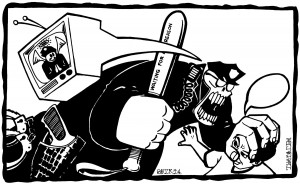
History provides some hopeful examples of community mobilization to address police violence. In her book Street Justice: A History of Police Violence in New York City, Marilynn S. Johnson suggests that urban residents began complaining and organizing against police brutality in the mid-19th century. In fact, the first major investigation into police misconduct was launched in New York City in 1894 through the Lexow Committee. This Committee found police abuses including corruption, brutality and perjury. In the late 19th century, the most common complaint from urban residents against the police was about “clubbing” which was “the routine bludgeoning of citizens by patrolmen armed with nightsticks or blackjacks.”

Johnson analyzed 270 articles in the New York Times from 1865 to 1894 that report on cases of alleged police brutality. She found that three-quarters of all cases covered by the Times involved clubbing, “the majority occurring between a uniformed officer and a single unarmed suspect.” She notes that “[i]njuries and deaths resulting from such beatings were common, with 9 percent of victims dying during or soon after the encounter.” Most of the reported cases of violence occurred in poor immigrant neighborhoods and involved young men. She adds that “[p]olice attacks on women, however, were not uncommon. Women suspects were involved in 20 percent of all cases.”

Johnson offers the story of John McDonald as an example of police violence in the late 19th century.

Around midnight one summer evening in 1881, John McDonald and his wife sat down on the stoop of their home on Second Avenue. They had spent the last several hours caring for a sick child and decided to step outside to cool off. Before long, Officer Montgomery Ditmars of the Nineteenth Precinct strolled by and stopped in front of their house. With what the New York Times called “a pompous show of authority,” he ordered the couple back inside. Tired and hot, John McDonald refused and told the officer to mind his own business. After further argument, Officer Ditmars drew his club and pummeled McDonald about the head and face until he begged for mercy. He then arrested both husband and wife for disorderly conduct and hauled them down to the station house, where the couple spent the night in a cell.”

You can read the book to find out what happened to the McDonalds and to Officer Ditmars 🙂 My point in highlighting this story and pointing to the history of police violence is to suggest that it has been with us for a long time and that people have been mobilizing against it for just as long. Improvements have been made over time and yet the intractability of police violence is a challenge to us all. As I continue to learn more about this history, I hope to share more information. In the meantime, I guess that the cops are going to keep being in my head…
Feb 25 2011

Friday Inspiration: Solidarity with Wisconsin!

I love Jasiri X and he is right on point with his new song and video in solidarity with the protestors in Wisconsin.

Here are the lyrics:

Scott Walker works for multi billionaires
John Boehner works for multi billionaires
while corporations get billions in welfare
and millions in this country been out of work for years

Sarah Palin works for multi billionaires
American workers vs multi billionaires
they wanna end social security and medicare
while millions in this country don’t have a dime to spare

Can main street get a bailout
Tell the president our checks weren’t mailed out
Tell the house of representatives and senate
And whatever business got the stimulus and spent it
Now they getting record profit that’s tripling with no limits
But they cutting jobs and unemployment benefits have ended
How we gone live with no income coming in
And the little help we get is cut from the budget then
What’s the role of government
Do workers stand a chance if multi billionaires are running it
Oh now you worried bout the deficit and cutting it
But when them banks needed billions you had enough for them.
Them car companies you had bucks for them
2 wars rebuilding 2 countries guess we stuck with them
the average citizen just ain’t lucky then
cause we be getting pimped so I guess we getting fucked again

Rush Limbaugh works for multi billionaires
Bill O’Reilly works for multi billionaires
while corporations get billions in welfare
and millions in this country been out of work for years

Sean Hannity works for multi billionaires
Crazy Glenn Beck works for multi billionaires
they wanna end social security and medicare
while millions in this country don’t have a dime to spare

When did the American worker become the enemy
Why is wanting a living wage such a penalty
What happened to justice and liberty
These billionaire haters wanna crush us literally
On the box is Murdoch and his foxes
And if you watch it you might as well be an ostrich
They terrorists cause they hold facts hostage
24 hours straight of we hate what Barack did
If you want to unionize your a communist
But if you buy a congressman they just call you a lobbyist
It’s so obvious but here’s where the problem is
they act like regular Americans but they sloppy rich
Why you think they wanna cut taxes
cause every single one of them in the higher brackets
This ain’t white or black it’s class warfare time for action
Just look at wide the gap is

American workers vs multi billionaires
The middle class vs multi billionaires
while corporations get billions in welfare
and millions in this country been out of work for years

Rupert Murdoch is multi billionaires
the Koch brothers are multi Billionaire
they wanna end social security and medicare
while millions in this country don’t have a dime to spare

Feb 25 2011

Crazy PIC Fact of the Day: Police Harassment Edition

Despite being less than 44 percent of the total population of New York City, black and Latino males composed 85 percent of the pool chosen for stop-and-frisk searches last year. With officers stopping 601,055 people, that means a full 511,000 of those people were men of color (for reference, the population of the entire state of Wyoming is 544,000). (Source: The NYPD Stopped Enough Black Men Last Year to Populate Wyoming)

Feb 24 2011

Free Screening: Concrete, Steel, & Paint – A Film about Restorative Justice

I have been asked by a friend to share information about a free screening that is taking place this Sunday February 27th. The information is below. I understand that the film is very powerful. I have not seen it but trust my friend’s judgment on this.

Concrete, Steel & Paint (55 mins)
A film about crime, restoration and healing
by Cindy Burstein and Tony Heriza

CHICAGO PREMIERE
at the Peace on Earth Film Festival
Sunday, February 27th
4:15pm (doors open at 4pm)
Chicago Cultural Center’s Claudia Cassidy Theater
78 E. Washington Street

When men in prison join with victims of crime to create a mural about healing, their views on punishment, remorse, and forgiveness collide. Finding consensus is not easy – but as the participants move through the creative process, mistrust gives way to surprising moments of human contact and common purpose.

The film raises important questions about crime, justice and reconciliation–and dramatically illustrates how art can facilitate dialogue about difficult issues.

This event is free and open to the public.
Filmmakers will attend a Q&A after the screening.

Here is a trailer for the film:

ABOUT THE PEACE ON EARTH FILM FESTIVAL
Peace on Earth Film Festival (POEFF) is a not-for-profit festival established to celebrate and encourage the work of independent filmmakers from around the globe on the themes of peace, nonviolence, social justice and an eco-balanced world. Through the power of motion pictures, POEFF endeavors to enlighten and empower individuals, families and communities to step out of the ignorance of conflict, violence and divisiveness into the light of communication, compassion and understanding.

The Festival runs from Friday, February 25th through Sunday, February 27th. For a complete schedule of events — including panels and workshops, visit the website.

Feb 24 2011

Disciplining Black and Brown Bodies…

I am playing around with some ideas today in light of two developments.

First, earlier today I read about racist anti-choice billboards that were showing up in NYC. The terrific women of color-led reproductive justice organization, Sistersong, put out a statement about the billboards which read in part:

Yesterday, racist billboards went up in Soho attacking black women and our human rights by claiming “the most dangerous place for an African American child is in the womb.” SisterSong, a coalition of 80 women of color and Indigenous women’s organizations, denounces this cynical attempt to use race during Black History Month as an excuse to assault women’s rights. Black women are not the pawns of these white people who erect such billboards. We find them offensive, racist, sexist and – most of all – disrespectful of our decision making, our 400-year history of raising and caring for black children, and our human right to make health care choices for ourselves.

Thankfully just a couple of hours ago, the company that had put the billboard up succumbed to public pressure to take it down.

This incident is only the latest in a long history of rhetoric and policies that try to control black women’s bodies and dictate their reproductive decisions. One of my favorite books about this topic is Dorothy Roberts’ “Killing the Black Body: Race, Reproduction, and the Meaning of Liberty.” In the book, Roberts recounts an emblematic anecdote:

In 1989, officials in Charleston, South Carolina, initiated a policy of arresting pregnant women whose prenatal tests revealed they were smocking crack. In some cases, a team of police tracked down expectant mothers in the city’s poorest neighborhoods. In others, officers invaded the maternity ward to haul away patients in handcuffs and leg irons, hours after giving birth. One woman spent the final weeks of pregnancy detained in a dingy cell in the Charleston County Jail. When she went into labor, she was transported in chains to the hospital, and remained shackled to the bed during the entire delivery. All but one of the four dozen women arrested for prenatal crimes in Charleston were black.”

The passage quoted above speaks to the ways that black women are disproportionately targeted and criminalized by the legal system. Our wombs were rented out during slavery and in 2011 the struggle to reclaim control over our bodies continues.

The second reason that I am thinking about how black and brown bodies are controlled by the system is because I am preparing for a presentation that I will be giving at a local University in a couple of weeks. The topic of my talk will be about how the PIC disciplines black and brown bodies. I will be particularly discussing how women’s bodies are controlled within the PIC. So I was very interested to read the following article today:

Kern County has agreed to pay as much as $7 million to former jail inmates who claimed they were strip-searched in front of other inmates or for no reason at the county jail. Thousands of former inmates soon will get notices they could collect part of the settlement. Payments will range from $200 to $2,500 per inmate.

Inmates claim they unnecessarily were searched when they were transported between jail facilities, that they were searched in unsanitary conditions and sometimes were searched in front of inmates of the opposite sex.

One of the most effective ways of oppressing individuals is to take away their ability to control their own bodies. This issue is particularly timely as the Republican Congress works steadily to further restrict women’s rights to abortion and to contraception by defunding Planned Parenthood. There is a method to the seeming madness.

As I continue to develop my thesis for my presentation, I will use this space as a way to explore what I really think about these issues.

Feb 23 2011

Preparing for Prison – Part 3

By Bec Young - Just Seeds Artists' Cooperative

Another update on the case that I originally mentioned last week. Following up on what I wrote in my initial update a couple of days later, the family talking circle took place last night. I was not part of the circle as I do not personally know the young man in question nor his family.

According to my friend, the circle was “incredible.” She says that everyone left feeling that they had a better understanding of the incarceration experience. My friends who shared their stories with the young man and his family offered practical tips about how he should handle himself while inside. Apparently they were honest about their own initial trepidation and fears as they were preparing to serve their time. The young man asked many questions and so did his family members. The best part is that they have invited the young man to participate in another talking circle in the next couple of weeks. They will invite other formerly incarcerated men to join the circle to continue to provide support and perspective to the young man before he is officially sentenced.

Today, the young man was back in court and there was another continuance sought and granted in the case. He must now return to court on March 18th for his eventual sentencing. So three more weeks of relative “freedom” before he has to report to prison… My friend tells me that the young man’s lawyer barely even looks at him. I can’t tell you how angry that makes me. This is a lawyer who has been on this case for two years now and he apparently has nothing but contempt for his client. He is not a public defender; the family (which is poor) has pooled its resources to pay for this person’s zealous advocacy on behalf of their child.

I want to say a couple of words about defense lawyers, particularly those who represent children in juvenile court. If you are a juvenile defense lawyer and you HATE CHILDREN, please get another job. Seriously! These young people who are in trouble with the law need the best representation possible. Their lives hang in the balance. What type of person can do this type of job and not have a missionary zeal? Look in the mirror and spare the young people more pain…

Thanks again to everyone who has reached out to ask about how things are proceeding.