Nov 17 2011

Steven Colbert Satirizes Police Violence

I really enjoy Steven Colbert. I like the way that Colbert connects the police reaction to the Occupy Berkeley students, Rodney King, and Bull Conner in the clip below. It is truly inspired. I really think that this is an opportune moment to do some popular education across the U.S. about policing and state violence. For those who are interested, the Chicago PIC Teaching Collective has compiled a Historical Timeline of Policing that is very relevant.

Nov 17 2011

Announcement: PIC 101 Curriculum and Other New Resources Available!

The Chicago PIC Teaching Collective is proud to share several new resources that we have developed.

First, we are extremely proud to share the CURRICULUM for our PIC 101 workshop with interested parties.

In creating the workshop pieces, Collective members utilized previous knowledge and knowledge gained at the PIC Communiversity, from research, and from other Collective members. In November and December 2010, portions of the curriculum were presented to the entire Collective to test for feasibility, accuracy, and fit with the overall vision of the Collective. From there, parts of the workshop were further developed, adjusted, and refined to work in conjunction with all other parts. Over the next several months, all parts of the workshop were compiled into a curriculum, appendices were added, and introductions and conclusions were developed to create a complete workshop.

In April, June, and October 2011, Collective members piloted the workshop with people outside the Collective. The attendees of these pilot workshops varied in terms of previous knowledge of or experience with the PIC; workshop participants included former prisoners and family members of prisoners, prison reform and abolition activists, and people working within the PIC, as well as people who knew very little about the PIC but were eager to learn more. Based on feedback from these sessions, the curriculum was adjusted with sections deleted and replaced with something else, options were included to help facilitate according to the participants’ interests and experience, and the final touches were added.

The PIC Teaching Collective is proud to present this curriculum, knowing that it was developed by dedicated volunteers who are interested in teaching others about the Prison Industrial Complex. We are pleased with our finished product and invite you to use it to inspire others to action against the PIC. We welcome your feedback, and would love to hear how you are using the curriculum.

In addition, we encourage you to visit the RESOURCES section of our website to find new additions including a prison solidarity activity, a Historical Timeline of Policing in the U.S. and a workshop template for discussing gender in the PIC using visual art. We sincerely hope that these resources will prove useful to your work. We offer them in the spirit of movement-building and in the hope of contributing to dismantling the prison industrial complex.

Nov 12 2011

Photo of the Day: Cops Should Not Be in Classrooms…

Source: U Raise Em, We Cage Em

Nov 11 2011

Guest Post: On State Violence, White Male Privilege, and “Occupy”

by Nancy A. Heitzeg
“I ain’t about to go get arrested with some muhfuhkuhs who just figured out yesterday that this shit ain’t right.” quoted by Greg Tate in The Village Voice

Much has been written of late as to the “white maleness” of the “Occupy” Movement. The demographics of the participants, which varies from city to city, but which is consistently seen as predominately young white and male, not fully reflective of the “99%”. The language of “occupy” itself – this is the rhetoric of colonialism, conquest, imperialism, militarism, and well, “white” males. The class-based framing and the lack of intersectional analysis – it is difficult to undo “the white supremacist capitalist patriarchy” by over-looking the centrality of white supremacy and patriarchy. The amorphous lack of specific demands, save that of attention – trust me, if my multi-race, multi-gendered, multi-sexuality crew and I are camping out in protest, in a public space at that, we know exactly what we are gonna ask for.

While the Occupy Movement may evolve and expand in new directions, form new coalitions, as of now, it is a movement dominated by “white” male privilege. And no where is this more telling than in the response to State violence against protesters, and in the absence of a critique of the political economy of the prison industrial complex.

In the aftermath of police actions in NYC, Oakland and elsewhere, some justifiable outrage and even more hyperbole abounded. Scott Olsen, the injured Iraq War veteran who galvanized Occupy Oakland critiques of police action, was described in various blog posts as “the Crispus Attucks of the movement”. Never mind that he is white. Or alive. A recent NYPD action that moved protesters off a public side – walk and resulted in 20 arrests was described by an observer as “the most egregious violation of Constitutional rights I have ever seen.”

Really??

Rodney King?? Oscar Grant?? Amadou Diallo?? Sean Bell?? Abner Louima?? Troy Davis??

How many millions more??

And where you been??
.
Read more »

Nov 08 2011

Two Concrete Ways to Support Youth in Conflict with the Law

I think that this is the first time that I have used this blog to appeal for concrete support for youth in conflict with the law in Chicago. I have decided to use this space today to ask those who might be inclined to help to support two initiatives.

Regular readers know that my organization has revived a project called Girl Talk this year in partnership with a terrific leadership team of young women of color. Girl talk will organize two “self-care” days for incarcerated girls on December 17th and 18th. We are seeking volunteers and as importantly we are accepting donations of supplies and money to make both days a success. You can find details about the self-care days here.

Next, my friend Matt runs a terrific program called Urban Life Skills in Little Village. This is basically a volunteer-run program that support court-involved and gang-involved youth and provides them with a real opportunity to change their lives. Dedicated mentors are assigned to the youth and ULS provides holistic services.

A couple of weeks ago, ULS had all of its video games stolen from their center. They took over $1000 worth of stuff including 2 xbox 360s, 8 controllers, and over 10 games. If you have any Xbox 360 equipment that you aren’t using, would be willing to sell for cheap, or if you’d like to give a donation to ULS to be able to purchase new equipment let me know in the comments section.

I can attest to the amazing work that ULS does with young people. Financial donations can be made online or if you have want to mail a check:

Checks should be made out to New Life Centers and mailed to ULS Program – Attention: Matt DeMateo, 3057 S. Drake, Chicago IL 60623. Xbox games can also be directly mailed to the same address.

As the holidays approach, please consider supporting either of these initiatives. Thanks for your consideration.

Nov 07 2011

A Short Hiatus…

Prison Culture will be on a short hiatus while I complete several outstanding projects. The end of the year is always hard. I look forward to getting back to posting regularly in the next couple of weeks.

Nov 04 2011

Race, Racism, and the Death Penalty…

Thanks to my friend Jane for sending this along to me. This video makes the connection between lynching, racism, and the current practice of state-sanctioned killing.

Nov 01 2011

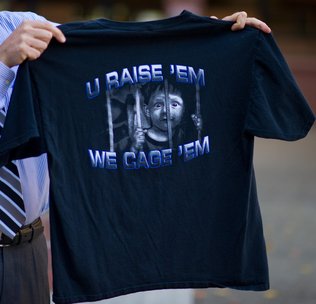
“U raise ’em, we cage ’em:” police in schools

I am currently working on a project with my friend Cait about policing in Chicago Public Schools. I look forward to sharing the product of our work in the next few weeks.

My views about having police in our schools are well-documented. I think that the increased militarization of our schools leads to profoundly negative outcomes for youth.

I came across an article today that should make it clear that the police are not confused about their role in our schools:

A Northern California school police officers union has angered a town after it sold T-shirts with a picture of a child behind bars and the slogan: “U raise ’em, we cage ’em.”

I appreciate the police officers’ honesty about their mission. The question is what will we (as citizens) do in response…

Oct 30 2011

Do We Really Want More Policing in Communities of Color?

I work with members of a block club on the West side of Chicago. This group of mostly elderly black women is courageous, committed and a lot of fun to be around. Over the years, the “ladies” as I like to call them have consistently advocated for a more responsive police presence in their community.
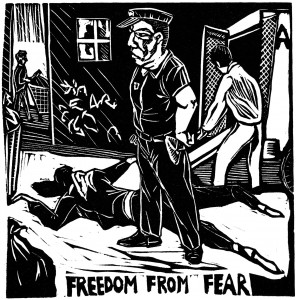
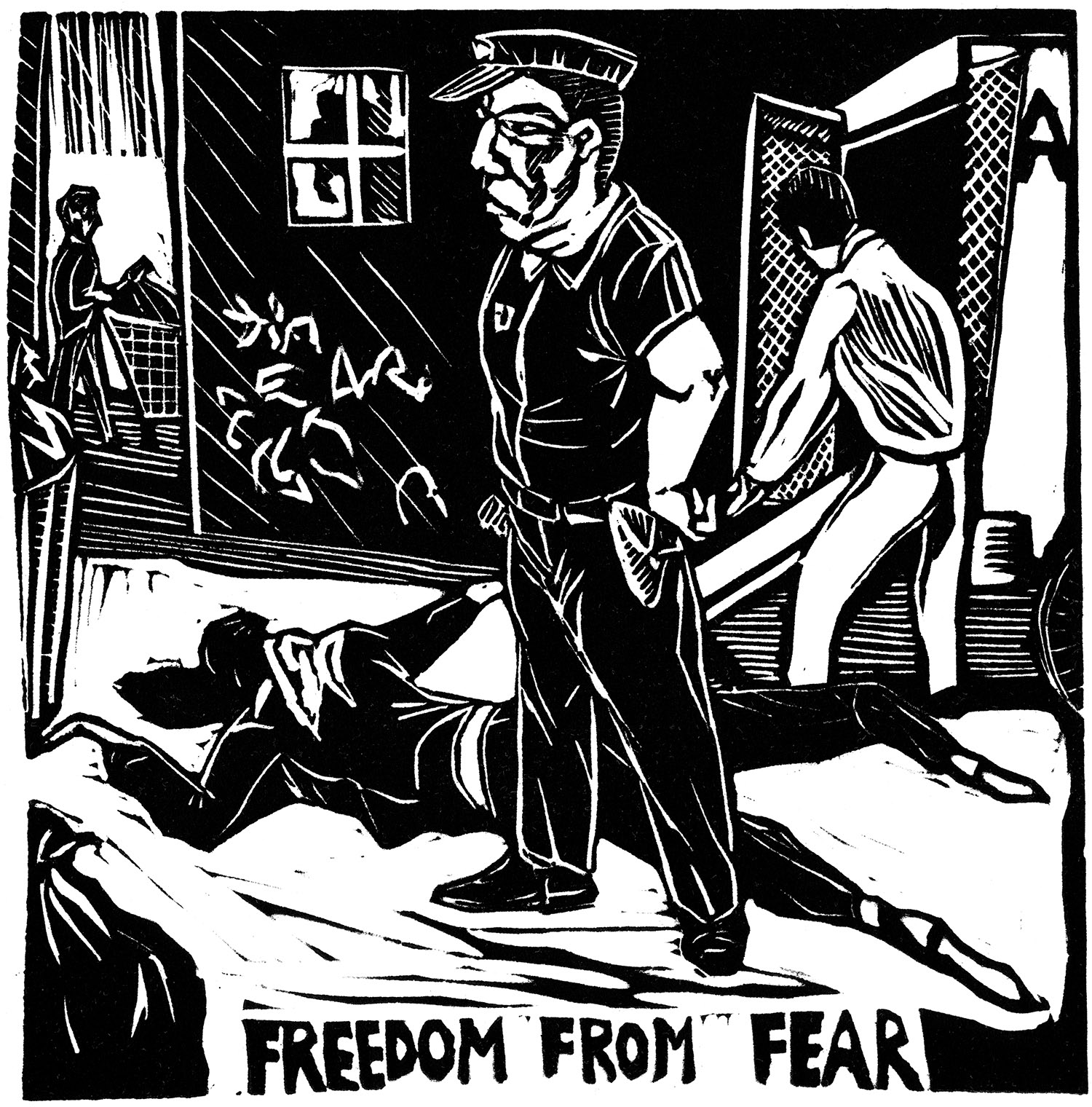
By Art Hazelwood

Anyone who has ever organized in a low-income community of color has confronted this dilemma – how to address the reality of police violence and harassment while responding to community members’ demands for safety. I write often about the police on this blog. I believe that as the most visible gatekeepers of state power, I can’t write enough about the police.

On Friday, the Chicago Tribune reported on an ACLU suit alleging that the police respond more slowly to calls from minority neighborhoods than white ones:

On Thursday, the American Civil Liberties Union of Illinois filed a civil rights lawsuit against the city that alleged Chicago’s deployment of police officers results in slower response times to 911 calls in primarily black and Hispanic neighborhoods compared with service in largely white communities.

“Because of experiences such as this, many of our neighbors simply will not call the police,” Reid, who is black, told reporters at a news conference at the ACLU’s downtown offices.

The Central Austin Neighborhood Association in Chicago’s crime-plagued West Side also joined the lawsuit filed in Cook County Circuit Court. Reid is its president.

The suit is based on recent news reports that found police districts that cover minority neighborhoods had disproportionately fewer officers than those covering white neighborhoods as measured by response times to emergency calls and rates of serious violent crime.

People who live in communities that are plagued with crime and violence understandably want to feel safe. They have that right. However, I have to wonder if it is a bad thing that community members living in Austin are not calling the police. For me, the question that we have to ask is:”Does an increased police presence in a community necessarily translate to more ‘safety’?” Instead of blanketing Austin with more police officers, can we instead find a way to provide jobs to all of the young men who are chronically unemployed? This is the best prescription for crime and violence.

Part of my work involves imagining (and then implementing) alternative ways of addressing community safety that do not rely on policing. The reality is that for many, many people, the police do not actually engender a sense of safety. Instead they can be the purveyors of violence. I read a good blog post about this very issue last week in Feministing.

“Folks who have grown up with the police serving and protecting them understandably think the police work for them. Folks who’ve grown up being harassed by the police – who’ve seen their family members pulled over for no reason, arrested for being in public space, or totally ignored or even charged when they were a victim of a crime – have a different image. When the cops work for you, it seems like a pretty good idea to trust them to serve and protect. When you’ve been a target of the police, you tend to see a different picture.”

Communities of color have always had a complicated relationship to law enforcement (at best). For example, Public Enemy’s 911 is a Joke is a commentary on the fact that emergency services neglect people who live in black and brown communities. While NWA’s F-the Police points to the hostility that young people of color feel towards their police aggressors. Most recently prominent figures like Cornel West have been publicly denouncing and protesting the NYPD’s Stop and Frisk Policy which is described as:

“a method the police department enforces in an effort to reduce crime in the city. Under the policy, officers may stop individuals who are suspected of criminal activity without clear cause. Once stopped, officers may ask for identification and conduct “pat downs” or “frisks” in which they search for illegal drugs or weapons.”

Stop and Frisk is a gross violation of our rights as citizens and seems designed to increase people of color’s mistrust of and anger towards the police. Next Saturday, a group of us are coming together to participate in a participatory action research project called Chain Reaction: Alternatives to Calling the Police. I will periodically update our progress on this project. I hope that it will provide us with some workable alternatives to relying on the police to address youth misbehavior. Stay tuned!

Oct 26 2011

Local Juvenile Justice Knowledge Quiz…

Please answer the following ten (10) questions to the best of your ability:

How many juvenile arrests were there in your city/state last year (2010)?

How many juveniles were referred to court in your city/state last year (2010)?

How many juvenile petitions were filed in your city/state last year (2010)?

How many juveniles were detained in your city/state last year?

How many juveniles were diverted from the juvenile justice system in your city/state last year?

How many juveniles were given probation/supervision last year?

How many juveniles were incarcerated in your city or state last year?

How many juvenile expungements of criminal records were granted in your city/state last year?

How much did it cost to incarcerate a juvenile in your city/state last year?

How much did it cost to offer community-based treatment for juveniles last year?

If you were unable to answer even one of the questions listed above correctly, don’t worry you are in good company. The vast majority of Americans have no clue about the scope or impact of the juvenile justice system in their local communities. Community members cannot be faulted for this. Local juvenile justice systems do not make the data readily accessible for the most part. This of course makes it very difficult to mobilize to hold the systems accountable for how they treat our children. Information properly deployed is power and I believe that the government tries to control and manage information so as to keep the public disempowered.

One exception that I just learned about is the state of Georgia which has launched a juvenile justice data clearinghouse as part of an effort to increase system transparency. I hope that every state in the country follows suit and expands this effort to include adult criminal legal data as well. It is critical for citizens to know what is being done in our name and to be able to hold public officials accountable for how they use our resources.

Here in Chicago (in a much more low budget and low tech way), my organization is also attempting to make juvenile justice data more transparent. This past weekend, I facilitated a training for over 30 community members about how to access and more importantly how to understand local juvenile justice data. The Chicago Youth Justice Data Project (CYJDP) is a grassroots attempt to mobilize community members to use data in organizing efforts to increase system accountability. I don’t think that it should be left to small community organizations to seek out relevant and accurate data. Our local governments need to do this work.

In the meantime, I encourage all citizens to get educated about how the juvenile justice system operates in your local community.