Aug 05 2011

Torture and Homicide in an American State Prison: Harper’s Weekly, 1858

A big part of what keeps me posting on a regular basis is the feedback that I get from readers. I also love it when I get questions that make me think or lead me to do more research. A couple of weeks ago, I wrote a post about corporal punishment and torture in early U.S. penitentiaries. It got a very big response judging from the number of views that it has amassed so far. I’m not sure why so many people seem interested in this aspect of prisons and frankly I do not want to think too deeply about it. I hope it is because people are deeply disturbed by these images and ideas. I want this to be true.

Anyway, a reader asked if I had any examples of the media of the time (19th century) inveighing against prison torture practices. In fact, I do. I have an original article from Harper’s Weekly dated December 18, 1958 titled “Torture and Homicide in an American State Prison.” I purchased the original article as a collector’s item mainly because of the illustrations that are included. I dug it out of storage earlier this week and will quote some of it below to illustrate how some media outlets covered prison torture in the 19th and early 20th centuries:

“We now present a far more fearful picture of the mismanagement of our public institutions for the confinement and correction of criminals. On 2nd inst. a convict named More, imprisoned in the State Prison at Auburn, was showered to death by prison officials. The circumstances of the case are simply as follows:

The convict, More, was a negro. He is certified to have been a man of naturally pleasant temper, but violent when crossed. On 1st inst. he was said to have been in a bad humor; he was seen, or is said to have been seen, to sharpen a knife, and to mutter threats against someone; on the strength of which he was, on 2nd inst. seized by several keepers or deputy-keepers of the State Prison, and by them dragged toward the shower-bath. Like most negroes, he entertained a lively fear of cold. He knew that the water of the shower-bath would be very cold indeed; and, after vainly appealing to the feelings of his captors to release him, he broke away from them and fled — be it remarked — to the shop where he was in the habit of working. At the door of the shop a convict arrested him; a keeper and his assistants swiftly followed: he was dragged by main force, and after many violent struggles, to the shower-bath; all the water that was in the tank — amounting to from three to five barrels, the quantity is uncertain — was showered upon him in spite of his piteous cries; a few minutes after his release from the bath he fell prostrate, was carried to his cell, and died in five minutes.

It is the homicide which we this week illustrate. The use of the shower-bath as a means of coercing criminals into submission to the orders of prison authorities began to be general about the year 1845. In that year a convict at the Auburn State Prison was whipped by order of competent authority, and died under the lash. The public indignation which was aroused by the event led to the abolition of whipping as a punishment in the prisons of the State of New York. It was preserved in other States, as, for instance, in Connecticut, in which State Prison wardens are authorized to this day to administer stripes — not over ten in number — to refractory prisoners. But in New York the cat was disused, and the shower-bath reigned in its stead.”

The article goes on for several pages to describe how the shower-bath works and to underscore several other forms of punishment that prisoners are subjected to at Auburn Prison. The expose also relies on research by leading experts about the physical and psychological effects of being subjected to the shower-bath. The article is definitely of its time as it distinguishes between whites who are believed to better be able to withstand the torture of the shower-bath and blacks who are seen as constitutionally unable to endure the practice. If you are interested in the history of American prisons, the article is worth reading and I am sure that it can be accessed through any library.

Below is an image of the shower-bath apparatus:
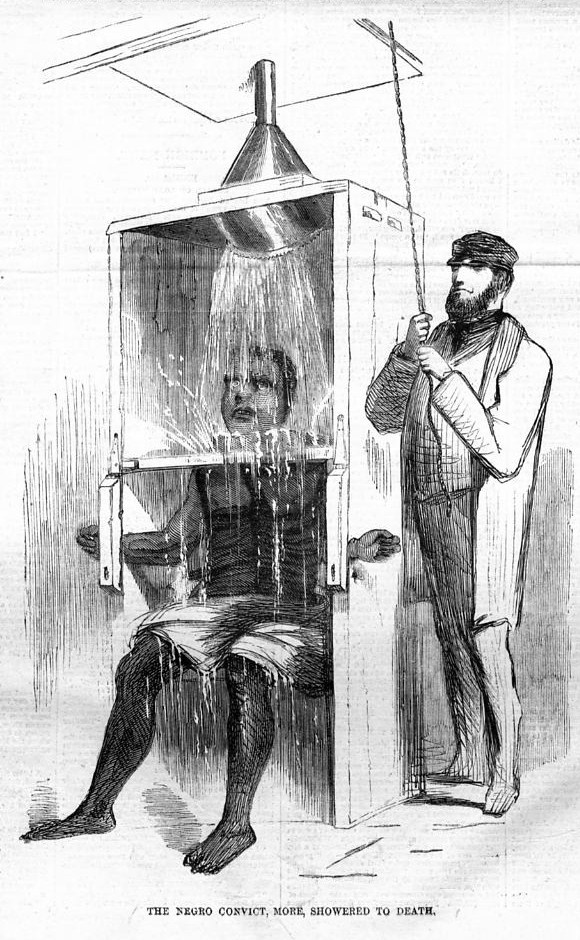
The article ends with these words:

“An inquest has been held on the body of the negro. Eight men composed the jury, six of whom are said to have been prison contractors. They refused to allow the prison physician to deliver his evidence, as he wished; and found the absurd verdict that the man’s death had been ‘hastened’ by the use of the shower-bath. It is clear that if any notice is to be taken of this poor convict’s death the District Attorney must move in the matter. It remains to be seen whether he will do so; or whether the civilization of the State of New York is to be disgraced by the torture and homicide, by State officials, of a poor convict in a State prison.”

Share
Aug 02 2011

FYI: Life for Blacks in U.S. Was Really Terrible…

In case you were confused or needed a reminder, it is impossible to overstate how horrible life for Blacks in the U.S. was for most of the past 400 years. I collect a lot of memorabilia about the Black experience in the U.S. and my latest find is a document from 1801 salvaged from town meeting minutes that documents the punishment for two black women in Rhode Island.

Whereas Sally Gibbs now confined in the Bridewell having returned to this Town to dwell after having been removed to Smithfield as being her place of her last legal settlement without the liberty so to from this Council whereby the said Sally Gibbs has incurred the penalty of Seven Dollars and in case of inability to pay the same is liable to be publicly whipped. Resolved therefore that the (crossed out) ——————– said Sally Gibbs be subjected to that payment of the said fine of Seven Dollars and that in default of her paying the same that she be publicly whipped fifteen stripes on her naked back between the hours of four and five of the clock in the afternoon of this Day and conducted thereafter without the limits of this Town and that the Clerk be and he is hereby directed to issue a Warrant for the above purpose accordingly forthwith.

Warrant Alexander this day.

** the reference to “the Bridewell” means that she was in jail.

bottom half: in full:
Whereas Deborah Barry a Black Woman, a transient person has neglected to depart as expected and who it is represented is still residing here, resolved therefore that she be apprehended and removed with her young child by the name of Charles to Warren in the County of Bristol adjudged to be her place of last legal settlement and that the Clerk make out a Warrant forthwith for her removal with her said Child Accordingly……….. NB Warrant issued …Henry Alexander

Note: As if on cue, Julianne Hing’s article published in Colorlines today underscores a history of the criminalization of black women (particuarly mothers).

Share
Jul 24 2011

Attica’s Still On My Mind: Here’s My Poem of the Day

Here’s another poem about the Attica Prison Revolt from the edited volume titled “Betcha Ain’t: Poems from Attica.”

Sept. 13
By Christopher Sutherland

Let the drums roll
Give the first command
That puts us in the ground

R-E-A-D-Y!

We stiffen our shoulders
Hold our heads up high
Let the world take note
That proud, black men
Are here about to die

A-A-A-I-M!

If our actions
Cause brothers and sisters to unite
As we die,
In their fighting spirits we live.
So let the drums roll
And damn that final order that us in
The ground…
F-I-R-E!

Christopher Sutherland – Multi-talented (poet, musician) and eyes that appear to pierce the soul – an early standout in the group sessions.

For those interested in a short primer on some of what happened 40 years ago, here is a short clip (under 10 minutes) from the documentary “Disturbing the Universe” about the lawyer William Kunstler who served as an observer and negotiator at Attica during the revolt.

Note: If you are in the Chicago area any time between September 6-8, you are invited to a photographic exhibition about the Attica Rebellion that will be taking place at Mess Hall, 6932 N. Glenwood Ave. In particular, we will be having a reception and reading on September 8th from 6:30 to 8:30 p.m. to commemorate the 40th Anniversary of the Attica Rebellion. All are invited.

Share
Jul 18 2011

A Prisoner’s Words Describing the “Hole”

We throw around the words solitary confinement in a very cavalier way in the U.S. Thanks to efforts like Solitary Watch public awareness is being raised about the brutality and torture of solitary confinement. This is a good thing. Today there is an excellent Op-Ed by Colin Dayan in the New York Times about the plight of prisoners at Pelican Bay and also about their resistance through hunger strikes. Yet I find something missing in our consideration of isolation in prison. We need to hear more of the voices of those who have experienced this torture.

A prisoner named Ahmad Al Aswadu wrote an essay titled “A Black View of Prison” in the April-May 1971 issue of the Black Scholar. In his essay, he describes the experience of living in the “hole” while incarcerated. Here is some of what he wrote:

The “Hole” (called such because its locality is usually under the prison’s first floor) is solitary confinement. One could stay in the hole for a week or a lifetime depending upon his color and attitude. It is here in the hole that men are made and broken at the same time. It is here that the previous threat of getting “hurt” can realize itself all too quickly. And it is here that the seeds of Black Consciousness have been cultivated in the minds of many black men.

It is very difficult for a layman such as I to describe the atmosphere of the hole but I shall try. I believe that the very first thing that the brother notices about the hole is the desolateness and the feeling of utter aloneness. The first time that I was sent to the hole I felt as if my soul had deserted me. I don’t believe that I had ever experienced such a feeling of intense emptiness in my life before then. I had been sent to the hole to have my attitude changed, because, as they stated, it was not conducive to “good order.” A brother had just been murdered by the guards who worked in the hole, and rather than go through that type of thing, I pretended to be institutionalized. Fortunately, my stay only lasted fourteen days and I was returned to the general inmate population.

Life in the hole is epitomized by one big question mark. Uncertainty is the order of the day. Your visitors are turned around at the gate when they come to see you. The food quantity and quality is drastically reduced to the level of subsistence. You might get a shower and you might not — depending upon whether or not the guard’s wife was good to him the night before. I believe that it is the hole that is the most memorable aspect of the prison experience. They are all the same, and yet they are totally different from one another.

Today, Critical Resistance is hosting a national conference call about the Pelican Bay Hunger Strike. All of the relevant details are below:

Monday, July 18th
6pm EST/ 5pm CST/ 4pm MST/ 3pm PST
toll-free call in number: 1(800)868-1837 (new number)
participant code: 62435226

Share
Jul 09 2011

Poem for the Day:13th and Genocide by Isaiah Hawkins

The clouds were low
when the sun rose that day.
For the white folks were coming
to lay some black brothers away.

From eight surrounding counties,
the white folks came,
with 12 hundred locks
and some brand new chains.

The word was kill niggers,
kill all you can.
For they don’t have the right
to live like men.

Then up in the sky
appeared a big green bird.
And from inside came
these few words.

“Put your hands on your heads
and you won’t get hurt,
lie on your bellies,
put your face in the dirt.”

Then from a distance
came a black brother’s cry.
“I’m a man, white folks,
and like a man I’ll die.”

This poem was written by Isaiah Hawkins who was a prisoner at Attica. He was a member of the prison liaison committee who worked for the betterment of all inmates’ conditions. He wrote the poem as a member of a poetry workshop that was intended as a rehabilitative measure for Attica. A series of 8 week poetry workshops began on May 24, 1972 and was run by Celes Tisdale who was a member of the Buffalo Black Drama workshop. Mr. Tisdale selected some of the poems from the workshops and published a pamphlet titled “Betcha Ain’t: Poems from Attica.” This is where I found Mr. Hawkins’s affecting poem. He was released soon after the workshop began.

Share
Jul 01 2011

Torture & Corporal Punishment in Early 20th Century American Penitentiaries…

There has been a lot of conversation over the past few weeks about Peter Moskos’s new book “In Defense of Flogging.” Basically, Moskos provokes the reader to consider whether flogging is any more inhumane than the current barbaric conditions in which we incarcerate people in the U.S. (especially those who are locked up for non-violent crimes). Moskos suggests that it might in fact be more humane to offer people convicted of crimes a choice of receiving lashes or spending time in prison. You should read the book itself to learn more about Moskos’s thesis. I have been reading the book this week and am not done with it yet. It gives one a lot of food for thought, that’s for sure.

Reading “In Defense of Flogging” has me thinking about torture and corporal punishment in U.S. prisons over their history. I found a very interesting book online titled “Crime and Criminals” that was published by the Prison Reform League in 1910. I have only read a couple of chapters in that book so far. However, the book provides a comprehensive review of the state of American prisons in the early 20th century. This includes a lot of documentation as well as first hand accounts of torture and corporal punishment.

From Crime and Criminals (1910)

From Crime and Criminals (1910):

“[I]n the Missouri state penitentiary at Jefferson City the whipping post is resorted to constantly for the disciplining of refractory prisoners and the warden vehemently defends its use. In Hampton’s Magazine, for October, 1909, Charles Edward Russell quotes him as follows:

In my opinion, it is absolutely necessary. You cannot manage 2000 men of the character of our convicts without corporal punishment. Some men cannot be governed by kindness and recognize only the power of a blow; if we used milk-and-water methods we should have a mutiny every week. I do not know of any punishment more effectual than the whipping post. If you have a bad man you must conquer him, and if society objects to the means employed, society should bear in mind the character of the convict.

“Mr. Russell describes the floggings, and adds reflections that according to our view, aptly summarize the general situation. He says: ‘At the whipping post in this prison the victim is fastened to a wooden pillar, his hands and feet are manacled and the lash is applied to his bare back. The prison officers say that the number of lashes does not exceed fifteen and that the whip is used only when solitary confinement fails to subdue the convict. It sounds to the last degree barbarous and horrible, but I do not know that it is worse than the sanded paddle of Columbus, and probably it is not so painful or dangerous as the water cure.’”

Below is an illustration of the water cure which is described as follows:

“Having been stripped the delinquent is manacled in the great bath tub. At the height of his neck in the sides of the tub are grooves and in these play great wooden clamps, carved to fit the human body. These are screwed together so as to grip in a vise the man’s chest and arms. In front of him is a faucet and a bit of hose, throwing a smart stream of water. First it is necessary to get the man’s mouth open by making him cry out (which is usually done by frightening him), whereupon the water streams down his throat and strangles him. By those who have suffered this treatment the sensations are said to be indescribably horrible. In spite of his reason the victim feels that with the most excruciating pains he is being tortured to death. I understand that in nine cases in ten the man was carried away insensible and sometimes spent days in the hospital. If he died, I don’t know how the facts would be known. ‘Tis but a man gone — and he is a convict.”

In seeing the image below, I think of the waterboarding that the Bush administration administered to detainees at Guantanamo and in CIA secret prisons. These techniques seem to be with us still…

From Crime and Criminals (1910)

Other forms of torture also included something called the “Humming-bird” which was documented as having been used in Ohio and Illinois penitentiaries.

“Having been stripped the delinquent was fastened on his back in a shallow metal tank filled with water and connected with one electrode from a dynamo; the other electrode was a wet sponge. Gloved in rubber the operator took the wet sponge and passed it slowly up and down the prisoner’s bare limbs. As it went his muscles corded into knots and he shrieked aloud until he fainted.”

From Crime and Criminals (1910)

Below are a couple of other visual illustrations of torture and corporal punishment in early 20th century prisons.

From Crime and Criminals (1910)

Bullrings – “The prisoner is strung up by the wrists in a dark cell and thus left hanging, like a carcass of beef.”

You might wonder what the value of knowing about these techniques is. First, it is important to understand that some of these techniques are still with us today (i.e. waterboarding). It seems important to have a historical context for current torture techniques used against prisoners. Practices do not emerge from nowhere. Second, I think that having a better understanding of prison history allows us to unfurl our imaginations and to consider prison abolition as a viable option. After all, prisons have not always existed and they have not always existed in their current incarnations. It is possible to make changes. It is possible to end incarceration.

Share
Jun 22 2011

Chicago Torture Justice Memorials: Launch Event on June 28th

By Art Hazelwood

Some of my friends and colleagues are organizing a very important project. For those of you in Chicago, you will want to attend the launch event for this project on June 28th. I will be providing much more information about the request for proposals etc… in the coming days as that information becomes available. I am proud to be a member of the advisory board for this important and much needed project.

CHICAGO TORTURE JUSTICE MEMORIALS
We invite artists and those who seek justice of all kinds to submit proposals for a monument to memorialize the Chicago Police torture cases. Our goal is to honor the survivors of torture, their family members, and the African American communities affected by the torture. The monument will also recall and honor the nearly three decade long struggle for justice waged by torture survivors and their families, attorneys, community organizers, and people from every neighborhood and walk of life in Chicago.

Project Launch: June 28, 2011, 6 – 8 pm
Hull House, 800 S. Halsted St., Chicago

The program will include:

* music and performances by Deja K. Taylor, In the Spirit / Emily Lansana & Zahra Baker, Basik, and Nicole Garneau;
* Testimony by Darrell Cannon, torture survivor;
* History by Joey Mogul, People’s Law Office;
* Reparations, Stan Willis, National Conference of Black Lawyers;
* MC, Alice Kim; and
* Introduction to the Memorial project with the organizers

Organizers include:
Stephen Eisenman, Adam Green, Alice Kim, Carla Mayer, Joey Mogul, Laurie Palmer, Amy Partridge, Laurie Jo Reynolds, Ellen Rothenberg, Ben Stagl, Jan Susler, Daniel Tucker

For more information about the launch event, visit FACEBOOK.

Share
Feb 05 2011

A Prisoner Says Farewell to Solitary Confinement – Writing by Lee Savage

By Josh MacPhee

My friend Gary shared some excerpts from prisoner zines that were published in the Utne Reader last year.   I was particularly moved and somewhat overwhelmed by the words of Lisa “Lee” Savage who wrote a farewell letter to solitary confinement just before her eventual release from prison:

Dear Lowell CM Unit,

Over the past two years of being trapped within this “hellhole,” your behavior modification (human mortification) chamber, I have written many formal letters against you to your conceivers—the DOC administration, and I’ve penned several articles to inform prisoners and “free world” citizens of your insidious plans to destroy my mind and any chance for a productive life once I am freed from your chokehold. But today is the first time I’ve ever written to you personally and I have many things to say, so bear with me as I’ve had to bear with you every minute of these past two years while locked in your solitary confinement….

First, despite your lies, the stories you would tell me that I will never leave you, I could never leave you and within you is truly where I belong and you were just “trying to help me” become a proper woman, I AM leaving you. I’ve completed my penance and within a couple of days, I will walk out and not look back. I know you find this hard to believe and I can hear you saying, “You’ll be back. You’ll come home to me ‘cuz I’ve taught you to bring yourself back into my walls.”  Don’t be so confident and sure of yourself or your ability to twist my mind. I think you already know I am different from the others you’ve courted and caged before me.

I admit the first time we met and you took me in 6 ½ years ago, I was quite naïve and rather weak in my physical, mental and emotional states. Yes, you definitely had control and I was at your mercy, which I never received any, regardless of how I begged and pleaded with you to stop beating me, to stop hurting me, to stop breaking my heart and PLEASE just let me hold onto ONE LITTLE HOPE. You never ceased in your cruelty and I responded the way you wished, like a feral animal lashing out at any and all human contact. I’ve never felt so ashamed, so helpless, but I found the answer to your abuse…it would end, everything would cease to exist, even me. I would escape you by hanging myself, my spirit would fly free, this I would gladly pay for with this shell of flesh and bone.

It would come to pass: I hang, I die, I’m free.

Fate has a way of placing its hands on the steering wheel of life though and I was revived and brought back to you. It was that anger that helped me live until EOS.

You know, I can’t believe I’m being so civil to you and not ranting.

Yes I can believe it. I’ve changed in this second time I’ve spent so unwillingly with you. I swore that this time, I wouldn’t allow you to destroy me, to steal my life no matter what you did to me. Somewhere along the way, I found that I wasn’t a victim. I would be a survivor, a fighter. I would see my son again. I would enjoy a summer day, a cool winter night or the spring rain. I would bask in the sunshine with my lover. I would defeat you, beat you at your own game, and teach others how to survive and fight you.

There were days, many days in which my strength and hope waned, days when I would fight the guards just to FEEL, to KNOW I am ALIVE, I am REAL. The pain was real, the suffering was real and through all the mental and emotional anguish I held onto that burning rage I had inside and I became a “soulja,” a trained reconnaissance soulja, an urban guerilla who was ready for your warfare on whatever level you chose to fight.

When there was no attack on me, but on my captive sisters, I fought for them. I had to guard and protect those who didn’t understand your tactics. After all, that is “how you roll”—to besiege and then sequester the innocent, the unsuspecting. Isolated, they are then abused and returned to the free world shell-shocked. These are my sisters. I couldn’t just turn a blind eye or a deaf ear, even if it meant that I put myself in the line of fire, targeted.

I admit you are quite the formidable adversary. That is why your reach has grown and now no one is safe from you, not even your conceivers and your capitalist grantors. I’m quite sure you’ve deceived them into believing that you will not bite the hand that feeds. Won’t they be surprised and horrified when even they become trapped within you…

But, as your reach continues to expand, so does my network—my allies, the grassroots guerillas who support my resistance.

Funny, you fail to realize that, even while locked within you, deep in your bowels, my army of one is multiplying. Many armies of one are joining to become an army of many, who will foster and implicate the prisoner resistance movement and who will bring this hidden revolution to light.

I am leaving you and I know you are angry at this, but you see, I am ANGRIER and I MUST take this fight where your scary ass doesn’t want me to—to the streets. For it is outside of your walls that this revolution is about to explode. I will take it to the everyday common hardworking folk, the masses of overworked and underpaid who are your targets, so they no longer remain blind. I will take it to the uncertain and educate them, give them weapons to fight you. I will take it to the elitists on their pedestals and knock them down.

This is a war all right, a war for human rights and I will not allow you to take any more children from their families so that you can train them to become statistics of recidivism. You will not destroy my people. You will not destroy my family. For as much as you hate those you harm, I love them 100 times more.

My visionaries are beside me, inside me, speaking their truths.

My revolutionary sisters and brothers are everywhere, learning their truths.

Abolition has begun and it will not stop now.

I will not stop until all are free.

And this, Lowell Correctional Institution, is such a Savage Reality.

Until there are no more death chambers, I will fight.

Your Ex-Hostage,

(Lisa) Lee Savage

Lee was released on August 1st,  and continues the struggle from the outside.  To contact her, write to her at:

PO. Box 5453
Gainesville, FL 32627-5453

The following is a very good article from the same issue of Utne Reader that provides a tour of prisoner zines.  If you are interested in prisoner writing, you will find this very informative.

Share
Jan 30 2011

On Solitary Confinement and Charles Dickens…

Artwork by Billy Dee

In 1842, Charles Dickens toured the United States. He subsequently cataloged his experiences in American Notes for General Circulation.

During his trip, he visited Eastern State Penitentiary which was located in Philadelphia. He wrote about his day-long visit and one of his most famous passages focused on the effects of solitary confinement at the prison:

The system here, is rigid, strict, and hopeless solitary confinement. I believe it, in its effects, to be cruel and wrong. In its intention, I am well convinced that it is kind, humane, and meant for reformation; but I am persuaded that those who devised this system of Prison Discipline, and those benevolent gentlemen who carry it into execution, do not know what it is that they are doing. I believe that very few men are capable of estimating the immense amount of torture and agony which this dreadful punishment, prolonged for years, inflicts upon the sufferers; and in guessing at it myself, and in reasoning from what I have seen written upon their faces, and what to my certain knowledge they feel within, I am only the more convinced that there is a depth of terrible endurance in it which none but the sufferers themselves can fathom, and which no man has a right to inflict upon his fellow-creature. I hold this slow and daily tampering with the mysteries of the brain, to be immeasurably worse than any torture of the body: and because its ghastly signs and tokens are not so palpable to the eye and sense of touch as scars upon the flesh; because its wounds are not upon the surface, and it extorts few cries that human ears can hear; therefore I the more denounce it, as a secret punishment which slumbering humanity is not roused up to stay.

In just a few words, Dickens sums up what I cannot imagine anyone being able to convey any better. Let these words roll off your tongue: “a secret punishment which slumbering humanity is not roused up to stay.” Imprint the image in your brain. Sear the concept in your heart. I wanted to share this passage because it is instructive to the current debates that we are having about whether solitary confinement is a form of torture. Dickens’s eloquent words provide support for the view that there is no question that it is.

Share
Dec 16 2010

Dr.King’s Fear of Solitary Confinement and Bradley Manning

I have received a couple of e-mails from readers of this blog sharing information about the Bradley Manning case. Reportedly this military officer at the heart of the Wikileaks scandal is being held in solitary confinement. I have previously blogged about my belief that solitary confinement is torture.

I am a student of history. I think that we have a lot to learn from our past in the continuing struggle for social justice. I have read extensively about the life of Dr. Martin Luther King Jr. I read his autobiography while I was in high school. His experiences have a direct bearing on the current debate about solitary confinement as an instrument of torture.


In 1963, Dr. King moved the site of the civil rights struggle to Birmingham, Alabama, a manufacturing city and one of the richest in the South. The two-month campaign was as rough and as risky as King had anticipated. Hundreds were arrested. An injunction was granted forbidding marches and demonstrations, but King decided to break it. He dressed in denims and a workshirt – his jail clothes — and led a march on Good Friday, April 12, 1963. Again he was arrested, this time placed in solitary confinement.

Historian Adam Fairclough (1995) writes about this incident in his book Martin Luther King Jr:

King dreaded solitary confinement. Separated from Abernathy after his arrest on April 12, “those were the longest, most frustrating and bewildering hours I have lived,” he remembered. “You will never know the meaning of utter darkness until you have lain in such a dungeon, knowing that sunlight is streaming overhead and still seeing only darkness below.” A gregarious man, he hated being alone. He ached to see his new daughter, born a few days earlier. He worried about the bail money. And he experienced straightforward fear. (p.77)”

It’s worth hearing about this entire episode in Dr. King’s own words. From the Autobiography of Martin Luther King, Jr:

We rode from the motel to the Zion Hill church, where the march would begin. Many hundreds of Negroes had turned out to see us and great hope grew within me as I saw those faces smiling approval as we passed. It seemed that every Birmingham police officer had been sent into the area. Leaving the church, where we were joined by the rest of our group of fifty, we started down the forbidden streets that lead to the downtown sector. It was a beautiful march We were allowed to walk farther than the police had ever permitted before. We were singing, and occasionally the singing was interspersed with bursts of applause from the sidewalks.

As we neared the downtown area, Bull Connor ordered his men to arrest us, and somebody from the police force leaned over and reminded Mr. Connor, “Mr. Connor, we ain’t got nowhere to put ‘em.” Ralph (Abernathy) and I were hauled off by two muscular policemen, clutching the backs of our shirts in handfuls. All the others were promptly arrested. In jail Ralph and I were separated from everyone else and later from each other.

For more than twenty-four hours, I was held incommunicado, in solitary confinement. No one was permitted to visit me, not even my lawyers. Those were the longest, most frustrating and bewildering hours I have lived. Having no contact of any kind, I was besieged with worry. How was the movement faring? Where would Fred and the other leaders get the money to have our demonstrators released? What was happening to the morale in the Negro community?

I suffered no physical brutality at the hands of my jailers. Some of the prison personnel were surly and abusive, but that was to be expected in Southern prisons. Solitary confinement, however, was brutal enough. In the mornings the sun would rise, sending shafts of light through the window high in the narrow cell which was my home. You will never know the meaning of utter darkness until you have lain in such a dungeon, knowing that sunlight is streaming overhead and still seeing only darkness below. You might have thought I was in the grip of a fantasy brought on by worry. I did worry. But there was more to the blackness than a phenomenon conjured up by a worried mind. Whatever the cause, the fact remained that I could not see the light.

When I had left my Atlanta home some days before, my wife, Coretta, had just given birth to our fourth child. As happy as we were about the new little girl, Coretta was disappointed that her condition would not allow her to accompany me. She had been my strength and inspiration during the terror of Montgomery. She had been active in Albany, Georgia, and was preparing to go to jail with the wives of other civil rights leaders there, just before the campaign ended.

Now, not only was she confined to our home, but she was denied even the consolation of a telephone call from her husband. On the Sunday following our jailing, she decided she must do something. Remembering the call that John Kennedy had made to her when I was jailed in Georgia during the 1960 election campaign, she placed a call to the President. Within a few minutes, his brother, Attorney General Robert Kennedy, phoned back. She told him that she hay learned that I was in solitary confinement and was afraid for my safety. The attorney general promised to do everything he could to have my situation eased A few hours later President Kennedy him self called Coretta from Palm Beach, and assured her that he would look into the matter immediately. Apparently the President and his brother placed calls to officials in Birmingham; for immediately after Coretta heard from them, my jailers asked if I wanted to call he: After the President’s intervention, conditions changed considerably.

I wanted to highlight Dr. King’s experience with solitary confinement to provide more testimony about the horrific nature of being held in isolation. I wanted convey the sense of fear and hopelessness that is nothing less than actual torture. I hope that as people think about Bradley Manning and the millions of other people across the globe currently being isolated in this way, that they will think about Dr. King’s words. We must do better than this. We must reclaim our humanity.

NOTE:
Prison Culture will be on hiatus for the next couple of days as I focus on the stack of work that I have to get through. I am very grateful to all of the readers who stop by this blog and also to those who reach out to me via e-mail. Your e-mails often provide the inspiration for the posts that I write. So thank you.

Share